.svg)
SQL vs NoSQL in 2026: Which Database Should You Choose?
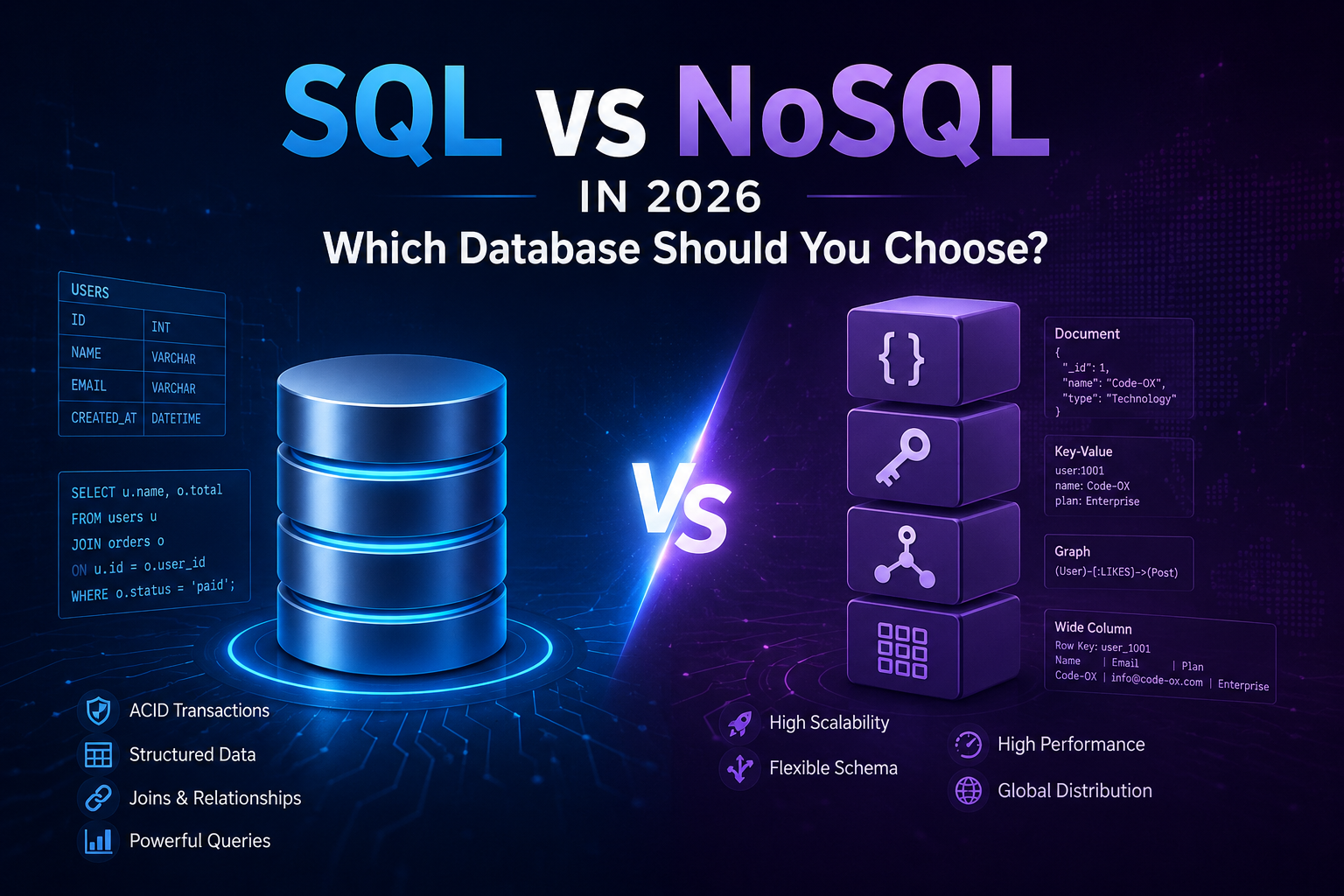
SQL vs NoSQL in 2026: Which Database Should You Choose?
Choosing the right database is one of the most important decisions when building a modern application. In 2026, businesses are working with increasingly large amounts of data, real-time applications, AI-powered features, cloud platforms, and distributed systems. This makes the choice between SQL and NoSQL databases more important than ever.
Both database technologies have evolved significantly. SQL databases continue to provide strong consistency, structured data management, and powerful querying capabilities, while NoSQL databases offer flexibility, scalability, and excellent performance for certain modern workloads.
So, which one should your business choose in 2026? The answer depends on your application's data structure, scalability requirements, performance needs, and business goals.
What Is an SQL Database?
SQL, or Structured Query Language, databases are relational databases that store information in structured tables consisting of rows and columns. Data is organized according to a predefined schema, and relationships between tables are established using keys.
Popular SQL databases include PostgreSQL, MySQL, Microsoft SQL Server, Oracle Database, and MariaDB.
SQL databases are particularly useful when applications require complex relationships, transactions, reporting, and strong data consistency.
Key Advantages of SQL
- Structured data: A predefined schema helps maintain consistent and organized data.
- ACID transactions: SQL databases are well suited for applications where transaction reliability is critical.
- Powerful queries: SQL supports complex queries, joins, aggregations, and reporting.
- Data integrity: Constraints and relationships help maintain accurate data.
- Mature ecosystem: SQL databases have extensive tooling, documentation, and community support.
What Is a NoSQL Database?
NoSQL databases are designed to store data using models other than traditional relational tables. Depending on the database, information can be stored as documents, key-value pairs, graphs, or wide-column records.
Popular NoSQL databases include MongoDB, Redis, Apache Cassandra, Amazon DynamoDB, and Couchbase.
NoSQL databases are often chosen for applications that require flexible data structures, rapid development, horizontal scaling, or high-volume data processing.
Key Advantages of NoSQL
- Flexible schemas: Data structures can evolve without requiring the same rigid schema changes used in traditional relational systems.
- Horizontal scalability: Many NoSQL systems are designed to distribute workloads across multiple servers.
- High performance: NoSQL can be highly effective for specific high-volume and low-latency workloads.
- Large-scale data handling: NoSQL databases are commonly used for applications generating massive amounts of data.
- Developer flexibility: Document-based models can work naturally with JSON-oriented application architectures.
SQL vs NoSQL: Key Differences
| Feature | SQL | NoSQL |
|---|---|---|
| Data model | Relational tables | Documents, key-value, graph, or wide-column models |
| Schema | Generally predefined and structured | Generally more flexible |
| Relationships | Excellent for complex relationships and joins | Often uses embedded or application-managed relationships |
| Transactions | Strong transactional support | Capabilities vary by database |
| Scaling | Traditionally strong vertical scaling, with modern distributed options available | Often designed with horizontal scaling in mind |
| Best suited for | ERP, finance, CRM, reporting, and transactional systems | Real-time apps, content platforms, large-scale distributed workloads, and flexible data models |
SQL vs NoSQL for Modern Applications in 2026
The database landscape in 2026 is not simply about choosing between "old" SQL technology and "modern" NoSQL technology. Both have continued to evolve, and many database platforms now support features traditionally associated with the other category.
For example, modern SQL databases can support JSON data, advanced indexing, distributed architectures, cloud deployments, and sophisticated analytical workloads. At the same time, many NoSQL platforms now provide stronger consistency models, transactions, and advanced querying capabilities.
This means the right question is not "Which database is better?" but rather "Which database is better for this particular application?"
When Should You Choose SQL?
SQL is usually a strong choice when your application depends heavily on relationships between data and reliable transactions.
Consider SQL when you are building:
- Financial and accounting applications
- ERP and business management systems
- Customer relationship management platforms
- Inventory and order management systems
- Applications requiring complex reporting
- Systems with strict data integrity requirements
- Applications with highly structured data
For example, an ERP system may need to connect customers, invoices, payments, products, inventory, employees, and accounting records. A relational database can model these relationships efficiently and maintain transactional consistency.
When Should You Choose NoSQL?
NoSQL can be a strong choice when flexibility, horizontal scalability, or specific high-volume access patterns are more important than a traditional relational structure.
Consider NoSQL when building:
- Real-time applications
- High-traffic web and mobile platforms
- Content management platforms
- IoT applications
- Large-scale event and log processing systems
- Applications with rapidly changing data structures
- Distributed applications requiring global scalability
What About AI and Data-Intensive Applications?
AI applications have made database architecture even more important. Modern AI systems may work with structured business data, unstructured documents, event streams, embeddings, and other data types at the same time.
For AI-powered applications, the choice may depend on how the data is stored and accessed. Relational databases can be excellent for structured business data, while specialized databases and NoSQL platforms can be useful for high-volume, flexible, or vector-oriented workloads.
In many cases, organizations may use more than one data technology rather than relying on a single database for every workload.
Can You Use SQL and NoSQL Together?
Yes. A modern application does not necessarily have to choose only one database technology.
A polyglot persistence approach allows different databases to handle different types of workloads. For example, an organization might use PostgreSQL for transactional business data, Redis for caching and fast access, and a document or specialized database for another workload.
This approach can provide flexibility, but it also introduces additional operational complexity. Teams need to consider synchronization, monitoring, backups, security, development skills, and infrastructure costs.
SQL or NoSQL: Which Is Better for Your Business?
There is no universal winner between SQL and NoSQL in 2026. The right choice depends on your application's requirements.
Choose SQL when structured data, relationships, transactions, reporting, and data integrity are central to your application.
Choose NoSQL when flexible data models, horizontal scalability, high-volume workloads, or specific low-latency access patterns are the primary requirements.
Consider a combination when your application has different workloads that are best handled by different database technologies.
Final Thoughts
Database technology is a foundation of modern digital products. In 2026, the SQL vs NoSQL decision should be based on architecture and business requirements rather than trends.
Before selecting a database, evaluate your data structure, transaction requirements, scalability expectations, performance targets, security requirements, development expertise, and long-term maintenance needs.
At Code-OX Technologies, we help businesses design and develop scalable technology solutions based on their specific requirements. Whether your application needs a relational database, a NoSQL architecture, or a combination of technologies, choosing the right architecture early can help create a more reliable and scalable product.
Need help choosing the right database architecture for your application? Talk to the Code-OX Technologies team to explore the right technology approach for your business.