.svg)
PyTorch: Building, Training, and Scaling Modern AI Models
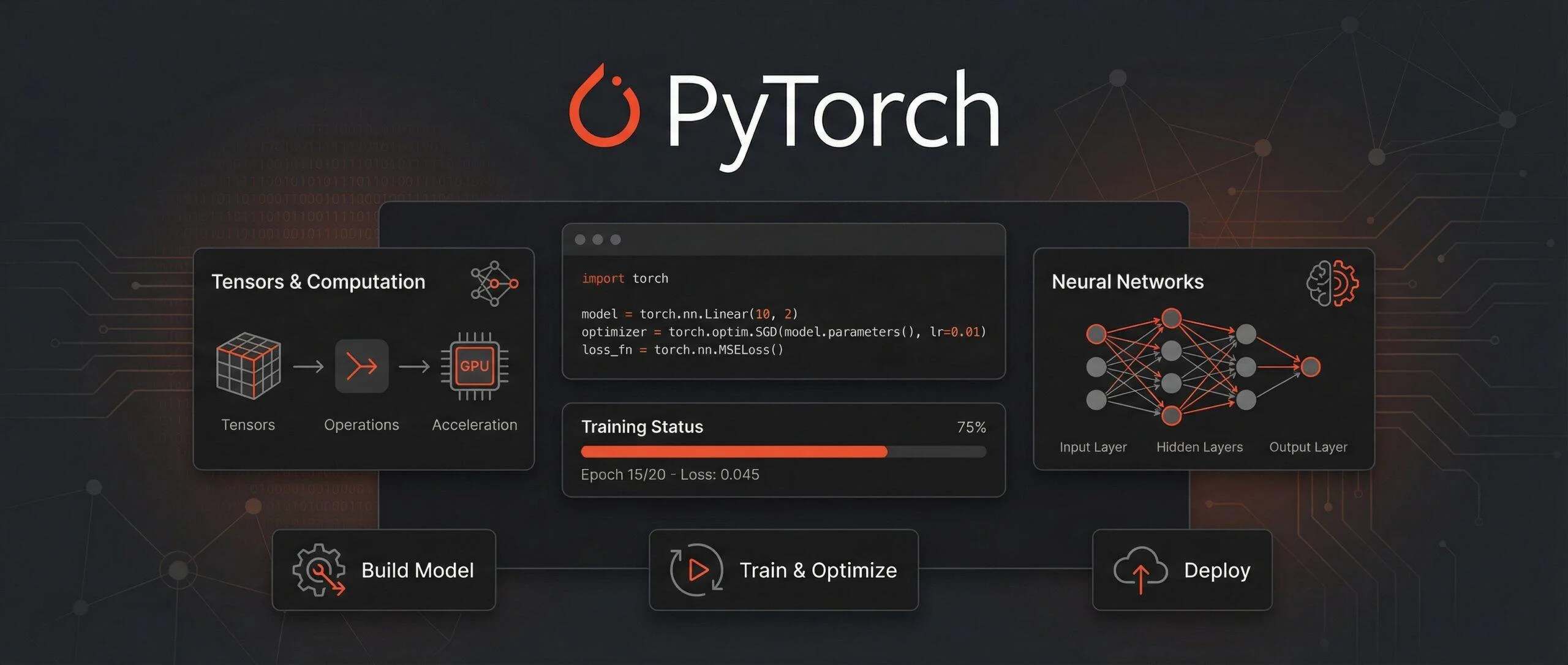
PyTorch: Building, Training, and Scaling Modern AI Models
Modern artificial intelligence systems depend on more than powerful models. They require a reliable framework for representing data, building neural networks, calculating gradients, training models, using hardware accelerators, and eventually taking those models into production.
PyTorch has become one of the major frameworks for developing deep learning systems. It provides tensor operations, automatic differentiation, neural network building blocks, data-loading utilities, hardware acceleration, model optimization, and distributed training capabilities.
For development teams building computer vision systems, natural language applications, recommendation engines, predictive models, generative AI solutions, or custom machine learning products, PyTorch can provide the underlying model-development layer.
For Code-Ox, PyTorch is particularly relevant when an AI solution requires more than connecting an application to an existing AI API. A custom AI product may require model training, fine-tuning, computer vision, prediction pipelines, or specialized inference workflows where a deep learning framework becomes part of the technology stack.
What Is PyTorch?
PyTorch is an open-source machine learning and deep learning framework centered around tensor computation and automatic differentiation.
At a practical level, developers can use PyTorch to:
- Represent and manipulate numerical data with tensors.
- Build neural networks using reusable modules.
- Calculate gradients automatically.
- Train models using optimization algorithms.
- Run workloads on supported accelerators.
- Build computer vision and natural language models.
- Profile and optimize model execution.
- Scale training across multiple devices and machines.
PyTorch's current documentation describes tensors, autograd, neural-network APIs, DataLoaders, compiler capabilities, and distributed training among its major components.
Why PyTorch Matters in AI Development
Building a machine learning application is different from building a conventional web application.
A typical web application might process a request, execute business logic, query a database, and return a response. A deep learning application has an additional computational lifecycle:
Data
  ↓
Preprocessing
  ↓
Tensor Representation
  ↓
Model
  ↓
Prediction
  ↓
Loss Calculation
  ↓
Gradient Computation
  ↓
Parameter Update
  ↓
Repeat
PyTorch provides the components needed to implement this training workflow while allowing developers to define the model architecture and computation in Python.
This flexibility is particularly useful when experimenting with new architectures, custom training logic, or research-driven AI applications.
Understanding PyTorch Tensors
The tensor is one of the fundamental concepts in PyTorch.
A tensor is a multidimensional numerical data structure. It can represent anything from a single value to batches of images, sequences of tokens, embeddings, or other high-dimensional data.
For example:
import torch

x = torch.tensor([
    [1.0, 2.0],
    [3.0, 4.0]
])

print(x)
Tensors can participate in mathematical operations and can be placed on supported hardware accelerators when appropriate.
This makes tensors the common representation through which data flows through many deep learning models.
Automatic Differentiation with Autograd
Training a neural network requires calculating how model parameters should change to reduce the error produced by the model.
PyTorch's autograd system automatically tracks operations involving tensors that require gradients and can calculate the derivatives needed for optimization.
Conceptually, the process looks like:
Input
  ↓
Forward Pass
  ↓
Prediction
  ↓
Loss
  ↓
Backward Pass
  ↓
Gradients
  ↓
Optimizer
  ↓
Updated Parameters
PyTorch's autograd system records the computation graph during execution and uses that graph to calculate gradients during the backward pass. The graph is recreated during each iteration, which supports dynamic Python control flow.
This is one reason PyTorch is useful when model architectures contain conditional logic, loops, or other dynamic behavior.
Building Neural Networks with torch.nn
PyTorch provides a neural network API through torch.nn.
The nn.Module abstraction allows developers to define models as reusable components.
A simplified example looks like:
import torch
from torch import nn

class Classifier(nn.Module):
    def __init__(self):
        super().__init__()

        self.network = nn.Sequential(
            nn.Linear(128, 64),
            nn.ReLU(),
            nn.Linear(64, 10)
        )

    def forward(self, x):
        return self.network(x)
The same approach can be extended to convolutional networks, transformer architectures, recurrent networks, multimodal models, and custom neural architectures.
PyTorch DataLoaders and Training Data
Model quality depends heavily on how training data is prepared and delivered.
PyTorch provides Dataset and DataLoader abstractions for working with training data.
A DataLoader can help organize data into batches and support common training requirements such as shuffling and parallel data loading.
For example, a computer vision project might process thousands of product images. Instead of loading the entire dataset into memory at once, the training pipeline can feed batches of images to the model.
This becomes particularly important when training large models or working with datasets that are significantly larger than available system memory.
PyTorch for Computer Vision
Computer vision is one of the most practical areas where PyTorch can be applied.
A business might use a PyTorch model to:
- Detect objects in images.
- Classify products.
- Identify manufacturing defects.
- Analyze medical or industrial imagery.
- Enhance or transform images.
- Segment objects or regions.
- Process video frames.
Consider an industrial quality-control system.
A camera captures an image of a manufactured component. The system sends the image through a trained PyTorch model, which predicts whether the component satisfies the required quality criteria.
Camera
  ↓
Image Preprocessing
  ↓
PyTorch Model
  ↓
Prediction
  ↓
Quality Result
  ↓
ERP / Dashboard / Workflow
The model is only one part of the solution. The production application still needs image ingestion, business rules, APIs, monitoring, storage, and an interface for employees.
PyTorch for NLP and Generative AI
PyTorch is also widely used as a foundation for natural language and generative AI workloads.
Developers can use it when working with architectures involving:
- Transformers
- Text classification
- Embeddings
- Sequence modeling
- Language models
- Multimodal models
- Custom generative AI research
In a business application, PyTorch might sit underneath a specialized model while the rest of the product is built using APIs, databases, backend services, and a custom frontend.
This distinction is important: PyTorch is a model-development framework, not an entire AI application platform.
PyTorch and GPU Acceleration
Deep learning workloads often involve very large numbers of mathematical operations. Accelerators can significantly improve the practicality of training and inference workloads when the workload and hardware are well matched.
PyTorch supports accelerator-oriented execution and provides APIs for working with different supported device types.
A simplified device-selection pattern might look like:
device = torch.device(
    "cuda" if torch.cuda.is_available() else "cpu"
)

model = model.to(device)
data = data.to(device)
However, moving a model to a GPU does not automatically guarantee a faster application. Data movement, batch size, model architecture, memory limitations, input pipelines, and workload characteristics all influence performance.
Training a PyTorch Model
A typical training loop contains several recurring steps.
for inputs, targets in dataloader:

    optimizer.zero_grad()

    outputs = model(inputs)

    loss = loss_function(outputs, targets)

    loss.backward()

    optimizer.step()
The model performs a forward pass, the loss function measures the difference between predictions and targets, autograd calculates gradients during the backward pass, and the optimizer updates the model parameters.
This loop can be customized extensively depending on the training problem.
PyTorch for Transfer Learning and Model Customization
Businesses often do not need to train a large model entirely from scratch.
A more practical approach can be to start with an existing model and adapt it to a specific domain.
For example, a company operating a warehouse might have a generic image model but need a system that recognizes its own product categories.
A customized workflow could involve:
- Collecting representative business data.
- Cleaning and labeling the dataset.
- Selecting an appropriate pretrained model.
- Adapting the model to the business task.
- Training or fine-tuning relevant parameters.
- Evaluating performance on unseen data.
- Deploying the model behind an application API.
- Monitoring real-world performance.
The goal is not simply to produce a high training score. The model needs to perform reliably on the real data and conditions it will encounter after deployment.
PyTorch and Distributed Training
As models and datasets grow, a single accelerator may no longer provide enough memory or compute capacity.
PyTorch provides distributed-training capabilities including DistributedDataParallel, Fully Sharded Data Parallel, Tensor Parallelism, Pipeline Parallelism, and related distributed primitives.
For example, DistributedDataParallel can replicate a model across processes and distribute different batches of training data across those processes.
For larger models that cannot fit comfortably on one GPU, sharding and other parallelism strategies can distribute model state and computation across multiple devices.
The correct strategy depends on the model size, available hardware, communication overhead, memory requirements, and training objective.
PyTorch Compiler and Model Optimization
Training and inference performance is not determined solely by hardware.
PyTorch includes compiler and optimization capabilities intended to improve model execution and resource usage.
For production workloads, teams may investigate:
- Graph compilation
- Operator optimization
- Memory usage
- Batching strategies
- Mixed precision
- Hardware-specific acceleration
- Model architecture optimization
- Inference serving strategies
Optimization should be driven by profiling rather than assumptions. A model that appears computationally expensive may not be the actual bottleneck if most application latency comes from data loading, network calls, preprocessing, or database operations.
PyTorch in a Production AI Architecture
A trained PyTorch model rarely exists by itself in a production application.
A more realistic architecture might look like:
Web / Mobile Application
          ↓
       API Layer
          ↓
    AI Application
       ↙     ↘
  PyTorch     Database
   Model
     ↓
Inference Service
     ↓
Business Workflow
     ↓
CRM / ERP / Analytics
The frontend might be built with React or Next.js, while the backend can use Python or another suitable technology.
The PyTorch model becomes one component within the larger application.
This separation makes it easier to independently improve the user interface, business logic, model, and infrastructure.
Example: AI-Powered Image Enhancement
Imagine an e-commerce company where product images arrive with inconsistent lighting, backgrounds, and visual quality.
A PyTorch-based computer vision workflow could be developed to perform a specialized image-processing task.
The application could work like this:
- The merchant uploads an image.
- The backend validates and stores the file.
- The image is preprocessed.
- The PyTorch model performs the required transformation.
- The resulting image is stored.
- The application returns the processed asset.
- Analytics track processing activity and failures.
This illustrates an important principle: the AI model creates the transformation, but application engineering turns that capability into a usable business feature.
Code-Ox's AI offering includes AI-powered image enhancement alongside conversational AI, voice AI, RAG systems, recruitment automation, and other AI solutions, making this type of model-to-product integration particularly relevant to its broader AI development work.
PyTorch and RAG Systems
PyTorch can also appear inside systems that use retrieval-augmented generation, although RAG itself does not require PyTorch.
For example, an enterprise knowledge system might use:
User
  ↓
AI Interface
  ↓
Retrieval
  ↓
Knowledge Base / Vector Search
  ↓
Relevant Context
  ↓
Language Model
  ↓
Response
A PyTorch model could be involved in a custom embedding, ranking, classification, reranking, or other machine-learning component within this architecture.
This means PyTorch can complement application-level AI technologies rather than replacing them.
PyTorch vs Traditional Machine Learning Libraries
PyTorch is especially strong when the problem requires neural networks and deep learning workflows.
Traditional machine learning libraries can remain excellent choices for structured-data problems where sophisticated neural networks are unnecessary.
For example, predicting customer churn from a relatively small tabular dataset may not require a large deep learning architecture.
Choosing PyTorch should therefore be based on the problem rather than simply selecting the most popular AI framework.
Common Challenges When Using PyTorch
PyTorch provides powerful building blocks, but production AI development still involves significant engineering challenges.
Data Quality
A sophisticated model cannot compensate for unreliable, biased, incorrectly labeled, or poorly representative training data.
Model Evaluation
Accuracy on a training dataset does not necessarily indicate real-world performance. Validation and test data should represent the conditions in which the model will operate.
Inference Latency
A model that performs well in a notebook may be unsuitable for an interactive application if inference takes too long.
Infrastructure
GPU memory, CPU capacity, storage, networking, deployment architecture, and monitoring all become important when moving from experimentation to production.
Model Maintenance
Production data can change over time. Models may require monitoring, evaluation, retraining, versioning, and controlled rollout strategies.
When Should a Business Use PyTorch?
PyTorch can be a strong choice when a business needs custom deep learning capabilities rather than simply consuming a prebuilt AI service.
Typical use cases include:
- Computer vision
- Image classification
- Object detection
- Image enhancement
- Natural language processing
- Recommendation systems
- Predictive modeling
- Speech and audio research
- Custom generative AI models
- Domain-specific model customization
- Research and experimentation
If a business only needs a standard text-generation feature, connecting directly to a suitable hosted model API may be simpler than building and operating a custom PyTorch model.
Building PyTorch-Based AI Solutions with Code-Ox
Turning a PyTorch model into a business product requires more than model development.
The surrounding system may need:
- Custom web or mobile interfaces
- Backend APIs
- Authentication and authorization
- Data pipelines
- Databases
- Cloud or on-premise deployment
- Model serving
- Monitoring and logging
- ERP or CRM integrations
- Analytics dashboards
- Human review workflows
This is where a business-focused development approach becomes important.
Code-Ox combines AI development with custom software, integrations, analytics, and business workflows. Its AI portfolio covers areas including conversational AI, voice and calling agents, recruitment automation, computer vision, RAG systems, AI image enhancement, and AI video creation.
For a company with a specialized machine-learning requirement, PyTorch can therefore serve as the model-development layer while Code-Ox builds the application and integration layer around it.
PyTorch in the AI Development Lifecycle
A successful PyTorch project should be treated as an engineering lifecycle rather than a single model-training exercise.
Business Problem
      ↓
Data Collection
      ↓
Data Preparation
      ↓
Model Selection
      ↓
Training
      ↓
Evaluation
      ↓
Optimization
      ↓
Deployment
      ↓
Monitoring
      ↓
Iteration
Each stage affects the final outcome.
A technically impressive model may still fail to deliver business value if the data is poor, the inference pipeline is too slow, the interface is difficult to use, or the model is disconnected from the organization's workflow.
The Future of PyTorch-Based AI Development
AI development is increasingly moving toward systems where models are components inside larger applications.
Instead of treating a model as an isolated research artifact, development teams increasingly need to connect models with APIs, databases, realtime interfaces, knowledge systems, business software, and automation.
PyTorch's combination of tensor computation, automatic differentiation, neural-network tooling, hardware acceleration, compilation, and distributed capabilities makes it suitable for both experimentation and increasingly sophisticated model-development workflows.
The broader opportunity is not simply to train bigger models. It is to build AI systems that solve specific problems reliably and integrate naturally into the way organizations already work.
Conclusion
PyTorch provides a flexible foundation for building and training modern deep learning models.
Its tensor system, automatic differentiation, neural network APIs, data-loading tools, accelerator support, compiler capabilities, and distributed-training features give developers the building blocks required for sophisticated AI workloads.
But PyTorch is only one layer of a production AI solution.
The strongest implementations combine model development with high-quality data, reliable infrastructure, secure APIs, thoughtful user experiences, monitoring, and integration with real business processes.
For businesses exploring computer vision, custom machine learning, predictive AI, or specialized AI applications, PyTorch can provide the technical foundation for the model layer. With Code-Ox's broader AI and software-development capabilities, that model can be transformed into a practical application connected to the workflows and systems that matter to the business.
Have a business problem that requires custom AI rather than a generic AI feature? Code-Ox can help turn the idea into a complete AI application—from model development and integration to the production software surrounding it.