.svg)
MVP vs Full Product Development: Which Approach Should Your Business Choose in 2026?
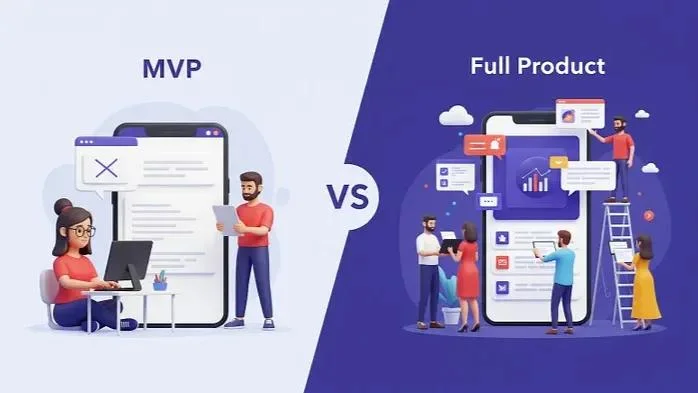
Building a software product requires more than having a great idea. Businesses need to decide how much to build, how quickly to launch, and how much investment to make before knowing whether the product will succeed.
Two common approaches are MVP development and full product development.
An MVP, or Minimum Viable Product, focuses on launching a functional version with the essential features needed to solve a specific problem and collect real user feedback. Full product development, on the other hand, aims to create a complete, scalable product with a broader set of features, integrations, security controls, and user experiences.
Choosing between the two depends on your business goals, budget, market conditions, technical requirements, and product maturity.
What Is an MVP?
An MVP (Minimum Viable Product) is the first usable version of a software product that includes only the core features required to provide value to users.
The purpose of an MVP is not to build a low-quality or incomplete application. Instead, it is to build the smallest practical version that can be tested with real users.
For example, imagine a business wants to build an online food delivery platform.
A full product could include customer mobile applications, restaurant dashboards, delivery partner applications, online payments, live GPS tracking, loyalty programs, promotional campaigns, AI recommendations, advanced analytics, and automated notifications.
An MVP might initially include:
- User registration
- Restaurant listing
- Menu browsing
- Shopping cart
- Order placement
- Basic payment integration
- Order status tracking
- Admin dashboard
Once the MVP is launched, user behavior and feedback can guide the next stage of development.
What Is Full Product Development?
Full product development focuses on building a more complete software solution from the beginning.
Instead of validating only the core concept, the development process considers a wider range of requirements, including:
- Advanced functionality
- Scalability
- Security
- Performance
- Third-party integrations
- Automation
- Analytics and reporting
- User experience
- Infrastructure
- Administration and management
- Long-term maintenance
For example, an enterprise ERP platform may require interconnected systems for accounting, inventory, HR, CRM, purchasing, sales, and reporting. In such cases, a more comprehensive architecture may be necessary from the beginning.
MVP vs Full Product Development
| Factor | MVP Development | Full Product Development |
|---|---|---|
| Primary Goal | Validate an idea | Build a complete product |
| Initial Features | Essential features | Broad feature set |
| Development Time | Usually shorter | Usually longer |
| Initial Investment | Lower | Higher |
| User Feedback | Collected early | Often collected later |
| Market Validation | Strong focus | Less immediate focus |
| Scalability | Designed for initial growth | Designed for larger scale |
| Complexity | Lower | Higher |
| Best For | Startups and new ideas | Established and enterprise products |
When Should You Choose an MVP?
An MVP is often the better choice when you are still validating your product idea.
1. Your Product Idea Is Unproven
If you do not know whether customers will actually use or pay for your product, building a large system immediately can create unnecessary risk.
An MVP allows you to test the concept with real users before making a larger investment.
2. You Need to Launch Quickly
Speed can be important when entering a competitive market. Instead of spending a long time building every possible feature, you can launch the core functionality, collect feedback, and continue improving the product.
3. You Have a Limited Initial Budget
MVP development allows businesses to prioritize the most important functionality. Development resources can be focused on solving the core business problem instead of investing heavily in features that may not be used.
4. Customer Requirements Are Unclear
Sometimes businesses understand the problem but do not yet know exactly what users expect from the solution.
An MVP provides an opportunity to learn from real users instead of making every product decision based only on assumptions.
5. You Want to Test Product-Market Fit
An MVP can help answer important questions:
- Are users interested in the product?
- Which features are actually useful?
- Are customers willing to pay?
- Where do users experience friction?
- Which features should be developed next?
When Should You Build the Full Product?
Full product development can make more sense when product requirements are already well understood.
1. Your Business Requirements Are Clearly Defined
If you already have validated requirements, an established customer base, and a clear product roadmap, building a complete solution may be more efficient.
2. The Product Requires Complex Integrations
Some applications depend on multiple systems from the beginning.
ERP → CRM → Payment Gateway → Inventory → Accounting → Reporting
When these systems are tightly connected, removing one component may prevent the overall business workflow from functioning correctly.
3. Security Is a Critical Requirement
Financial platforms, enterprise applications, and other sensitive systems may require strong security architecture from the beginning.
Authentication, authorization, encryption, auditing, monitoring, and data protection should be designed into the system rather than treated as later additions.
4. The Product Is Enterprise-Focused
Enterprise software often requires:
- Role-based access control
- Multi-user workflows
- Approval systems
- Audit logs
- Third-party integrations
- Advanced reporting
- Data management
- Scalability
- High availability
A lightweight MVP may not be sufficient for these requirements.
5. The Cost of Rebuilding Is High
Sometimes an MVP built with a temporary architecture can create significant technical debt.
If the application is expected to process large amounts of data or serve a large number of users, the initial architecture should account for future scalability and performance requirements.
An MVP Does Not Mean Building Poor-Quality Software
One common misconception is that an MVP means creating a low-quality application.
That is not the goal.
A good MVP should still have:
- Clean architecture
- Secure authentication
- Reliable database design
- Responsive user interface
- Error handling
- Basic monitoring
- Maintainable code
- Production-ready deployment
The difference is scope, not necessarily quality. The MVP should minimize unnecessary features while maintaining a strong technical foundation.
MVP Development in 2026
Modern development technologies have made MVP development faster and more flexible.
Businesses can use technologies and services such as:
- Next.js
- React
- TypeScript
- Flutter
- Node.js
- PostgreSQL
- MongoDB
- Cloud platforms
- Managed authentication
- Payment APIs
- AI APIs
- Third-party integrations
AI-assisted development can also accelerate prototyping, testing, documentation, and repetitive development tasks. However, faster development does not eliminate the need for proper architecture, security, testing, and product planning.
AI and MVP Development
AI can become part of the MVP itself rather than only being a development tool.
An AI-enabled business application could start with features such as:
- AI-powered search
- Automated document processing
- Customer support chatbots
- Recommendation engines
- Content generation
- Data summarization
- Workflow automation
The MVP can help validate whether these AI capabilities provide real business value before expanding them into a larger AI platform.
A Better Approach: MVP → Feedback → Product
The decision does not always have to be strictly MVP or Full Product.
For many businesses, a practical strategy is:
Idea → MVP → Real Users → Feedback → Improvements → Scalable Product
Phase 1: Discovery
- Identify the business problem
- Define target users
- Analyze competitors
- Identify core workflows
- Define business objectives
- Evaluate technical requirements
Phase 2: MVP
Build only the features required to validate the core concept.
Phase 3: Launch
Release the MVP to a controlled group of real users.
Phase 4: Measure
Analyze user engagement, conversion, retention, feature usage, application performance, and customer feedback.
Phase 5: Improve
Use real-world results to prioritize the next features and improvements.
Phase 6: Scale
Once the product demonstrates demand, invest in advanced architecture, automation, scalability, security improvements, integrations, analytics, and AI capabilities.
MVP vs Full Product: Cost Considerations
The cost of software development depends on much more than the number of screens.
Important factors include:
- Product complexity
- Number of platforms
- UI/UX requirements
- Backend architecture
- Database design
- API integrations
- Third-party services
- Security requirements
- AI functionality
- Cloud infrastructure
- Testing
- Maintenance
An MVP generally requires a smaller initial investment because its scope is limited. However, businesses should avoid choosing an MVP purely because it is cheaper.
The better question is:
What is the minimum product we can build without compromising the core business objective?
How Code-OX Technologies Can Help
At Code-OX Technologies, we approach product development based on business requirements rather than following a one-size-fits-all development model.
Our development approach can support businesses at different stages, from validating a new software idea to developing and scaling a complete digital product.
Our capabilities include:
- MVP development
- Custom software development
- Web application development
- Mobile application development
- UI/UX design
- API development and integration
- Odoo and ERP solutions
- E-commerce development
- AI-powered applications
- Cloud deployment
- Database architecture
- Security implementation
- Product scaling and maintenance
Whether you need a small MVP to validate an idea or a complete enterprise application, the architecture and development strategy should be aligned with your long-term business goals.
How to Decide Between MVP and Full Product Development
Before starting development, ask the following questions:
Do We Know Our Target Customers?
If not, an MVP can help validate the market.
Are the Requirements Already Well Established?
If yes, full product development may be more practical.
Do We Need Complex Integrations From Day One?
If yes, a broader architecture may be required.
Is the Application Enterprise-Critical?
If yes, security, scalability, reliability, and maintainability should be considered from the beginning.
How Much Initial Investment Can We Make?
A limited budget may favor an MVP approach.
How Quickly Do We Need to Enter the Market?
If speed is critical, an MVP can provide an earlier launch.
Conclusion
There is no universal winner between MVP and Full Product Development.
An MVP is ideal when you need to validate an idea, reduce initial risk, launch quickly, and learn from real users.
Full product development is more appropriate when requirements are established, the system is complex, integrations are critical, or the application requires enterprise-level scalability and security from the beginning.
For many businesses, the smartest strategy is to start with a well-designed MVP and evolve it into a complete product based on real-world data and customer feedback.
The goal is not simply to build software faster.
The goal is to build the right product, at the right stage, with the right level of investment.
Frequently Asked Questions
1. Is an MVP a complete product?
An MVP is a functional version of a product containing the essential features needed to solve the primary user problem and validate the concept.
2. Is MVP development cheaper than full product development?
Usually, yes, because an MVP has a smaller scope. However, the actual cost depends on the product's technical complexity and requirements.
3. How long does it take to build an MVP?
There is no fixed timeline. A simple MVP may take weeks, while a complex application involving multiple integrations can require several months.
4. Can an MVP become a full product?
Yes. A well-designed MVP can become the foundation for a larger product as new features, integrations, users, and scalability requirements are introduced.
5. Should startups always build an MVP?
Not necessarily. If the product requires complex infrastructure, strict compliance, or critical integrations from the beginning, a more comprehensive development approach may be appropriate.