.svg)
MongoDB vs PostgreSQL: Choosing the Right Database for Modern Applications
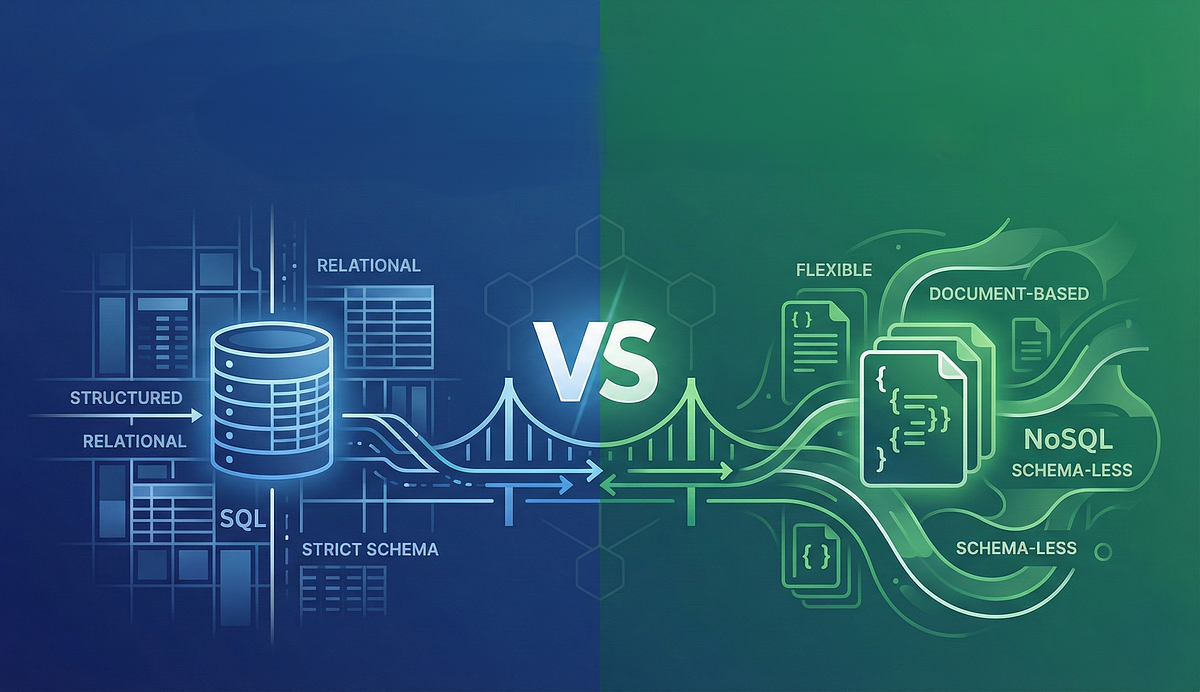
MongoDB vs PostgreSQL: Choosing the Right Database for Modern Applications
Choosing the right database is a critical part of building a reliable and scalable application. As modern applications become more data-intensive, developers and businesses often compare MongoDB and PostgreSQL when selecting their database technology.
MongoDB and PostgreSQL are both powerful, mature, and widely used databases, but they approach data management differently. MongoDB is a document-oriented NoSQL database designed around flexible JSON-like documents, while PostgreSQL is a relational SQL database known for structured data, powerful queries, transactions, and data integrity.
So, which database should you choose for your application? The answer depends on your data model, application architecture, scalability requirements, query patterns, and long-term business needs.
What Is MongoDB?
MongoDB is a document-oriented NoSQL database that stores data in flexible documents. Instead of organizing information primarily into rows and columns, MongoDB uses collections and documents that can contain nested objects and arrays.
This flexible structure makes MongoDB particularly useful for applications where data models change frequently or where application data naturally maps to JSON-like objects.
Key Advantages of MongoDB
- Flexible data model: Documents can contain different fields and nested structures.
- Developer-friendly: JSON-like documents can map naturally to objects used by many modern applications.
- Horizontal scalability: MongoDB supports distributed architectures and sharding for large workloads.
- Rapid development: Flexible schemas can make it easier to evolve applications during development.
- Suitable for large-scale applications: MongoDB can handle high-volume workloads when properly designed and deployed.
What Is PostgreSQL?
PostgreSQL is an open-source object-relational database management system. It uses SQL and a structured relational model while also providing advanced capabilities for working with JSON and other data types.
PostgreSQL is widely recognized for its reliability, strong transactional capabilities, data integrity, sophisticated queries, and extensibility.
Key Advantages of PostgreSQL
- Strong data integrity: Constraints, relationships, and transactions help maintain reliable data.
- Powerful SQL: PostgreSQL supports complex queries, joins, aggregations, common table expressions, and advanced analytical operations.
- ACID transactions: PostgreSQL provides strong transactional guarantees for applications where consistency matters.
- Advanced data types: PostgreSQL supports JSON/JSONB, arrays, ranges, geographic data through extensions, and many other data types.
- Extensibility: Extensions and custom functionality allow PostgreSQL to support a wide range of application requirements.
MongoDB vs PostgreSQL: Key Differences
| Feature | MongoDB | PostgreSQL |
|---|---|---|
| Database type | Document-oriented NoSQL | Relational / object-relational SQL |
| Data structure | Documents and collections | Tables, rows, and columns |
| Schema | Flexible document structure | Structured relational schema with support for flexible data types |
| Relationships | Often modeled through embedded documents or references | Strong support for relationships, foreign keys, and joins |
| Query language | MongoDB Query API | SQL |
| Transactions | Supports multi-document transactions | Strong ACID transaction support |
| Scaling | Horizontal scaling through distributed architectures and sharding | Strong vertical scaling with multiple options for replication and distributed deployments |
| Best suited for | Flexible, document-centric, and distributed applications | Structured, relational, transactional, and analytical workloads |
MongoDB vs PostgreSQL: Data Modeling
The biggest difference between MongoDB and PostgreSQL is how they model data.
In PostgreSQL, data is generally organized into related tables. For example, an e-commerce application might have separate tables for customers, products, orders, and payments. Relationships between these entities can be represented using primary and foreign keys.
MongoDB typically organizes information into documents. Related information can sometimes be embedded inside a single document, which can reduce the need for joins and allow an application to retrieve related data efficiently.
The right approach depends on how your application reads and writes data. A relational model can be excellent for highly connected data, while a document model can be convenient when application data naturally forms self-contained objects.
MongoDB vs PostgreSQL: Performance
Database performance depends on much more than the database product itself. Data modeling, indexing, query design, hardware, workload patterns, caching, network architecture, and application code can all have a significant impact.
MongoDB can perform well for document-oriented workloads where data is accessed together and the document model matches the application's access patterns.
PostgreSQL can perform extremely well for structured workloads involving complex queries, relationships, aggregations, and transactional operations, especially when tables and indexes are designed correctly.
Instead of choosing a database based only on benchmark numbers, businesses should test their expected workload using realistic data and queries.
MongoDB vs PostgreSQL: Scalability
Both MongoDB and PostgreSQL can scale, but they provide different approaches.
MongoDB supports horizontal scaling through sharding and distributed deployments. This can make it suitable for applications that need to distribute data and workloads across multiple servers.
PostgreSQL has traditionally been strong in vertical scaling and replication-based architectures. Modern PostgreSQL deployments can also use partitioning, read replicas, connection pooling, distributed extensions, and cloud-managed architectures to support large workloads.
The best scaling strategy depends on the application's traffic patterns, consistency requirements, data volume, infrastructure, and operational model.
MongoDB vs PostgreSQL for AI and Modern Applications
Modern applications increasingly combine traditional business data with events, documents, application-generated content, and AI-related data.
PostgreSQL can be a strong foundation for applications that require structured business data, transactional workflows, complex relationships, and analytical queries. Its support for JSON and extensibility also allows developers to handle different types of data within a relational platform.
MongoDB can be attractive for applications centered around flexible documents, rapidly evolving data structures, content-heavy systems, and distributed workloads.
For AI-enabled applications, the decision should also consider how embeddings, metadata, documents, search, and transactional data will be stored and queried. In some architectures, a single database may be sufficient; in others, specialized technologies may be combined.
When Should You Choose MongoDB?
MongoDB can be a good choice when your application benefits from flexible document structures and distributed scalability.
Consider MongoDB for applications such as:
- Content management platforms
- Real-time applications
- Product catalogs with varying attributes
- Mobile and web applications with evolving data models
- IoT and event-driven applications
- Applications handling large volumes of document-oriented data
- Distributed applications with flexible data requirements
When Should You Choose PostgreSQL?
PostgreSQL is often an excellent choice when data relationships, consistency, transactions, and sophisticated queries are central to the application.
Consider PostgreSQL for:
- ERP and business management systems
- Financial and accounting applications
- CRM platforms
- E-commerce systems
- Inventory and order management
- Applications with complex relationships
- Reporting and analytics workloads
- Systems requiring strong transactional consistency
Can MongoDB and PostgreSQL Be Used Together?
Yes. Businesses do not always need to select a single database for every workload.
A modern architecture may use PostgreSQL for transactional business data while MongoDB handles a document-oriented workload. Other technologies can also be used for caching, search, analytics, or specialized workloads.
This approach is sometimes referred to as polyglot persistence. It can provide flexibility, but it also increases operational complexity. Teams must consider data synchronization, monitoring, backups, security, infrastructure, and maintenance.
MongoDB vs PostgreSQL: Which One Should You Choose?
There is no universal winner between MongoDB and PostgreSQL.
Choose MongoDB when your application requires a flexible document model, rapidly changing data structures, or distributed document-oriented workloads.
Choose PostgreSQL when your application depends on structured data, complex relationships, strong transactions, advanced SQL queries, and strict data integrity.
Consider both when your architecture contains different workloads that benefit from different database technologies.
Final Thoughts
MongoDB and PostgreSQL are both excellent database technologies for modern software development. The right choice should be based on your application's actual requirements rather than popularity or technology trends.
Before making a decision, evaluate your data model, query patterns, transaction requirements, scalability goals, performance expectations, development expertise, security needs, and long-term maintenance costs.
At Code-OX Technologies, we help businesses design and develop scalable applications using technologies that fit their specific business requirements. Whether you need MongoDB, PostgreSQL, or a combination of database technologies, the right architecture can provide a strong foundation for long-term growth.
Need help choosing the right database for your application? Connect with Code-OX Technologies to discuss your project requirements and build a scalable database architecture.