.svg)
Employee Monitoring Without Screenshots: A More Privacy-First Approach to Workforce Management
Reported By
Mishal
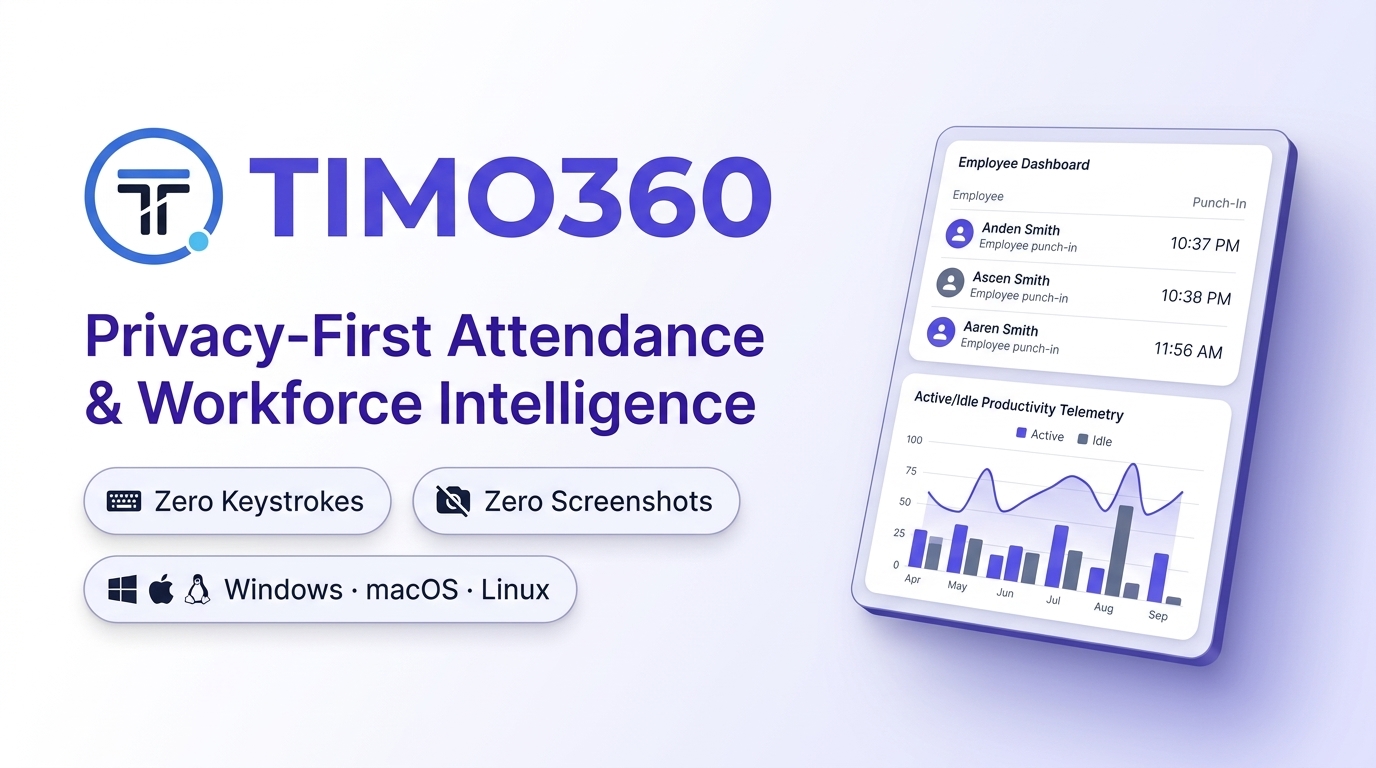
Employee monitoring has changed dramatically over the last decade. Businesses want better visibility into attendance, work patterns, and productivity, while employees increasingly expect workplace technology to respect their privacy.
That creates an important question for modern businesses: how can teams understand whether work is happening without turning employee monitoring into constant surveillance?
One answer is to move away from collecting everything and instead focus on the signals that actually help managers understand work.
The problem with invasive employee monitoring
Traditional employee monitoring software often tries to create visibility by collecting as much information as possible. Screenshots, keystroke logging, and detailed activity surveillance can produce large amounts of data.
But more data does not automatically mean better management. In many cases, excessive monitoring can make employees feel that they are being watched rather than supported.
Privacy concerns
Employees may feel uncomfortable when personal or unnecessarily detailed information is continuously captured.
Too much data
Large volumes of activity data can make it harder to identify the information managers actually need.
Reduced trust
A surveillance-heavy environment can influence how employees perceive management and workplace technology.
Wrong incentives
Visible computer activity is not always the same thing as meaningful work or useful outcomes.
Why privacy matters in employee monitoring
Employee monitoring should begin with a clear business purpose. Companies may need information about attendance, schedules, application activity, and work patterns, but that does not mean every action on a computer needs to become a permanent record.
A privacy-first approach starts with a simple principle: collect information because it serves a defined operational purpose, rather than collecting it simply because the technology makes it possible.
The goal should be to understand the work that needs to be managed, not to observe every detail of the person doing it.
A better alternative to screenshots
Businesses still need visibility. Managers need to know whether employees are working scheduled hours, whether applications are being used appropriately, and whether teams are staying productive.
Many of these questions can be answered through less invasive signals.
| Business question | Useful signal | Privacy approach |
|---|---|---|
| Was the employee working? | Attendance and active/idle time | No screen content required |
| What applications were used? | Application activity | Focus on application usage rather than screen content |
| Was scheduled work completed? | Schedules and activity patterns | Measure work patterns instead of capturing everything |
| Where are productivity issues? | Productivity insights | Use signals to identify patterns and areas for improvement |
Traditional monitoring vs privacy-first monitoring
The difference is not whether a company has visibility. The difference is how that visibility is created.
What privacy-first employee monitoring looks like
A privacy-first monitoring strategy does not mean removing all visibility. It means choosing the right level of visibility.
Instead of asking how much employee activity can be captured, businesses can start by asking what information is necessary to manage work effectively.
Define the question
Identify what managers actually need to understand about work, attendance, or productivity.
Choose useful signals
Use attendance, activity, application usage, and schedules to answer those questions.
Turn signals into insight
Use the resulting information to understand patterns and improve workforce management.
How TIMO360 approaches employee monitoring
TIMO360 is built around a privacy-first approach to employee monitoring and workforce management.
Rather than making screenshots or keystroke logging the foundation of monitoring, TIMO360 focuses on workforce signals that can help businesses understand how work is happening.
These include attendance, active and idle time, application activity, schedules, and productivity insights.
The objective is useful workforce visibility without depending on screenshots or keystroke logging.
Five principles for better employee monitoring
Start with the business question
Decide what managers actually need to know before deciding what data the system should collect.
Collect useful signals
Attendance, schedules, activity, and application usage can provide useful information without recording everything.
Make monitoring understandable
Employees should understand what is being measured and why the information is relevant to their work.
Focus on patterns
A single activity signal rarely tells the whole story. Trends and patterns are generally more useful for management.
Use monitoring to improve work
Monitoring should help identify operational problems, improve workflows, and support better conversations.
What should a privacy-first monitoring system provide?
A useful employee monitoring system should provide enough visibility to help managers understand work without turning every computer interaction into surveillance.
The future of employee monitoring is more purposeful
Employee monitoring does not have to be a choice between having no visibility and watching everything employees do.
There is a middle ground: collect useful information, understand work patterns, and avoid unnecessary surveillance.
For businesses, that can mean better operational visibility. For employees, it can mean workplace technology that respects reasonable boundaries.
The goal is not to know everything an employee does. The goal is to know enough to manage work effectively.
Frequently asked questions
Can employee monitoring work without screenshots?
Yes. Businesses can use signals such as attendance, active and idle time, application activity, schedules, and productivity insights without making screenshots the foundation of their monitoring strategy.
Is employee monitoring always invasive?
Not necessarily. The impact depends on what information is collected, why it is collected, and how that information is used. A purpose-driven approach can provide workforce visibility with less invasive data collection.
Why avoid keystroke logging?
Individual keystrokes can contain highly detailed information without necessarily providing useful management insight. Broader work signals can often answer the business question without recording every keyboard action.
What does TIMO360 monitor?
TIMO360 focuses on workforce signals such as attendance, active and idle time, application activity, schedules, and productivity insights rather than relying on screenshots or keystroke logging.
Better visibility doesn't require more surveillance.
Explore a privacy-first approach to employee monitoring with TIMO360.
Explore TIMO360