.svg)
Your Database Layer Matters: Prisma or Drizzle for Modern TypeScript Apps?
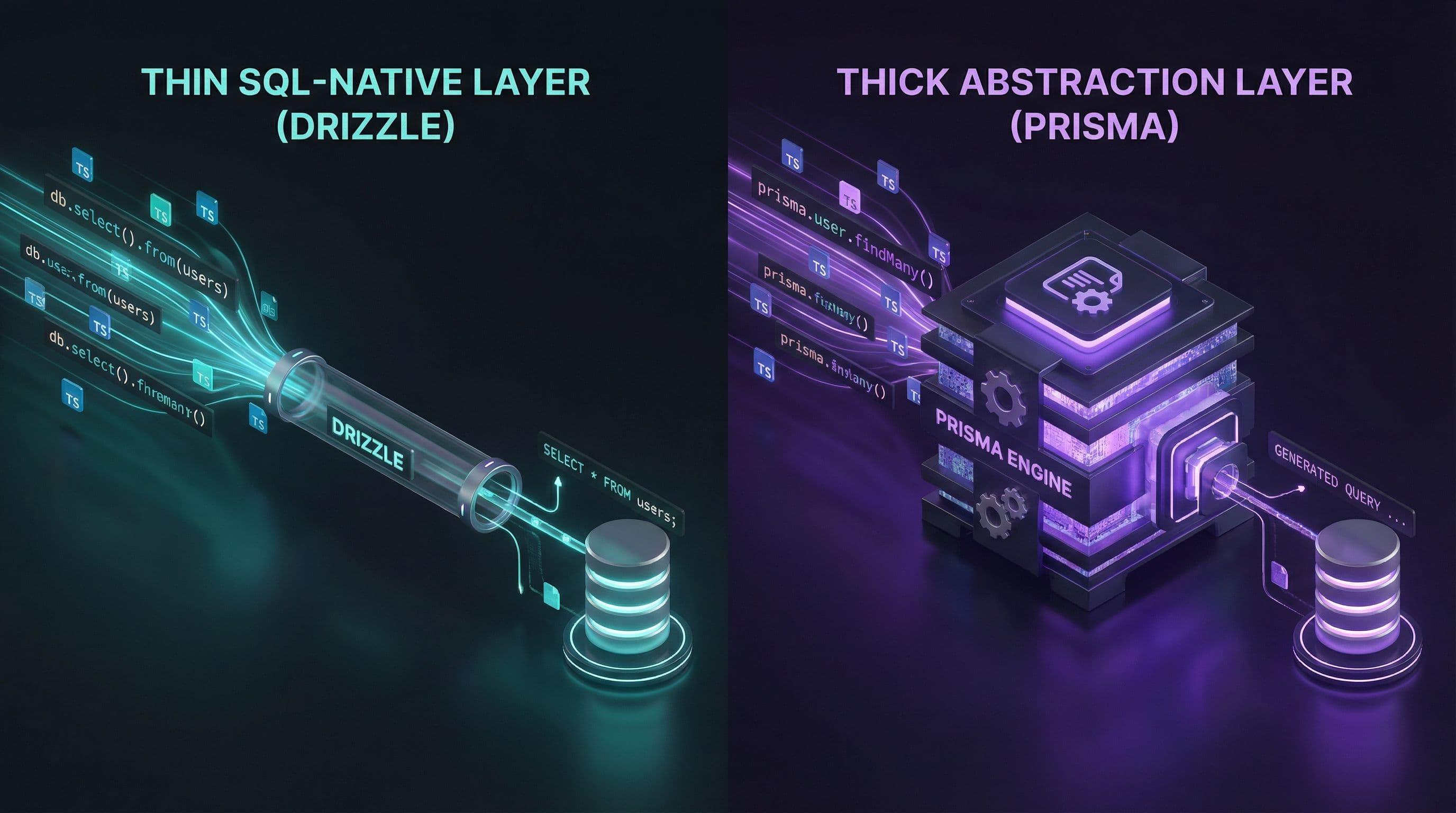
Your Database Layer Matters: Prisma or Drizzle for Modern TypeScript Apps?
Choosing an ORM is easy when an application has a handful of database tables. The decision becomes much more important when the application starts handling real business logic, complex relationships, transactions, reporting queries, background jobs, and growing traffic.
For teams building modern TypeScript applications, Prisma ORM and Drizzle ORM have become two prominent choices. Both provide strong TypeScript integration, database tooling, migrations, and ways to query relational data. However, they take noticeably different approaches to how developers should work with the database.
Prisma emphasizes a structured, schema-driven developer experience with a generated, type-safe client. Drizzle takes a more SQL-oriented approach, allowing developers to define schemas in TypeScript and write queries that remain close to SQL.
That difference matters more than the feature lists suggest.
If you're building a SaaS platform, customer portal, marketplace, ERP-connected application, or another production system, the better question is not simply "Which ORM is faster?" It is "Which database abstraction fits the way this application needs to evolve?"
Prisma vs Drizzle at a Glance
| Area | Prisma | Drizzle |
|---|---|---|
| Core philosophy | Structured ORM with a strong schema-driven developer experience | Lightweight TypeScript data framework with a SQL-like approach |
| Schema definition | Traditionally centered around Prisma Schema, with newer TypeScript-based options | Defined directly in TypeScript |
| Query style | High-level typed client API | SQL-like and relational APIs |
| Type safety | Strong generated typing | Strong TypeScript typing |
| SQL familiarity | Higher abstraction from SQL | Very close to SQL concepts |
| Migrations | Integrated migration tooling | Drizzle Kit-based migration tooling |
| Database control | High, with abstraction over common operations | Very high and SQL-oriented |
| Learning curve | Straightforward for teams adopting the Prisma model | Natural for developers comfortable with SQL and TypeScript |
| Best fit | Teams prioritizing structured productivity and a rich ORM experience | Teams prioritizing SQL control, lightweight abstractions, and TypeScript-native schemas |
What Prisma ORM Brings to the Table
Prisma is designed around a structured data model and a type-safe application programming experience. Its ecosystem includes Prisma ORM, Prisma Client, migration tooling, and Prisma Studio.
A traditional Prisma workflow starts with a schema that describes the application's data model. Prisma then provides a typed client that allows application code to interact with those models without manually constructing every SQL query.
This can make everyday database operations particularly readable.
For example, a TypeScript application can express a query around users, orders, and related records using Prisma's generated client rather than manually assembling SQL for every common operation.
Prisma's current evolution is also important. Prisma 8 introduces a TypeScript runtime, a contract-based data model, a new query API, and a revised migration architecture. Teams evaluating Prisma today should therefore look at the current Prisma 8 direction rather than relying only on older Prisma tutorials and comparisons. :contentReference[oaicite:0]{index=0}
Where Prisma Feels Strong
- Structured data modeling
- Strong type-safe query experience
- Generated database client
- Developer-friendly autocomplete
- Integrated migration workflow
- Convenient relational queries
- Useful tooling around the database layer
- Good fit for teams that want a consistent ORM abstraction
Prisma's documentation highlights type-safe queries, generated types, relational querying, migrations, and database tooling as central parts of its ecosystem. :contentReference[oaicite:1]{index=1}
Where Drizzle Takes a Different Path
Drizzle is built around a different idea: developers should be able to work with databases without feeling like the ORM is hiding SQL from them.
Database schemas are defined directly in TypeScript, and queries can use a SQL-like syntax. This creates a development experience that feels closer to writing SQL while retaining TypeScript's type checking.
Drizzle describes itself as a headless TypeScript ORM/data framework and emphasizes that it should work with an application's existing structure rather than forcing the project to revolve around the framework. Its query APIs support both SQL-like and relational approaches. :contentReference[oaicite:2]{index=2}
Where Drizzle Feels Strong
- TypeScript-native schema definitions
- SQL-like query syntax
- Fine-grained database control
- Lightweight abstraction
- Strong fit for SQL-oriented developers
- Relational query support
- Good fit for serverless-oriented architectures
- Easy transition between ORM concepts and SQL concepts
Drizzle's own documentation emphasizes its SQL-like approach, TypeScript schema definitions, relational querying, and lightweight philosophy. :contentReference[oaicite:3]{index=3}
The Real Difference Is Abstraction
The biggest difference between Prisma and Drizzle is not simply syntax. It is how much abstraction you want between your application code and your database.
Prisma gives you a higher-level interface around your data model. You describe your models and use the generated client to work with them.
Drizzle stays much closer to database concepts. Tables, columns, joins, conditions, and SQL-style operations remain visible in the application code.
Neither philosophy is inherently better.
The right level of abstraction depends on the development team and the application.
Prisma: When the ORM Should Do More of the Work
Imagine a Code-Ox team is developing a subscription-based SaaS platform.
The system has customers, subscriptions, invoices, plans, users, permissions, payment records, and subscription events.
Most database operations are conventional business operations: retrieve a customer, create a subscription, update a billing status, load related records, or retrieve invoices for an account.
A higher-level ORM abstraction can make these operations easier for the team to reason about. Developers can work primarily with application models and typed client operations rather than translating every operation into SQL.
This is one of the scenarios where Prisma can be particularly attractive.
Drizzle: When SQL Should Stay Visible
Now consider a different application: an analytics-heavy platform where developers frequently work with joins, aggregations, database-specific features, reporting queries, and carefully optimized SQL.
In this environment, hiding too much of the database can become frustrating.
Drizzle's SQL-like query model allows developers to stay closer to the database while still benefiting from TypeScript's type system.
For teams where SQL knowledge is already strong, this can produce a very natural development workflow.
Type Safety: Both Take It Seriously
TypeScript developers increasingly expect database operations to participate in compile-time type checking.
Prisma generates types based on the application's data model and provides typed query APIs. Its documentation specifically describes full type safety for queries, including partial queries and included relations. :contentReference[oaicite:4]{index=4}
Drizzle takes a TypeScript-first approach, with schemas and query expressions defined directly in TypeScript. The result is also strongly typed while keeping the query structure close to SQL.
So the comparison is not really "typed versus untyped."
Both can provide strong type safety. The difference is how that type safety is achieved and how much abstraction sits around it.
Schema Definition: Prisma Schema vs TypeScript
Prisma has historically centered its workflow around the Prisma Schema language. This gives the team a dedicated place to describe models and relationships.
Prisma's current architecture is evolving, however, and Prisma 8 supports authoring models in Prisma Schema or directly in TypeScript as part of its new contract-based workflow. :contentReference[oaicite:5]{index=5}
Drizzle defines database schemas directly in TypeScript.
This distinction can matter in projects where developers want the schema to live alongside the rest of their TypeScript code and use familiar language constructs throughout the data layer.
Querying Relationships
Real applications rarely operate on isolated tables.
A sales platform may need customers and orders. A project-management platform may need projects, tasks, employees, and time entries. An e-commerce platform may need products, variants, inventory, orders, and payments.
Prisma provides a high-level relational query model designed around these relationships. Its documentation highlights nested queries, relation traversal, filtering related records, nested writes, and generated relation types. :contentReference[oaicite:6]{index=6}
Drizzle provides relational queries as well as SQL-like joins, giving developers more direct control over how relational operations are expressed. :contentReference[oaicite:7]{index=7}
This is an important distinction for teams that frequently need to reason about the exact SQL shape of a query.
Migrations: An Often-Underestimated Decision
Developers often focus heavily on query syntax and overlook migrations.
That can become a problem once a production database contains years of customer data.
A migration is not simply: "add a column."
It can involve:
- Existing production data
- Indexes
- Foreign keys
- Large tables
- Zero-downtime deployment requirements
- Backwards compatibility
- Data transformation
- Rollback planning
Prisma provides integrated migration tooling. Its current Prisma 8 workflow treats migrations as versioned, reviewable changes between application contracts and database state. :contentReference[oaicite:8]{index=8}
Drizzle uses Drizzle Kit as part of its schema and migration workflow, keeping the database definition close to TypeScript while providing tooling for generating and applying migrations.
For either ORM, the important engineering question is not simply how easy it is to generate a migration. It is whether your team has a disciplined process for reviewing, testing, deploying, and monitoring database changes.
Performance: Don't Choose an ORM by Benchmark Headlines
Performance comparisons between Prisma and Drizzle are often reduced to benchmark numbers.
That can be misleading.
Real-world database performance depends on the database engine, indexes, query shape, connection management, network latency, caching, transaction boundaries, dataset size, and application architecture.
A poorly indexed SQL query can be slow regardless of which ORM generated it.
Likewise, a well-designed application can perform effectively with either ORM when queries, indexes, connections, and caching are designed correctly.
The ORM should therefore be evaluated as one component of the complete data-access architecture rather than as an isolated benchmark winner.
Serverless and Edge-Oriented Applications
Modern TypeScript applications are increasingly deployed using serverless functions and distributed runtimes.
In these environments, database connection behavior becomes especially important.
Developers should evaluate connection pooling, driver compatibility, runtime support, deployment topology, database location, and the provider's recommended architecture before selecting an ORM.
Drizzle's lightweight approach can be attractive for applications where developers want minimal abstraction around the database driver.
Prisma also supports modern deployment environments and continues to evolve its runtime architecture, so the correct decision should be based on the specific database and deployment environment rather than assuming that one ORM is automatically better for serverless applications.
Complex SQL and Database-Specific Features
Eventually, many serious applications encounter a query that doesn't fit neatly into the application's normal CRUD patterns.
You may need a complex aggregation, a database-specific operator, a specialized index, a reporting query, or an optimized SQL statement.
This is where SQL visibility becomes important.
Drizzle's SQL-like design makes this style of database work feel natural.
Prisma also allows developers to use lower-level SQL when the higher-level client abstraction is not the appropriate tool. Prisma's documentation explicitly supports using raw SQL when required. :contentReference[oaicite:9]{index=9}
Therefore, the comparison should not be framed as "Prisma means no SQL" versus "Drizzle means SQL." The more useful distinction is how frequently your team wants SQL concepts to appear directly in everyday application code.
Developer Experience
Prisma's developer experience is particularly appealing to teams that prefer a clear model-driven workflow. The schema becomes an important source of truth, while the generated client provides autocomplete and typed access to models.
Drizzle's experience tends to feel more natural to developers who already think in SQL and want TypeScript to enhance rather than replace that mental model.
A senior backend developer who can immediately read a JOIN may prefer Drizzle's style.
A product-focused TypeScript team that wants database operations to resemble application-level objects may prefer Prisma.
Prisma vs Drizzle for a Growing SaaS Product
Consider a SaaS product during its first year.
Initially, the application has users, organizations, subscriptions, and invoices. Six months later, it adds permissions, audit logs, notifications, integrations, reporting, and usage metering.
At this stage, developer productivity becomes extremely important.
Prisma's structured client and model-oriented workflow can be valuable when many developers are working across the same application and need a consistent way to access data.
Drizzle can be attractive when the team wants the database structure to remain visible and prefers composing queries directly in TypeScript.
Neither choice automatically scales better. The team's ability to maintain the data layer matters more than the ORM's marketing label.
Prisma vs Drizzle for Enterprise Applications
Enterprise systems introduce additional concerns:
- Long-lived databases
- Complex business relationships
- Strict migration procedures
- Multiple environments
- Auditability
- Data governance
- Performance monitoring
- Legacy database integration
- Multiple development teams
In such environments, the ORM decision should be part of a wider architecture review.
A development team might prioritize Prisma because it provides a structured abstraction and consistent developer workflow.
Another team might choose Drizzle because its SQL-oriented model gives database specialists more direct control.
The important thing is to establish conventions early. An enterprise database can survive an ORM choice; inconsistent database practices are much harder to survive.
Where Code-Ox Fits Into the Decision
At Code-Ox, technology selection is approached from the application architecture outward.
When building a custom web platform, SaaS product, business application, or API-driven system, the ORM is only one part of the stack.
Before selecting Prisma or Drizzle, a Code-Ox development team would consider questions such as:
- What database will power the application?
- How complex are the relationships?
- How SQL-heavy will the application become?
- How many developers will maintain the data layer?
- Will the application use serverless infrastructure?
- How frequently will the schema change?
- Are there existing databases that must be integrated?
- Does the system require specialized reporting queries?
- What are the long-term maintenance requirements?
For a business application with conventional CRUD-heavy workflows, a structured ORM experience can reduce unnecessary development complexity.
For a data-intensive platform where SQL control is central to the application's performance and reporting architecture, a SQL-oriented approach can be more appropriate.
This is also why Code-Ox does not treat an ORM as an isolated technology decision. The database layer needs to work with the application's APIs, authentication, business logic, integrations, deployment model, and future scaling requirements.
When Prisma Is the Better Fit
Prisma is worth considering when:
- Your team prefers a structured ORM abstraction.
- You want a model-driven development workflow.
- Developer productivity and autocomplete are major priorities.
- Your application contains many conventional relational operations.
- You want integrated database tooling.
- Your team prefers working with application models rather than SQL for most operations.
- You want a mature ecosystem around schema, client, migrations, and database tooling.
When Drizzle Is the Better Fit
Drizzle is worth considering when:
- Your team is comfortable with SQL.
- You want database schemas directly in TypeScript.
- You prefer SQL-like queries.
- You want a lightweight abstraction.
- Your application contains complex joins and reporting queries.
- You want database behavior to remain highly visible in application code.
- You value close control over how database queries are expressed.
A Better Way to Make the Decision
Instead of asking which ORM is objectively better, score the project against these five areas:
1. Team Preference
Does your team think naturally in ORM models or SQL? The technology that matches the team's mental model will usually produce fewer unnecessary abstractions.
2. Query Complexity
If most operations are straightforward CRUD and relationship queries, a high-level ORM can be productive. If complex SQL is a daily requirement, SQL visibility becomes much more important.
3. Database Architecture
Consider PostgreSQL, MySQL, SQLite, MongoDB, extensions, database-specific capabilities, and existing infrastructure before committing to a data layer.
4. Deployment Model
A traditional Node.js server, serverless functions, containers, and edge-oriented infrastructure can place different requirements on database connectivity.
5. Long-Term Maintenance
Ask what the database layer will look like after several years—not just on the day the application launches.
Prisma vs Drizzle: The Bottom Line
Prisma and Drizzle are both strong options for modern TypeScript applications, but they solve the developer experience problem from different directions.
Prisma is compelling when your team wants a structured, model-oriented ORM experience with strong generated typing and integrated tooling.
Drizzle is compelling when your team wants a lightweight TypeScript-native approach that keeps SQL concepts close to the surface.
If your application is primarily business-logic driven and your team values abstraction and productivity, Prisma may be the more comfortable choice.
If your application is data-intensive and your team values SQL control and database transparency, Drizzle may be the better fit.
But the most important decision is not choosing the ORM with the most impressive feature list. It is choosing the database layer that your team can understand, operate, optimize, and maintain as the application grows.
Final Thoughts
An ORM becomes part of an application's architecture long after the initial database setup is finished. It influences how developers write queries, how schema changes are managed, how relationships are modeled, and how the application interacts with its most important persistent data.
That is why Prisma vs Drizzle should be treated as an architectural decision rather than a simple library comparison.
At Code-Ox, we evaluate that decision in the context of the entire system—business requirements, database design, APIs, integrations, deployment, security, performance, and future growth.
Whether the right choice is Prisma, Drizzle, or another data-access approach, the goal is the same: build a database layer that remains reliable as the product becomes more complex.