.svg)
JWT vs Session Authentication: Which Should You Use?
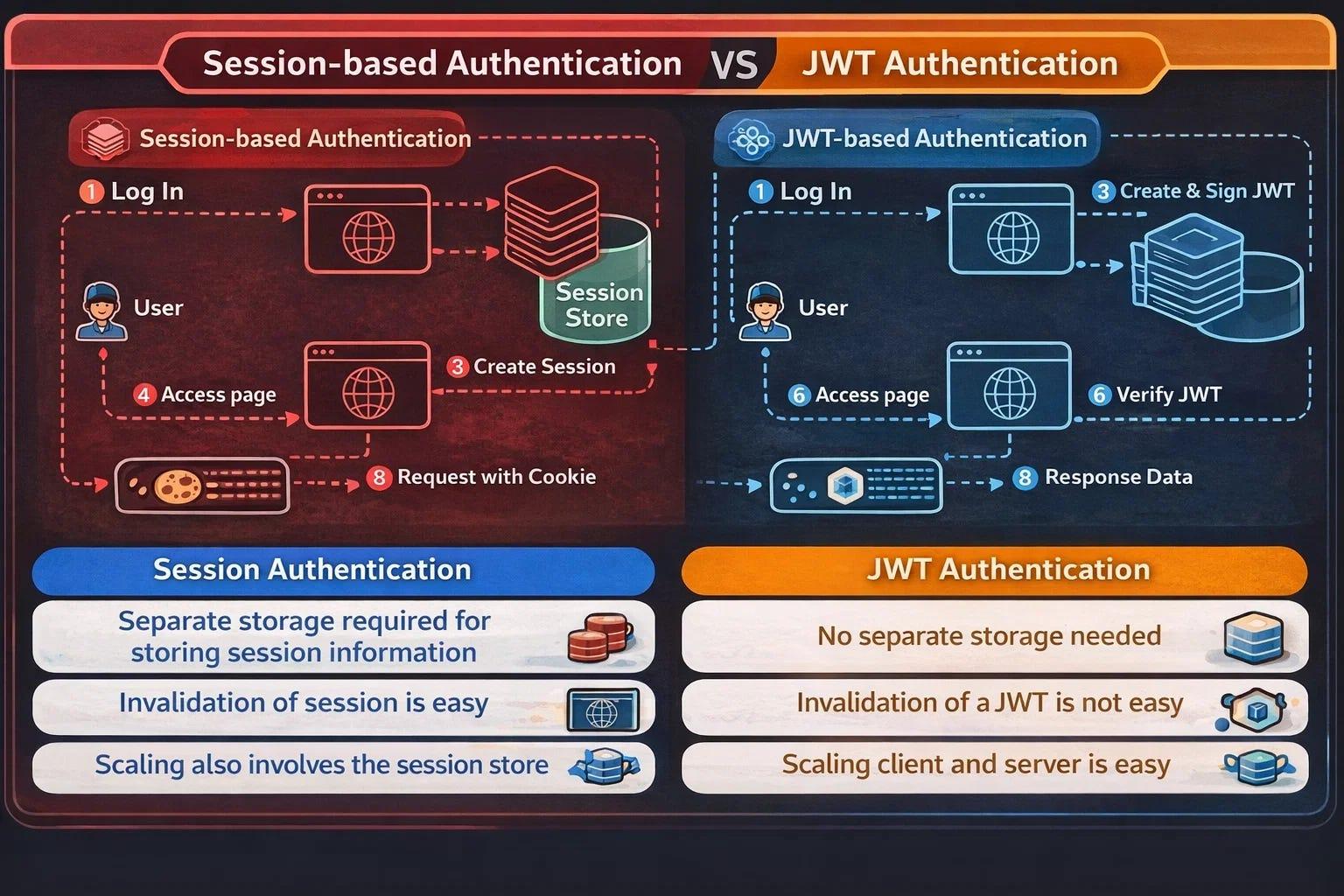
JWT vs Session Authentication: Which Should You Use?
Authentication is one of the first architectural decisions behind any application that has user accounts, protected APIs, dashboards, or private data. Two approaches appear repeatedly in web development: session-based authentication and JWT-based authentication.
They can both answer the same basic question — “Is this user authenticated?” — but they answer it in very different ways.
With sessions, the server keeps the authentication state and the client usually carries an opaque session identifier. With JWT authentication, the client carries a signed token containing claims that the receiving service can validate.
That difference affects much more than token storage. It influences logout, credential revocation, horizontal scaling, API architecture, security controls, and how authentication behaves when an application grows from one backend into multiple services.
JWT vs Session Authentication: The Core Difference
The simplest way to understand the difference is to ask:
Where does the authentication state live?
- Session authentication: the server stores the session state, while the browser generally stores only a session ID.
- JWT authentication: the token itself carries signed claims that the server or API can validate.
Think of a session ID as a coat-check ticket. The ticket does not contain your belongings; it tells the server which stored session belongs to you.
A JWT is different. It is a signed representation of claims such as the subject, issuer, audience, and expiration. The receiving service can validate the signature and relevant claims without necessarily looking up a session record.
How Session-Based Authentication Works
Consider a customer logging into an e-commerce application.
- The customer submits their credentials.
- The server verifies the credentials.
- The server creates a session record containing information such as the user ID, expiration, and relevant authentication state.
- The server sends an opaque session ID to the browser, commonly through a cookie.
- The browser sends that cookie with subsequent requests.
- The server retrieves the session and determines whether the request is authenticated.
A simplified flow looks like this:
User
  ↓
Login Request
  ↓
Application Server
  ↓
Create Session
  ↓
Session Store
  ↓
Session ID Cookie
  ↓
Authenticated Requests
  ↓
Session Lookup
  ↓
Authorized Response
The important point is that the session ID itself normally does not contain the user's complete authentication state. It is an identifier pointing to server-side state.
How JWT Authentication Works
Now consider a mobile application communicating with several independent backend services.
- The user authenticates with the application.
- The authentication system issues a signed JWT.
- The client sends the token when accessing protected resources.
- The receiving API validates the token's signature and relevant claims.
- If the token is valid and the user has the required permissions, the API processes the request.
A simplified flow looks like this:
User
  ↓
Login
  ↓
Authentication Service
  ↓
Issue Signed JWT
  ↓
Mobile/Web Client
  ↓
API Request + JWT
  ↓
Token Verification
  ↓
Authorization
  ↓
Response
This model can be particularly useful when several independent services need to establish trust without maintaining the same server-side session store.
JWT vs Session: Side-by-Side Comparison
| Factor | Session Authentication | JWT Authentication |
|---|---|---|
| Authentication state | Stored server-side | Represented in the signed token |
| Client typically stores | Session ID, commonly in a cookie | JWT, commonly transmitted with requests |
| Server-side lookup | Normally required to retrieve session state | Can validate locally when the required signing keys and claims are available |
| Logout/revocation | Usually straightforward by invalidating the session | More involved for already-issued access tokens |
| Horizontal scaling | Usually requires shared session storage or appropriate session routing | Can simplify independent verification across services |
| Token size | Usually small because the client carries an identifier | Can be larger because claims are included |
| Best fit | Many browser-based applications | Distributed APIs and systems with a genuine need for portable signed credentials |
Security: JWT Is Not Automatically More Secure
One of the most persistent misconceptions in authentication is that JWT is inherently more secure than sessions.
It is not.
Security depends on the entire implementation: credential handling, cookie configuration, token storage, expiration, transport security, CSRF protection, XSS defenses, authorization, key management, and logout behavior.
For browser applications, an HttpOnly, Secure cookie can help prevent JavaScript from directly reading authentication cookies. Appropriate SameSite settings and CSRF defenses are also important depending on the application's architecture.
JWTs introduce their own design considerations. A signed JWT protects the integrity of its claims, but signing does not make the payload secret. Sensitive information generally should not be placed in a JWT simply because it is encoded.
The Revocation Problem
This is one of the biggest practical differences between sessions and JWTs.
Imagine an employee's laptop is stolen and the security team needs to terminate that employee's access immediately.
With a server-side session, the application can invalidate or delete the relevant session record. The next request can be rejected.
With a self-contained access JWT that is still valid, the receiving service may continue accepting it until its expiration unless the architecture includes an additional mechanism for revocation.
This is why JWT systems commonly need carefully designed expiration and refresh-token strategies when long-lived authentication is required.
The important architectural lesson: JWTs can remove a session lookup, but they do not remove the need to think about credential lifecycle management.
Scaling: Sessions Are Not “Bad for Scalability”
Another common misconception is that sessions cannot scale.
A session-based application can scale horizontally. Instead of keeping sessions only in the memory of one application server, a deployment can use shared infrastructure such as a distributed session store.
For example, a platform running several application instances can store session state in a shared data layer. Any application instance can then validate the same session ID.
The trade-off is operational complexity and an additional dependency.
JWTs can simplify one particular scaling problem because services can validate a signed token independently when they have the necessary verification keys and trust configuration.
That does not automatically make JWT applications faster. Database queries, network calls, business logic, and external services can dominate request latency.
When Sessions Are Usually the Better Choice
Session authentication is often a strong choice for a traditional web application where the browser communicates primarily with one backend.
For example, imagine a business management portal with:
- Employee login
- Admin dashboards
- Role-based permissions
- Customer records
- Invoices and reports
- Internal workflows
If the application does not need independent services to validate portable credentials, introducing JWTs may add complexity without solving an important problem.
Sessions also make certain administrative actions straightforward. An administrator can invalidate a user's active session, and the application can centrally control session lifetime and state.
When JWTs Make More Sense
JWTs become more attractive when the architecture genuinely benefits from portable signed credentials.
Consider a platform with a web frontend, mobile applications, a public API, and several backend services.
A request might move through an API gateway and then reach separate services for orders, payments, notifications, and customer data. Each service may need to establish the identity and permissions associated with the request.
A signed token can be useful in this type of distributed architecture because individual services can validate the credential without necessarily maintaining the same application session.
JWTs can also be useful in architectures involving:
- Multiple independent backend services
- Mobile applications
- Third-party API access
- Federated identity systems
- Distributed authorization flows
- Service-to-service authentication
The key is that JWT should solve an architectural requirement rather than being selected simply because it is popular.
JWT vs Sessions for APIs
APIs are often where teams assume JWT is automatically the correct choice.
That is not necessarily true.
A first-party web application can use cookie-based sessions while exposing APIs behind the same authenticated browser experience. There is no requirement that every API use JWTs.
On the other hand, an API intended for multiple independent clients or services may benefit from a token-based authorization model.
The right decision depends on who consumes the API, how trust is established, how credentials are revoked, and whether multiple services need to independently validate authentication.
Can You Use Both JWT and Sessions?
Yes.
Real systems do not always have to choose one authentication mechanism for everything.
For example, a browser-facing application might use a secure session cookie while backend services communicate using short-lived signed access tokens.
This hybrid approach can separate the authentication requirements of different parts of the architecture.
For example:
Browser
   ↓
Secure Session Cookie
   ↓
Web Application
   ↓
Short-Lived Service Credential
   ↓
Backend Service
   ↓
Database / External API
The important part is defining clear trust boundaries instead of adding authentication mechanisms without a specific reason.
Common JWT Mistakes
Storing Tokens Carelessly
Where a token is stored matters. Putting long-lived bearer credentials into browser-accessible storage can increase the impact of an XSS vulnerability. Browser authentication should be designed around the application's threat model rather than copying a storage pattern from a tutorial.
Making Access Tokens Too Long-Lived
A long-lived credential increases the time available for an attacker to use it if it is compromised. Access-token lifetime should be appropriate for the application's risk profile.
Putting Sensitive Data in JWT Payloads
JWT payloads are encoded, not automatically encrypted. Do not treat a JWT as a secure container for secrets.
Ignoring Authorization
Authentication answers who are you? Authorization answers what are you allowed to do?
A valid JWT or session does not automatically mean the user can access every resource.
Skipping Key and Token Lifecycle Planning
Production systems need a plan for signing-key rotation, token expiration, refresh credentials, compromised credentials, logout, and emergency access revocation.
A Practical Decision Guide
| Application Scenario | Recommended Starting Point |
|---|---|
| Traditional server-rendered web application | Session-based authentication |
| Business dashboard with browser users | Session-based authentication |
| Single backend with a first-party frontend | Usually sessions |
| Mobile app with a dedicated API | Token-based authentication may be appropriate |
| Multiple independent backend services | JWT or another suitable token architecture may fit |
| Third-party API consumers | Token-based authorization is often appropriate |
| Complex distributed platform | Evaluate JWT, sessions, OAuth/OIDC, and hybrid patterns based on trust boundaries |
JWT vs Session Authentication: Which Should You Choose?
There is no universal winner.
Choose sessions when your application primarily needs secure, centrally managed browser authentication. They provide straightforward session invalidation and are a natural fit for many traditional web applications.
Choose JWTs when your architecture genuinely benefits from independently verifiable, portable credentials. This is particularly relevant for distributed APIs, multiple services, and certain mobile or third-party integration scenarios.
And if your architecture has different authentication requirements at different boundaries, using a hybrid model can be perfectly reasonable.
The best authentication architecture is not the one with the most modern-looking technology. It is the one that gives your application the right balance of security, revocation, scalability, operational simplicity, and developer control.
Building Secure Authentication Into Modern Applications
Authentication should be considered part of the application's architecture from the beginning rather than added after the core features are complete.
Whether you are building a customer portal, SaaS platform, mobile application, business dashboard, or distributed API platform, the authentication strategy should be designed around your actual users, services, data sensitivity, and trust boundaries.
At Code-Ox, we design and develop custom web applications, APIs, mobile solutions, integrations, and AI-enabled platforms with authentication and authorization built around the application's architecture rather than forcing the same authentication pattern into every project.
If your application is growing from a single backend into a multi-service or API-driven platform, choosing the right authentication model early can prevent significant security and architectural rework later.