.svg)
OAuth vs JWT: Understanding Modern Authentication in 2026
Meta Description: Understand the difference between OAuth and JWT in modern authentication. Learn how OAuth authorization works, how JWT tokens work, their security considerations, and when to use each approach.
Authentication and authorization are fundamental parts of modern web and mobile applications. As applications increasingly rely on APIs, cloud services, mobile clients, and third-party integrations, developers need secure ways to verify users and control access to protected resources.
Two technologies frequently appear in discussions about modern authentication: OAuth and JWT. Although they are often compared directly, they solve different problems. OAuth 2.0 is an authorization framework, while JSON Web Token (JWT) is a compact token format used to represent claims between parties.
Understanding this distinction helps developers design authentication systems that are secure, scalable, and appropriate for their application's architecture.
What Is OAuth?
OAuth 2.0 is an authorization framework that allows an application to obtain limited access to protected resources without requiring the user to share their password with that application.
For example, when an application lets you sign in using an external identity provider or grants another service limited access to an account, OAuth can provide the authorization mechanism behind that interaction.
OAuth introduces several important roles:
- Resource Owner: The person or entity that owns the protected resources.
- Client: The application requesting access.
- Authorization Server: The system that authenticates the user and issues authorization credentials.
- Resource Server: The API or service that hosts the protected resources.
The OAuth framework separates the authorization process from direct access to the user's credentials. Instead of giving an application a user's password, the application receives an access token with defined permissions and lifetime.
What Is JWT?
JSON Web Token, commonly called JWT, is a compact, URL-safe format for representing claims between two parties.
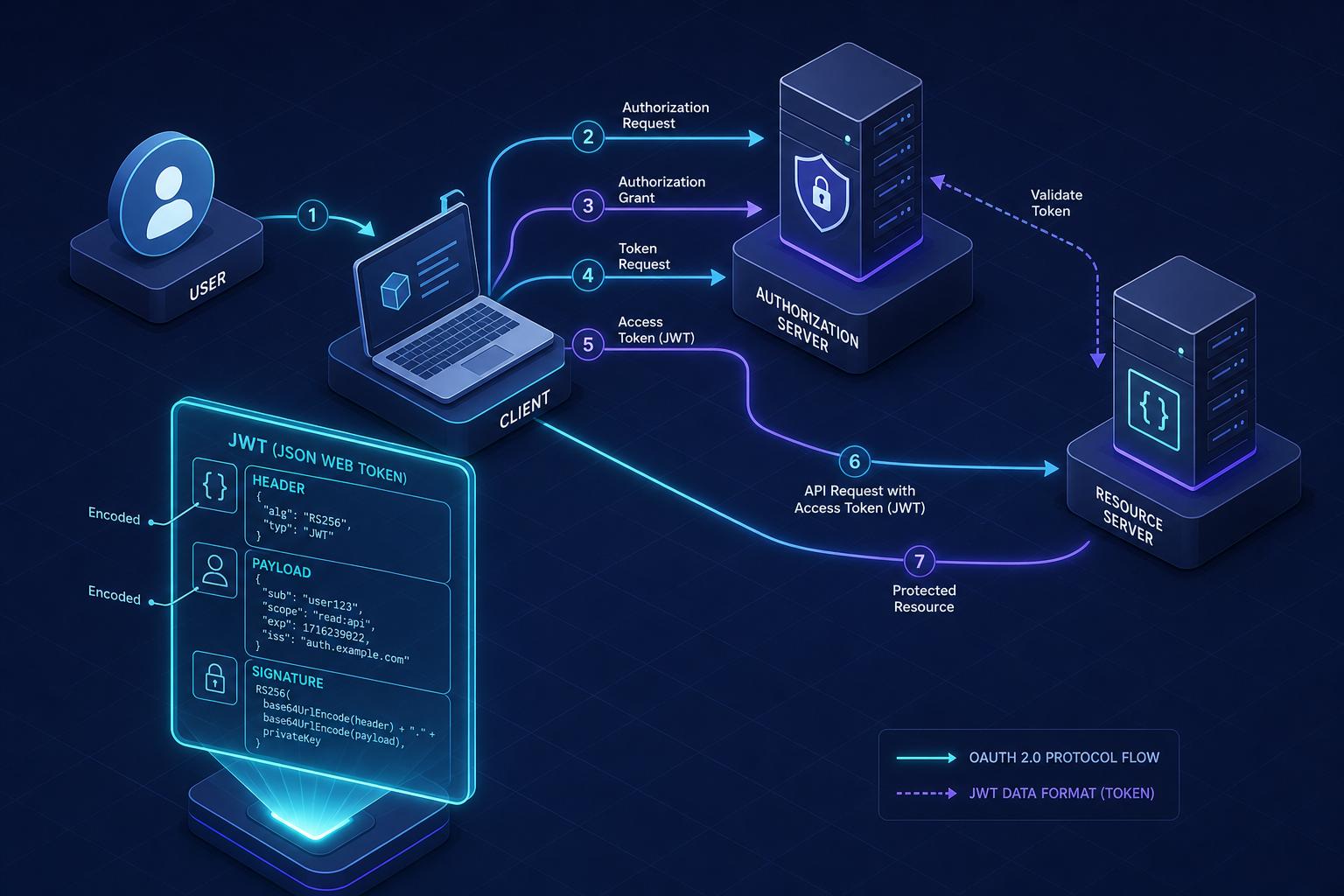
A JWT commonly contains three parts:
- Header: Describes information such as the token type and cryptographic algorithm.
- Payload: Contains claims such as a subject, issuer, expiration time, or application-specific information.
- Signature: Helps the receiving system verify that the token has not been modified and, depending on the algorithm and key management, that it was issued by a trusted party.
A simplified JWT structure looks like this:
header.payload.signatureJWT is a token format, not an authentication protocol by itself. It can be used in several security architectures, including as a format for OAuth access tokens.
OAuth vs JWT: The Key Difference
| Aspect | OAuth 2.0 | JWT |
|---|---|---|
| Type | Authorization framework | Token format |
| Primary purpose | Delegated authorization | Representing claims |
| Defines authorization flows | Yes | No |
| Defines token structure | No | Yes |
| Can use access tokens | Yes | Can represent an access token |
| Can be used together | Yes | Yes |
How OAuth Works
A simplified OAuth authorization flow generally works like this:
- The user starts an action that requires access to a protected resource.
- The client redirects or otherwise interacts with the authorization server.
- The user authenticates and provides authorization.
- The client obtains an authorization result, such as an authorization code.
- The client exchanges the authorization code for an access token.
- The client sends the access token when requesting protected resources.
- The resource server validates the token and determines whether the requested operation is permitted.
Modern OAuth implementations should follow current security best practices. For browser-based and public clients, PKCE is an important protection, and current OAuth security guidance requires authorization servers to support PKCE.
How JWT Authentication Works
A common JWT-based authentication architecture works differently.
- The user submits valid login credentials to the application's authentication service.
- The server verifies the credentials.
- The server creates a signed JWT containing appropriate claims.
- The client receives the token.
- The client presents the token when making protected API requests.
- The API validates the token and checks claims such as expiration, issuer, audience, and permissions.
For example, an API request may include a bearer token in the Authorization header:
Authorization: Bearer <access-token>The exact way tokens are issued, stored, validated, refreshed, and revoked is an application architecture decision and should be designed carefully.
Is OAuth Better Than JWT?
Not necessarily. This comparison is similar to comparing a security framework with a data format.
OAuth and JWT are not direct alternatives. OAuth defines how authorization can be delegated and how clients obtain access tokens. JWT defines one possible format for carrying claims.
An application can therefore use OAuth with JWT access tokens.
For example, an OAuth authorization server can issue a JWT-formatted access token that an API validates. OAuth defines the authorization process, while JWT provides the structure of the token.
OAuth With JWT
Combining OAuth and JWT can be useful in distributed systems and API-based architectures.
A typical architecture may contain:
- A frontend application
- An authorization server
- One or more APIs
- A resource server
- Short-lived access tokens
- Refresh-token mechanisms where appropriate
In this model, OAuth manages authorization while JWT may be used as the access-token representation.
Advantages of OAuth
Delegated Access
OAuth allows applications to request controlled access to resources without requiring the user to provide their password directly to the client application.
Scopes and Permissions
Access tokens can be restricted using scopes and other authorization attributes. This allows applications to request only the permissions they actually need.
Third-Party Integrations
OAuth is particularly useful when applications need to interact with external APIs or services on behalf of users.
Flexible Architecture
OAuth can support architectures involving separate authorization servers, resource servers, web applications, mobile applications, and APIs.
Advantages of JWT
Compact Format
JWTs are compact and suitable for transmitting claims through HTTP-based systems.
Self-Contained Claims
A signed JWT can contain information that the receiving service can validate without necessarily querying a central session store for every request.
API-Friendly
JWTs are commonly used in API architectures where services need a standardized way to receive and validate claims.
Cross-Service Communication
When correctly designed, signed tokens can make it easier for distributed services to validate identity and authorization information.
Security Considerations
Using OAuth or JWT does not automatically make an application secure. Security depends heavily on implementation choices.
Use HTTPS
Authentication and authorization traffic should be protected using secure transport. Tokens should not be transmitted over unencrypted connections.
Use Short-Lived Access Tokens
Short-lived access tokens reduce the amount of time an exposed token remains useful. Refresh mechanisms can be used where appropriate.
Limit Token Scope
Applications should avoid giving access tokens more permissions than necessary. Current OAuth security guidance recommends reducing token lifetime and limiting scopes where possible.
Protect Refresh Tokens
Refresh tokens can provide longer-term access and therefore require strong protection and appropriate rotation or revocation strategies.
Validate JWT Claims
APIs should validate the relevant JWT properties instead of simply decoding the payload and trusting its contents. Depending on the architecture, this can include signature, issuer, audience, expiration, and required scopes or claims.
Use PKCE for Appropriate OAuth Clients
PKCE helps protect OAuth authorization-code flows against authorization-code interception and related attacks. Current OAuth security guidance requires authorization servers to support PKCE.
OAuth vs JWT: When Should You Use Each?
Choose OAuth When:
- Your application needs delegated authorization.
- Users need to grant controlled access to external applications.
- You are integrating with third-party APIs.
- You need standardized authorization flows.
- Your system contains separate clients, authorization services, and APIs.
Use JWT When:
- You need a compact claims representation.
- Your API architecture benefits from signed tokens.
- Multiple services need to validate token claims.
- You need a standardized token format.
Use OAuth and JWT Together When:
- You need delegated authorization and JWT-formatted access tokens.
- Your application has multiple APIs or services.
- You are building a modern identity and authorization architecture.
- You need controlled access between clients and resource servers.
OAuth vs JWT for Web and Mobile Applications
For modern web applications, OAuth can be appropriate when authentication and authorization are managed by a dedicated identity platform. Browser-based applications should follow current OAuth security recommendations and carefully consider token handling and the authorization-code flow with PKCE.
For mobile applications, OAuth provides standardized authorization flows while JWT may be used as the format of an access token. Native applications should use platform-appropriate security mechanisms and avoid treating client-side application code as a place to keep confidential credentials.
Common Mistakes Developers Should Avoid
- Thinking OAuth and JWT are the same technology.
- Using JWT simply because it is popular without evaluating the application's requirements.
- Putting sensitive information into JWT payloads without understanding that signed JWT payloads are generally readable by the token holder.
- Using excessively long-lived access tokens.
- Failing to validate token expiration and other important claims.
- Using overly broad scopes or permissions.
- Implementing OAuth flows without appropriate protections such as PKCE.
- Storing tokens insecurely on clients.
- Assuming that a valid signature alone means an API request should automatically be authorized.
OAuth vs JWT: A Simple Way to Remember
A useful way to remember the difference is:
OAuth answers: “How can an application obtain authorized access?”
JWT answers: “How can claims be represented in a compact token format?”
They can work independently in some architectures, but they are frequently used together.
Conclusion
OAuth and JWT play different roles in modern application security. OAuth 2.0 provides an authorization framework for controlling delegated access, while JWT provides a standardized format for representing claims.
For simple applications, a carefully designed token-based authentication system may be sufficient. For applications requiring third-party integrations, delegated permissions, multiple clients, or complex API architectures, OAuth provides a more comprehensive authorization model.
In many modern architectures, the most practical approach is not choosing between OAuth and JWT, but understanding how they complement each other. OAuth can manage the authorization flow, while JWT can be used as one possible access-token format.
Ultimately, the right authentication architecture depends on your application's clients, APIs, security requirements, token lifecycle, authorization model, and operational needs.