.svg)
Platform Engineering vs DevOps: What’s the Difference in 2026?
Modern software teams need to deliver applications faster while maintaining reliability, security, scalability, and operational efficiency. DevOps has become a fundamental approach for achieving these goals. However, as organizations adopt cloud-native technologies, Kubernetes, microservices, and distributed architectures, development teams are also dealing with increasingly complex infrastructure.
This is where Platform Engineering comes into the picture.
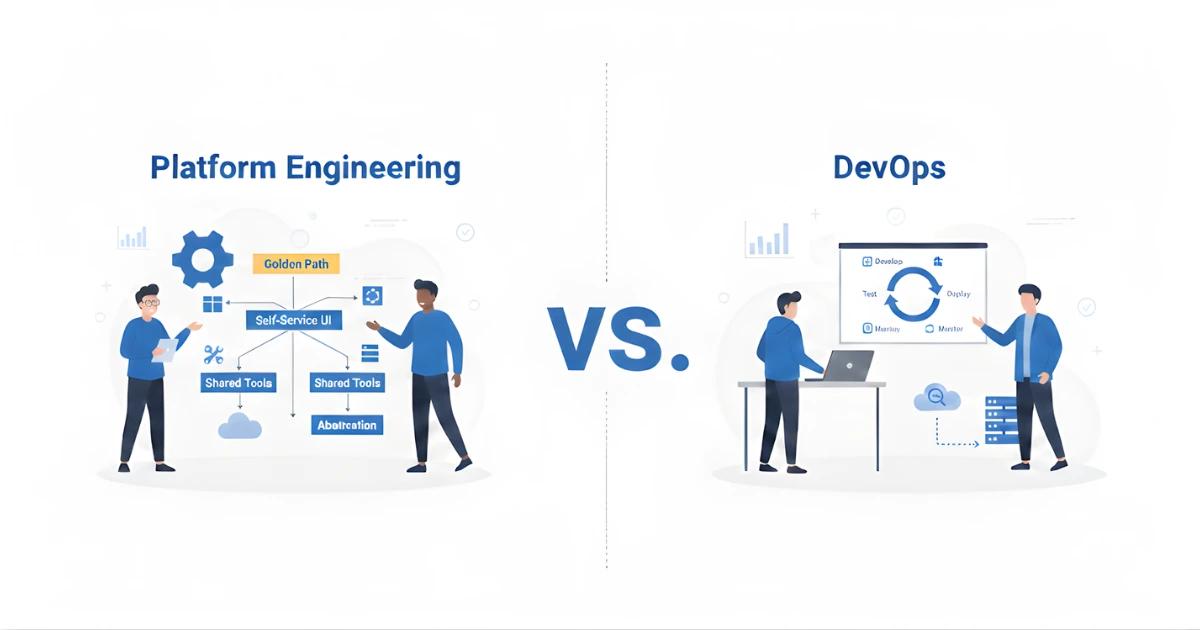
Platform Engineering and DevOps are closely connected, but they serve different purposes. DevOps focuses on collaboration, automation, continuous delivery, and shared responsibility between development and operations. Platform Engineering focuses on creating internal platforms that make these practices easier and more scalable for development teams.
In this article, we will compare Platform Engineering and DevOps, explore their differences, benefits, use cases, and explain how they can work together in modern software organizations.
What Is DevOps?
DevOps combines software development and IT operations practices to improve collaboration and accelerate the software delivery lifecycle.
Instead of keeping development and operations as separate functions, DevOps encourages teams to share responsibility for building, testing, deploying, monitoring, and maintaining applications.
Common DevOps practices include:
- Continuous Integration and Continuous Delivery (CI/CD)
- Infrastructure as Code
- Automated testing
- Cloud infrastructure automation
- Application monitoring
- Security automation
- Version control
- Automated deployments
The main objective of DevOps is to make software delivery faster, more reliable, and more efficient while reducing manual processes.
What Is Platform Engineering?
Platform Engineering focuses on designing, building, and maintaining internal platforms that provide developers with reusable tools, infrastructure services, automation, and self-service workflows.
Instead of requiring every development team to understand the details of cloud infrastructure, Kubernetes, networking, CI/CD, security, and monitoring, a platform team provides standardized capabilities that developers can consume more easily.
These capabilities are often delivered through an Internal Developer Platform (IDP).
An Internal Developer Platform may provide:
- Application templates
- Development environments
- CI/CD pipelines
- Cloud resource provisioning
- Secrets management
- Logging and monitoring
- Security policies
- Deployment workflows
- Service catalogs
- Developer portals
The goal is to give developers a self-service experience while maintaining organizational standards for security, reliability, governance, and infrastructure.
Platform Engineering vs DevOps: Key Differences
| Area | DevOps | Platform Engineering |
|---|---|---|
| Primary focus | Collaboration and software delivery | Internal developer platforms |
| Main goal | Faster and more reliable software delivery | Make development and deployment easier through self-service |
| Approach | Culture, practices, automation, and shared responsibility | Product-oriented engineering and platform automation |
| Main users | Development and operations teams | Application development teams |
| Infrastructure | Teams may interact directly with infrastructure | Platform abstracts much of the infrastructure complexity |
| Automation | CI/CD, testing, infrastructure, monitoring, and deployment | Self-service workflows, templates, and automated infrastructure |
| Developer experience | Improved through DevOps practices | A primary design objective |
DevOps Is More Than a Set of Tools
DevOps is not simply about using CI/CD tools or cloud services. It is also an engineering culture that encourages development and operations teams to work together.
A DevOps approach can include:
- Shared ownership
- Continuous integration
- Continuous delivery
- Infrastructure automation
- Automated testing
- Monitoring and observability
- Continuous feedback
- Faster incident response
These practices help organizations create a more efficient software delivery lifecycle.
Why Platform Engineering Is Becoming Important
As companies grow, the number of applications, environments, cloud resources, and development teams can increase significantly.
Without standardization, individual teams may create different solutions for similar problems. One team may use one deployment process while another uses a completely different approach.
This can lead to:
- Duplicated engineering work
- Inconsistent infrastructure
- Higher operational complexity
- Longer onboarding times
- Security inconsistencies
- Increased dependency on infrastructure specialists
Platform Engineering addresses these challenges by creating reusable and standardized internal capabilities.
How an Internal Developer Platform Works
An Internal Developer Platform acts as an abstraction layer between developers and underlying infrastructure.
For example, a developer may simply select an option such as Create Application.
The platform can then automatically:
- Create the application repository.
- Apply an approved project template.
- Provision required infrastructure.
- Configure CI/CD pipelines.
- Apply security policies.
- Enable monitoring and logging.
- Deploy the application to the required environment.
The developer does not necessarily need to understand every underlying infrastructure component to complete the process.
What Are Golden Paths?
A Golden Path is a recommended and supported way for developers to complete a common engineering task.
For example, a company could provide a standard template for creating a Node.js API.
The template could automatically include:
- Project structure
- Testing configuration
- CI/CD pipelines
- Container configuration
- Security scanning
- Monitoring
- Logging
- Deployment configuration
Developers can still choose alternative approaches when necessary, but the Golden Path provides a reliable default option.
Platform Engineering and Developer Experience
One of the biggest goals of Platform Engineering is improving Developer Experience (DevEx).
Modern developers may need to work with cloud platforms, containers, Kubernetes, databases, networking, security systems, deployment tools, monitoring platforms, and many other technologies.
Platform Engineering attempts to reduce this cognitive load by providing simple interfaces and reusable workflows.
Instead of learning how every infrastructure component works, developers can focus primarily on building and delivering business functionality.
Platform Engineering Does Not Replace DevOps
Platform Engineering should not be considered a replacement for DevOps.
Instead, Platform Engineering can help organizations scale DevOps practices across multiple teams.
For example:
DevOps: A team creates an automated deployment pipeline.
Platform Engineering: The platform team turns that deployment capability into a reusable self-service workflow that many development teams can use.
This relationship allows organizations to combine DevOps principles with standardized engineering platforms.
Benefits of Platform Engineering
1. Faster Developer Onboarding
New developers can use standardized templates and workflows instead of learning complex infrastructure configurations from scratch.
2. Improved Developer Productivity
Developers spend less time dealing with repetitive infrastructure tasks and more time building application features.
3. Greater Standardization
Organizations can establish consistent patterns for deployments, security, monitoring, and infrastructure.
4. Self-Service Infrastructure
Developers can request environments and infrastructure resources through predefined workflows without depending on manual intervention for every task.
5. Better Governance
Security and compliance requirements can be incorporated into platform templates and automated workflows.
6. Reusable Engineering Capabilities
Instead of every development team solving the same infrastructure problem independently, platform teams can build capabilities that can be reused across the organization.
When Should a Company Consider Platform Engineering?
Platform Engineering can be particularly valuable for organizations experiencing increasing engineering and infrastructure complexity.
It may be worth considering when:
- The organization has multiple development teams.
- Cloud infrastructure is becoming difficult to manage.
- Developers frequently depend on infrastructure teams.
- Teams use inconsistent deployment processes.
- Infrastructure configuration is repeatedly duplicated.
- Kubernetes or microservices introduce operational complexity.
- Security and compliance requirements need standardization.
- Developer onboarding takes too long.
When Is DevOps Enough?
For smaller teams with relatively simple applications and infrastructure, a dedicated Platform Engineering function may not be necessary.
In such situations, organizations can first focus on establishing strong DevOps practices such as:
- Git-based workflows
- Automated testing
- CI/CD
- Infrastructure as Code
- Monitoring
- Security automation
- Incident management
As the organization grows, these practices can gradually evolve into reusable platform capabilities.
Platform Engineering vs DevOps: Which Should You Choose?
| Business Situation | Recommended Approach |
|---|---|
| Small development team | Start with DevOps |
| Growing development organization | Strengthen DevOps and automation |
| Multiple development teams | Consider Platform Engineering |
| Complex cloud infrastructure | Use platform capabilities to reduce complexity |
| Large Kubernetes or microservices environment | Consider an Internal Developer Platform |
| High security and governance requirements | Standardize controls through platform engineering |
The Future of Platform Engineering
As cloud-native software development continues to evolve, organizations are looking for better ways to manage infrastructure complexity while maintaining developer productivity.
Platform Engineering addresses this challenge by combining automation, self-service capabilities, reusable workflows, standardization, and developer-focused tooling.
In 2026, the focus is increasingly moving beyond simply automating infrastructure toward creating an internal engineering experience that is easier, safer, and more consistent for developers.
Final Thoughts
Platform Engineering and DevOps are closely related, but they are not interchangeable.
DevOps focuses on collaboration, shared responsibility, automation, continuous delivery, and improving the software delivery lifecycle.
Platform Engineering focuses on building internal platforms that make these capabilities easier and more scalable for development teams.
For smaller organizations, strong DevOps practices may be enough. For larger engineering organizations dealing with multiple teams, Kubernetes, microservices, cloud complexity, and repetitive infrastructure tasks, Platform Engineering can provide a scalable solution.
The most effective strategy for many organizations is not choosing one over the other, but using Platform Engineering to scale and strengthen DevOps practices.