.svg)
Odoo vs SAP: Which ERP Is Right for Your Business in 2026?
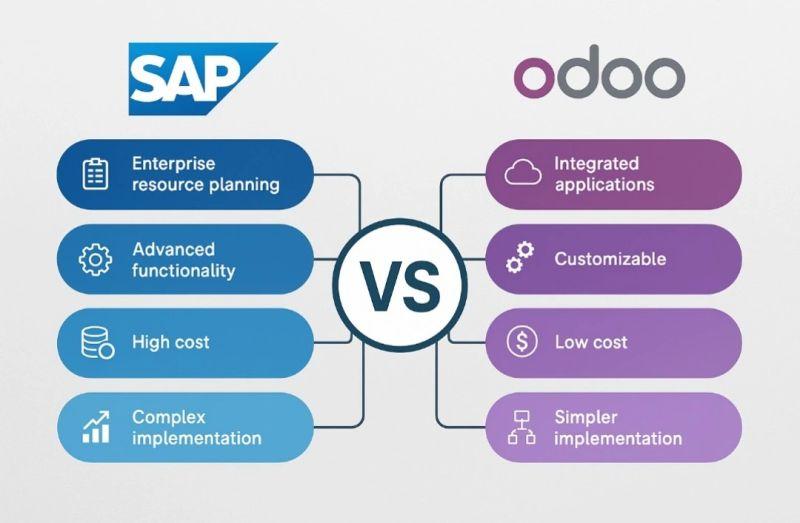
Choosing the right Enterprise Resource Planning (ERP) system is an important decision for any growing business. An ERP platform connects essential business operations such as finance, sales, purchasing, inventory, manufacturing, human resources, and customer management in one environment.
Two well-known ERP platforms are Odoo and SAP. Both can support complex business processes, but they are designed with different priorities, implementation approaches, levels of customization, and organizational needs.
In 2026, the question is not simply whether Odoo or SAP is the better ERP. The better question is: Which platform fits your company's size, processes, budget, technical requirements, and long-term growth strategy?
What Is Odoo?
Odoo is an open-source business application platform that brings multiple business functions together in an integrated ecosystem. Its applications cover areas such as CRM, eCommerce, accounting, inventory, point of sale, project management, sales, purchasing, and manufacturing.
Odoo is available in Community and Enterprise editions. Its modular architecture allows businesses to start with the applications they need and expand the system as their requirements grow.
Odoo also supports customization through its open-source ecosystem, Odoo Studio, Odoo.sh, integrations, and custom development.
What Is SAP?
SAP is a major enterprise software provider whose ERP portfolio includes SAP S/4HANA Cloud and related SAP Cloud ERP offerings.
SAP Cloud ERP is designed to support large-scale business operations across areas such as finance, supply chain, procurement, manufacturing, sales, asset management, and other enterprise processes.
SAP emphasizes standardized industry processes, real-time data, embedded analytics, automation, and AI-driven capabilities across its cloud ERP offerings.
Odoo vs SAP: At a Glance
| Category | Odoo | SAP |
|---|---|---|
| Primary positioning | Integrated business application platform | Enterprise-grade ERP platform |
| Target organizations | Small, midsize, and growing businesses, with scalability for larger organizations | Midmarket and large enterprises, especially organizations with complex processes |
| Architecture | Modular and highly customizable | Enterprise-focused with extensive configuration and industry capabilities |
| Open-source availability | Yes | No |
| Customization | Highly flexible | Highly configurable, with strong enterprise extensibility |
| Implementation | Often simpler for smaller and less complex deployments | Can require significant planning, consulting, and process transformation |
| Manufacturing | Strong integrated manufacturing capabilities | Advanced enterprise manufacturing and planning capabilities |
| Supply chain | Integrated inventory, purchasing, logistics, and related workflows | Extensive enterprise supply-chain capabilities |
| Business applications | Broad suite of integrated applications | Broad enterprise business suite |
| Best fit | Businesses prioritizing flexibility, integration, and accessible customization | Organizations requiring deep enterprise processes, scale, and industry capabilities |
Odoo vs SAP: Feature Comparison
1. Finance and Accounting
Both platforms provide comprehensive financial management capabilities, but their approaches can differ significantly.
Odoo integrates accounting with sales, purchasing, inventory, expenses, invoicing, and other business applications. This can provide a unified workflow for businesses that want financial information closely connected to day-to-day operations.
SAP Cloud ERP provides extensive financial capabilities including financial planning, accounting, financial close, accounts payable and receivable, treasury management, compliance, and risk management.
Best choice: Odoo can be attractive for businesses seeking integrated and flexible financial workflows, while SAP is particularly suited to organizations with complex financial structures, compliance requirements, and enterprise-scale processes.
2. CRM and Sales
Odoo provides CRM and sales applications that can be connected with quotations, orders, invoicing, inventory, marketing, and other applications.
SAP provides enterprise sales and customer-process capabilities as part of its broader business ecosystem.
Best choice: Odoo is often appealing when CRM and ERP processes need to be managed in a single, accessible platform. SAP becomes especially relevant when sales operations must integrate with complex enterprise processes and broader SAP landscapes.
3. Inventory and Supply Chain
Inventory management is an important part of both platforms.
Odoo provides integrated inventory and logistics functionality, including warehouse operations, replenishment, barcode workflows, traceability, and connections with purchasing and sales.
SAP Cloud ERP provides extensive supply-chain functionality covering inventory, warehouse management, transportation, order promising, material flows, and supply-chain analytics.
Best choice: Odoo can work very well for businesses looking for integrated inventory and warehouse management without unnecessary complexity. SAP is particularly powerful when supply-chain operations span complex facilities, processes, geographies, and enterprise planning requirements.
4. Manufacturing
Both Odoo and SAP support manufacturing operations.
Odoo's manufacturing functionality includes manufacturing orders, work orders, bills of materials, routing, planning, quality management, maintenance, traceability, barcode operations, and shop-floor workflows.
SAP provides extensive manufacturing capabilities covering production planning, production control, product engineering, quality management, demand forecasting, scheduling, and multiple manufacturing models.
Best choice: Odoo can be an excellent choice for businesses looking for integrated manufacturing functionality with a relatively accessible user experience. SAP can be a stronger fit for highly complex manufacturing environments with sophisticated planning, engineering, supply-chain, and enterprise requirements.
5. Customization and Flexibility
Customization is one of the areas where Odoo is particularly attractive.
Because Odoo has an open-source foundation and a large ecosystem of applications, businesses can extend workflows and create custom modules for specific requirements.
SAP also provides extensive configuration and extensibility options, but enterprise customization typically requires more structured architecture, governance, and specialist expertise.
Odoo advantage: Flexible customization and modular development.
SAP advantage: Strong enterprise governance, configuration, and extensibility for complex organizations.
6. Ease of Use
Odoo is designed around an integrated application experience where different business functions can share the same platform and data.
This can make it attractive for organizations that want employees to work across sales, inventory, accounting, purchasing, projects, and other applications without maintaining disconnected systems.
SAP provides powerful enterprise capabilities but can involve more complex processes and specialized configurations depending on the implementation.
Best choice: Odoo may be easier to adopt for many small and midsize organizations, while SAP can be appropriate when the organization needs sophisticated enterprise processes and is prepared for a more structured implementation.
7. Implementation
ERP implementation is not only about installing software. It involves business-process analysis, data migration, configuration, integrations, testing, training, security, and change management.
Odoo's modular structure can allow companies to start with selected applications and expand over time.
SAP implementations can involve substantial business-process transformation, particularly when the organization operates across multiple countries, business units, manufacturing facilities, or complex supply chains.
The actual implementation effort depends heavily on the organization's size, scope, integrations, customization, data quality, and business complexity.
8. Cost Considerations
ERP cost should not be evaluated only by looking at subscription prices.
The total cost of ownership can include:
- Software subscriptions
- Implementation services
- Customization and development
- Data migration
- Integrations
- Infrastructure or cloud services
- Training
- Support and maintenance
- Future upgrades
Odoo can be attractive to businesses that want a modular platform and the flexibility of an open-source ecosystem. SAP is often evaluated for larger enterprise environments where the value comes from deep functionality, scale, standardized processes, and integration across complex organizations.
Therefore, companies should compare total implementation and ownership costs rather than comparing license prices alone.
9. Scalability
Both Odoo and SAP can support growing organizations, but scalability should be evaluated in terms of more than the number of users.
Businesses should consider:
- Number of legal entities
- Countries and currencies
- Transaction volumes
- Number of warehouses
- Manufacturing complexity
- Supply-chain requirements
- Integration requirements
- Regulatory requirements
- Reporting and analytics
Odoo can scale as businesses add applications and workflows. SAP is particularly designed for organizations that need sophisticated enterprise-wide processes and large-scale operational integration.
10. AI and Automation in 2026
AI is becoming an increasingly important part of modern ERP platforms.
Odoo is incorporating AI capabilities into its business application ecosystem, while its open-source approach also provides opportunities for businesses and developers to create customized AI-powered workflows.
SAP Cloud ERP increasingly integrates AI into areas such as finance, manufacturing, supply chain, analytics, and business processes.
For example, SAP highlights AI-driven forecasting, automated finance processes, intelligent manufacturing, and AI-supported supply-chain decision-making in its current cloud ERP capabilities.
The important question for businesses is not simply whether an ERP has AI. Companies should evaluate whether the AI features solve real business problems and integrate naturally with their existing workflows.
Who Should Choose Odoo?
Odoo may be a strong option for businesses that:
- Want an integrated business platform
- Need flexible customization
- Prefer a modular ERP approach
- Want CRM, accounting, inventory, sales, and other applications in one ecosystem
- Need to start with a smaller implementation and expand over time
- Value open-source technology
- Want an ERP that can adapt to changing business processes
- Need a potentially more accessible ERP implementation for a small or midsize organization
Who Should Choose SAP?
SAP may be a strong option for organizations that:
- Operate at large enterprise scale
- Have complex financial structures
- Need sophisticated supply-chain processes
- Operate complex manufacturing environments
- Require extensive industry-specific capabilities
- Manage multiple countries, entities, or business units
- Need deep enterprise governance and standardized processes
- Already have significant investment in the SAP ecosystem
Odoo vs SAP: Which Is Better?
There is no universal winner.
Odoo may be the better choice when flexibility, modularity, integrated business applications, customization, and ease of adoption are major priorities.
SAP may be the better choice when enterprise-scale operations, complex processes, sophisticated supply-chain requirements, industry capabilities, and large-scale governance are the primary priorities.
| Business Requirement | Potentially Better Fit |
|---|---|
| Small or midsize business | Odoo |
| Highly customizable workflows | Odoo |
| Open-source flexibility | Odoo |
| Integrated CRM + ERP + eCommerce | Odoo |
| Large multinational enterprise | SAP |
| Highly complex enterprise processes | SAP |
| Advanced enterprise supply chain | SAP |
| Complex manufacturing environments | SAP |
| Existing SAP ecosystem | SAP |
How to Choose Between Odoo and SAP
Before selecting an ERP, businesses should evaluate their actual requirements rather than choosing a platform based only on brand recognition.
- Map your business processes. Identify how sales, purchasing, finance, inventory, manufacturing, HR, and customer operations work today.
- Identify pain points. Determine which manual processes, disconnected systems, and reporting problems the ERP needs to solve.
- Define your growth requirements. Consider future countries, branches, products, users, warehouses, and transaction volumes.
- Calculate total cost of ownership. Include implementation, customization, integrations, training, support, and upgrades.
- Evaluate integrations. Check whether the ERP can connect with your existing websites, payment systems, marketplaces, CRM tools, payroll systems, and other applications.
- Run real business scenarios. Test actual workflows rather than relying only on product demonstrations.
- Evaluate implementation partners. A good ERP implementation partner can have a major impact on project success.
Final Thoughts
Odoo and SAP represent two different approaches to enterprise software.
Odoo focuses on an integrated, modular, open-source business application ecosystem that can be adapted to many types of organizations. SAP focuses strongly on enterprise-grade processes, scale, industry capabilities, and complex business operations.
For a growing company looking for flexibility and an integrated platform, Odoo can be a compelling option. For a large organization managing highly complex operations and requiring extensive enterprise capabilities, SAP can be the stronger fit.
The right ERP is ultimately the one that aligns with your business processes, growth plans, budget, technical environment, and operational complexity.
Instead of asking "Odoo or SAP?", businesses should ask "Which ERP will help us run our business more effectively today and scale with us tomorrow?"