.svg)
Jest vs Vitest: Which Testing Framework Should You Choose?
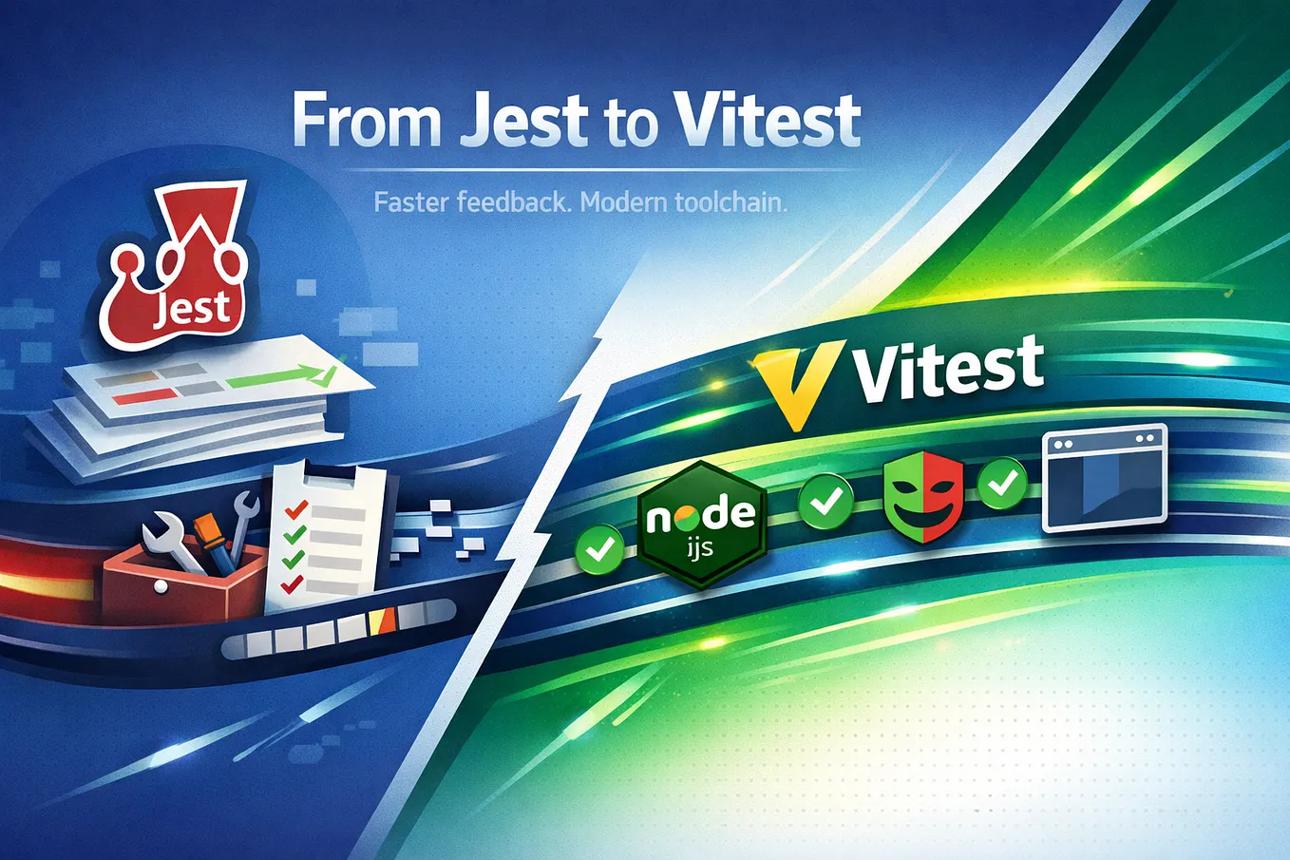
Jest vs Vitest: Which Testing Framework Should You Choose?
Testing is one of the foundations of reliable JavaScript and TypeScript applications. As frontend applications become more complex, teams need a testing framework that fits their build system, development workflow, component architecture, and CI pipeline.
For years, Jest has been one of the most established choices in the JavaScript ecosystem. It provides an integrated testing experience with assertions, mocking, snapshots, code coverage, and test isolation. Vitest takes a different approach: it was designed around the Vite ecosystem and provides a Jest-compatible testing API while reusing Vite's configuration, transformation, and plugin pipeline.
That makes the decision more nuanced than simply asking which tool is faster. The better question is: which testing architecture fits your project?
What Is Jest?
Jest is a JavaScript testing framework designed around simplicity and an integrated testing experience. It supports JavaScript projects as well as ecosystems involving TypeScript, React, Vue, Angular, Babel, and Node.js.
Jest provides many of the features teams expect from a modern testing framework in one environment, including test assertions, mocking, snapshots, test isolation, and code coverage. Its configuration model is designed to work with little setup for many projects.
For example, a business application might use Jest to test an order-calculation function before connecting that function to a larger React or Node.js application.
test('calculates the order total', () => {
  const total = calculateTotal(100, 20);
  expect(total).toBe(120);
});
This integrated approach is one of Jest's biggest strengths: developers can establish a familiar testing workflow without assembling many separate testing components.
What Is Vitest?
Vitest is a modern testing framework built with Vite in mind. Its major architectural advantage is that it can reuse Vite's configuration, plugins, module resolution, and transformation pipeline.
This becomes particularly useful for applications already using Vite. Instead of maintaining one transformation environment for development and another for testing, teams can align the two.
Vitest also provides a Jest-compatible API, including familiar concepts such as expect, snapshots, mocking, and test suites. Its documentation explicitly positions migration from Jest as a supported path, although compatibility is not perfect and some Jest-specific behavior requires changes.
Jest vs Vitest at a Glance
| Area | Jest | Vitest |
|---|---|---|
| Core approach | Standalone JavaScript testing framework | Vite-native testing framework |
| Configuration | Dedicated Jest configuration | Can reuse Vite configuration |
| Assertions | Built-in Jest assertions | Jest-compatible APIs with Chai support |
| Mocking | Built-in Jest mocking | Jest-compatible mocking through vi |
| Snapshots | Supported | Jest-compatible snapshots |
| Coverage | Built-in coverage workflow | V8 and Istanbul coverage support |
| TypeScript / JSX | Supported through project configuration | First-class support within the Vite-oriented workflow |
| Watch workflow | Powerful watch and test-selection features | Module-graph-aware watch mode similar to Vite's development experience |
| Best fit | Established ecosystems and highly customized Jest workflows | Vite-based modern web applications and teams wanting integrated tooling |
The Biggest Architectural Difference
The most important distinction is not the syntax of the tests. Both frameworks can provide familiar testing patterns.
The bigger difference is how the testing environment relates to the application build environment.
Consider a Vite application containing TypeScript, JSX, aliases, custom plugins, and environment-specific configuration.
With a Vite-native approach, the same ecosystem can participate in both development and testing. Vitest can use Vite's configuration, transformation, resolver, and plugin mechanisms. This reduces the need to recreate parts of the application's tooling specifically for tests.
Jest approaches the problem independently. That independence can be an advantage when a team wants a testing environment that is not tied to its application bundler, but it can also mean maintaining additional configuration when the application relies heavily on Vite-specific behavior.
Testing Experience and Developer Workflow
Imagine a developer changing a single utility function used by three components.
A productive testing workflow should quickly identify the tests related to that change rather than forcing the developer to think about the entire test suite every time.
Vitest's Vite-based architecture allows its watch mode to use the module graph and rerun tests related to changed modules. This creates a development experience that feels conceptually similar to Vite's HMR workflow.
Jest also provides intelligent test execution and watch functionality, including prioritizing previously failed tests and considering test execution time.
Therefore, both tools provide strong developer workflows. The difference is that Vitest's workflow is particularly aligned with the Vite development model.
Performance: Is Vitest Faster Than Jest?
This is one of the most common questions in the comparison, but a blanket statement that one framework is always faster is misleading.
Test performance depends on factors such as:
- Number and size of test files
- Module transformation
- Application architecture
- Mocking strategy
- DOM environment
- Database and network dependencies
- Worker configuration
- Coverage instrumentation
- CI machine resources
Vitest is designed around a fast, Vite-native development experience and uses parallel execution and intelligent test reruns. That can make a noticeable difference in development workflows, especially for Vite projects.
However, the correct way to compare performance for a production codebase is to benchmark the actual test suite rather than relying on a generic benchmark.
Mocking: Jest vs Vitest
Mocking is another area where the APIs look familiar but are not identical.
Jest uses the jest object for mocking and related functionality:
const sendEmail = jest.fn();

sendEmail('customer@example.com');

expect(sendEmail).toHaveBeenCalledWith(
  'customer@example.com'
);
Vitest provides comparable functionality through the vi object:
import { expect, vi, test } from 'vitest';

const sendEmail = vi.fn();

sendEmail('customer@example.com');

expect(sendEmail).toHaveBeenCalledWith(
  'customer@example.com'
);
This similarity makes many migrations straightforward, but it does not mean the frameworks are behaviorally identical. Vitest's migration documentation identifies differences involving globals, mock behavior, timers, configuration, and module mocking.
Snapshots and Code Coverage
Both frameworks support snapshot testing, making it possible to compare the output of components or other structured data against an expected snapshot.
Coverage is also supported by both ecosystems. Jest provides coverage as part of its testing workflow, while Vitest supports coverage through providers such as V8 and Istanbul.
For a React application, for example, a team could combine unit tests, component tests, snapshots where appropriate, and coverage reporting in its CI pipeline.
The important consideration is not simply whether the framework supports coverage. Teams should define meaningful coverage policies around business-critical behavior instead of treating a high percentage as proof that an application is fully tested.
TypeScript, JSX, and Modern Frontend Projects
Modern frontend projects frequently combine TypeScript, JSX or TSX, CSS tooling, module aliases, environment variables, and framework-specific plugins.
Vitest is particularly attractive when these projects already use Vite because it can participate in the same tooling ecosystem.
For example, a frontend team building a dashboard with TypeScript and React might already rely on Vite plugins and aliases. Keeping development and test transformations aligned can simplify the project architecture.
Jest remains a strong option when an application already has a mature Jest configuration, extensive custom tooling, or dependencies built around Jest-specific APIs.
What About React and Component Testing?
Neither Jest nor Vitest should be viewed as the entire component-testing strategy.
A React project may combine a test runner with a component-testing library and a browser-like environment such as jsdom. The test runner executes and coordinates the tests, while other tools provide rendering and interaction capabilities.
Vitest supports component testing for React, Vue, Svelte, Lit, Marko, and other ecosystems, as well as browser-mode testing. This makes it a strong candidate for modern frontend projects that want a unified Vite-oriented environment.
Migrating from Jest to Vitest
One reason Vitest is attractive to existing Jest users is its compatibility with familiar Jest-style APIs.
A simple test can often move from:
import { jest } from '@jest/globals';

const calculate = jest.fn();
to a Vitest equivalent:
import { vi } from 'vitest';

const calculate = vi.fn();
But a production migration should not be treated as a simple global search-and-replace.
Teams should audit:
- Jest configuration
- Custom transformers
- Jest plugins and reporters
- Module mocking
- Global test APIs
- Fake timers
- Snapshot serializers
- Environment configuration
- Coverage configuration
- CI commands
Vitest provides a migration path, but its own documentation notes that compatibility is not complete. For example, global APIs are configured differently, and certain mocking and timer behaviors differ.
When Jest Is the Better Choice
Jest can be the better decision when:
- Your existing application already has a mature Jest test suite.
- Your organization depends on Jest-specific integrations.
- Your team uses custom Jest transformers, reporters, or serializers.
- Your testing infrastructure has been stable for years and provides little business value to rewrite.
- You need a testing environment that remains independent of Vite.
- Your team already has strong Jest expertise and established CI practices.
There is rarely a good engineering reason to migrate a stable, well-maintained test suite simply because another framework is newer.
When Vitest Is the Better Choice
Vitest becomes particularly compelling when:
- You are starting a new Vite-based application.
- Your development environment already depends heavily on Vite.
- You want development and testing to share configuration and transformations.
- You want a Jest-compatible testing API without adopting Jest as a separate tooling layer.
- Fast feedback during development is a major priority.
- Your team is building modern TypeScript and component-based applications.
For a new Vite-powered application, choosing Vitest can reduce tooling duplication and create a more cohesive development environment.
Should You Use Jest and Vitest Together?
Technically, teams can maintain multiple testing tools, but that should be an intentional decision.
Running two test frameworks may make sense during a gradual migration or when different parts of a large organization have genuinely different requirements.
For a single application, however, maintaining two testing ecosystems can increase configuration complexity, developer learning costs, CI maintenance, and debugging effort.
A better strategy is usually to select one primary test runner and introduce another only when there is a measurable technical reason.
Jest vs Vitest: The Real Decision
The decision can be simplified into a few practical questions.
- Already using Jest successfully? Keep it unless there is a measurable reason to change.
- Starting a Vite project? Vitest is a natural option because it integrates directly with Vite.
- Need extensive Jest-specific integrations? Jest may remain the safer choice.
- Want a Vite-native development and testing workflow? Vitest is worth serious consideration.
- Considering migration? Benchmark the real test suite and audit Jest-specific dependencies first.
How Code-Ox Approaches Testing
At Code-Ox, testing is not treated as an isolated development activity. The testing strategy should match the architecture, business risk, release process, and technology stack of the application.
For a customer-facing React or Next.js application, that can mean combining unit tests for business logic, component tests for important user interactions, integration tests for APIs, and automated checks in CI.
For example, an e-commerce workflow might test price calculations independently, validate checkout components at the UI level, verify API behavior through integration tests, and run critical regression tests before deployment.
The choice between Jest and Vitest should therefore come after understanding the application's architecture rather than being decided solely by popularity or benchmark claims.
Final Verdict
Jest and Vitest are both capable testing frameworks, but they optimize for different development environments.
Jest offers an established, integrated testing ecosystem with a large installed base and extensive configuration possibilities. It remains an excellent choice for existing applications and teams with mature Jest-based workflows.
Vitest brings a Vite-native architecture, Jest-compatible APIs, modern TypeScript and JSX support, smart watch behavior, and the ability to reuse Vite's configuration and transformation pipeline.
For a new Vite-based application, Vitest is often the more natural starting point. For a stable application already deeply invested in Jest, migration should be justified by measurable benefits rather than trend alone.
The best testing framework is not necessarily the newest or fastest one—it is the one that gives your team reliable tests, fast feedback, maintainable tooling, and a workflow that fits the application.
Sources
Technical details in this article are based on the official Jest documentation and official Vitest documentation, including Vitest's feature and Jest migration guides.