.svg)
Kafka vs Redis Streams: Choosing the Right Event Streaming Platform
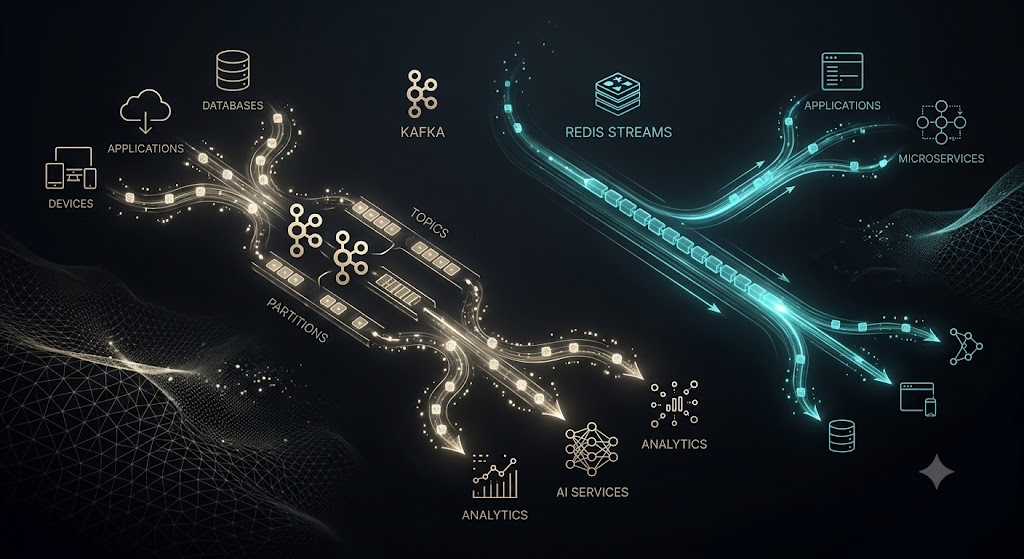
Kafka vs Redis Streams: Choosing the Right Event Streaming Platform
Modern applications increasingly depend on asynchronous communication. Orders generate events, payments trigger workflows, IoT devices continuously send telemetry, and AI systems consume streams of information in real time. As these workloads grow, choosing the right event-streaming technology becomes an architectural decision rather than simply a framework preference.
Apache Kafka and Redis Streams are two popular technologies for building event-driven systems, but they are designed around different strengths. Kafka is a distributed event-streaming platform built for durable, scalable streams and high-throughput data pipelines. Redis Streams is a data structure within Redis that provides append-only streams, consumer groups, message acknowledgment, and other capabilities for building lightweight event-driven workflows.
The right choice depends on the volume of events, retention requirements, operational complexity, latency expectations, existing infrastructure, and how your application needs to consume and replay data.
What Is Apache Kafka?
Apache Kafka is a distributed event-streaming platform designed to publish, store, process, and consume streams of events. Applications write events to Kafka topics, where the events are stored and can later be consumed by one or more consumer applications.
For example, consider an e-commerce platform. When a customer places an order, the application could publish an order.created event. Separate consumers could then process inventory updates, payment workflows, notifications, analytics, and shipping without tightly coupling all of those services to the original order-processing request.
Kafka's architecture is particularly useful when events need to remain available for later consumption or replay.
What Are Redis Streams?
Redis Streams is a Redis data structure designed for handling ordered sequences of messages. Applications can append entries to a stream and consumers can process those entries individually or through consumer groups.
Imagine a customer-support platform where incoming requests are placed into a stream. Multiple workers can consume the stream using a consumer group, allowing the application to distribute processing across workers while tracking which messages have been acknowledged.
Redis Streams can be particularly attractive when Redis is already part of the application's infrastructure and the event workload does not justify introducing a separate distributed streaming platform.
Kafka vs Redis Streams: The Core Difference
The biggest architectural distinction is that Kafka is a dedicated distributed event-streaming platform, while Redis Streams is one capability within the broader Redis data platform.
Kafka is commonly selected when event streams themselves are an important part of the architecture: large-scale ingestion, durable event histories, replayable data pipelines, and independent consumers are central requirements.
Redis Streams is often a strong fit when an application already relies on Redis and needs fast stream processing, worker coordination, or event-driven workflows without adding another major infrastructure component.
Architecture and Data Model
Kafka organizes events into topics and partitions. Partitions allow a topic to be distributed across brokers and provide the basis for parallel consumption and horizontal scaling.
Redis Streams stores entries inside streams. Consumer groups allow multiple consumers to divide work and acknowledge processed entries.
The difference becomes important at scale. A system processing a very large event history across many independent consumers may benefit from Kafka's partitioned distributed architecture. A transactional application that already uses Redis for caching, sessions, queues, or real-time features may find Redis Streams simpler to integrate.
Message Retention and Replay
Retention is one of Kafka's strongest architectural characteristics. Kafka can retain events for a configured period or according to storage policies, allowing consumers to read historical events again.
This is valuable in situations such as analytics pipelines. Suppose a company introduces a new fraud-detection service. If historical transaction events are still retained in Kafka, the new service can consume those events without requiring the original applications to regenerate them.
Redis Streams also supports persistent stream entries and controlled trimming. However, the appropriate retention strategy depends heavily on Redis memory and persistence architecture and the application's overall data lifecycle.
Consumer Groups
Both Kafka and Redis Streams support consumer-group patterns, but they implement them within different architectures.
In Kafka, consumer groups allow partitions to be distributed among consumers. Adding consumers can increase parallel processing when enough partitions are available.
Redis Streams consumer groups allow multiple consumers to cooperate on processing stream entries. Redis also maintains pending-entry information so applications can identify messages that have been delivered but not yet acknowledged.
For a background-processing system such as image processing, report generation, or notification delivery, either technology may work well. The decision depends more on scale and surrounding architecture than on the existence of consumer groups alone.
Throughput and Latency
Neither Kafka nor Redis Streams should be selected based on a simplistic claim that one is always faster.
Kafka is engineered for high-throughput distributed event streaming and can scale by distributing partitions across brokers and consumers. Redis operates primarily as an in-memory data platform, which can provide very low-latency operations when the workload fits its architecture.
Actual performance depends on message size, persistence settings, replication, network topology, consumer behavior, partitioning, Redis memory configuration, workload patterns, and application-level processing.
For example, a small order-processing application may see little practical benefit from adopting Kafka simply because Kafka can support enormous throughput. Conversely, a telemetry platform ingesting events from thousands of devices may eventually outgrow a Redis-based design if its retention, replay, scaling, and pipeline requirements become substantial.
Scalability
Kafka is designed around distributed scaling. Topics can be divided into partitions and distributed across brokers, allowing producers and consumers to work in parallel.
Redis can also scale through replication, clustering, and other deployment architectures, but Redis Streams remains part of the Redis ecosystem rather than a dedicated distributed event-log system.
This distinction matters when designing a platform that expects event volume, consumer count, retention requirements, or geographical distribution to grow significantly over time.
Operational Complexity
Kafka introduces additional infrastructure considerations because it is a distributed streaming platform. Teams need to think about brokers, partitions, replication, consumer groups, retention, monitoring, capacity planning, and failure recovery.
Redis Streams can be operationally simpler when Redis is already deployed for other application functions.
Consider a SaaS application that already uses Redis for caching, rate limiting, sessions, and real-time features. Adding a stream for background jobs may be straightforward. Introducing Kafka solely for a small stream-processing requirement could increase operational overhead without providing enough architectural value.
When Kafka Is the Better Choice
Kafka is generally worth considering when your system requires:
- Large-scale event ingestion
- Longer-lived event retention
- Event replay and historical consumption
- Many independent consumers
- Distributed data pipelines
- High-throughput event processing
- Strong partition-based scaling
- Integration with analytics, data engineering, or stream-processing ecosystems
A logistics company, for example, may receive continuous shipment, vehicle, warehouse, and delivery events. Different teams may need the same events for operations dashboards, alerts, analytics, forecasting, and customer notifications. Kafka can provide a durable central event stream that multiple downstream systems consume independently.
When Redis Streams Is the Better Choice
Redis Streams can be a strong option when your application needs:
- Low-latency stream processing
- Simple event-driven workflows
- Background worker coordination
- Consumer groups
- Fast integration with an existing Redis deployment
- Real-time application workflows
- A smaller operational footprint
For example, an appointment platform could use Redis Streams to distribute booking-related tasks among workers. One worker could send confirmation notifications, another could update internal systems, and another could trigger an analytics event.
Kafka vs Redis Streams: Comparison
| Area | Kafka | Redis Streams |
|---|---|---|
| Primary role | Distributed event-streaming platform | Stream data structure within Redis |
| Architecture | Distributed brokers and partitions | Redis-based stream architecture |
| Retention | Designed for durable event retention and replay | Supports persistence and stream trimming |
| Consumer groups | Yes | Yes |
| Large event pipelines | Excellent fit | Depends on workload and architecture |
| Operational footprint | Higher | Often simpler when Redis already exists |
| Existing Redis environment | Requires separate infrastructure | Natural integration |
| Event replay | Core architectural strength | Supported within stream retention limits |
How to Choose for a Real Application
Start with the business requirement rather than the technology name.
If the application primarily needs a fast mechanism for distributing background work and Redis is already deployed, Redis Streams may provide everything required.
If the application is becoming an event backbone for multiple services, needs durable historical streams, or feeds analytics and data-processing systems, Kafka deserves serious consideration.
A useful architecture decision might look like this:
- Small SaaS workflow: Redis Streams can often be sufficient.
- Real-time worker coordination: Redis Streams is a practical option.
- Large event-driven architecture: Kafka is usually a stronger candidate.
- Analytics and data pipelines: Kafka is often better suited.
- Existing Redis-heavy application: Start by evaluating Redis Streams.
- Multiple independent consumers and replay requirements: Evaluate Kafka first.
Can Kafka and Redis Streams Be Used Together?
Yes. Choosing Kafka does not mean Redis has to disappear from the architecture.
A system might use Kafka as the durable event backbone while Redis handles low-latency caching, session data, rate limiting, real-time application state, or specialized stream-processing workloads.
For example, an AI-powered customer-support platform could publish customer interaction events to Kafka for analytics and long-term processing while using Redis for short-lived conversation state and fast application access.
The key is to assign each technology a clear responsibility rather than introducing both without an architectural reason.
Kafka vs Redis Streams for AI and Modern Applications
AI applications increasingly process continuous streams of information: customer conversations, application telemetry, document-processing events, model requests, user activity, and operational signals.
Kafka can provide the durable event layer behind large AI data pipelines, while Redis Streams can support lower-latency workflows around AI services.
For example, a recruitment platform could publish candidate-processing events to Kafka while Redis coordinates short-lived AI processing tasks between application workers. The architecture can therefore separate durable event history from fast operational state.
Where Code-Ox Fits
Choosing Kafka or Redis Streams is only one part of designing an event-driven application. The surrounding architecture determines whether the technology actually delivers business value.
At Code-Ox, event-driven architectures can be integrated into custom web applications, AI platforms, dashboards, ERP workflows, and automation systems. The implementation can include API design, background workers, database integration, Redis infrastructure, Kafka-based event pipelines, monitoring, authentication, and deployment architecture.
For a growing business, the goal should not be to introduce Kafka or Redis Streams simply because they are popular technologies. The better approach is to identify where asynchronous processing, event replay, workload isolation, or real-time processing will improve the actual business workflow.
Final Verdict
Kafka and Redis Streams can both power reliable event-driven applications, but they solve different architectural problems.
Choose Kafka when durable event streaming, replayability, high-throughput distributed pipelines, and many independent consumers are central to the system.
Choose Redis Streams when you need lightweight, low-latency stream processing and already have Redis as part of your application infrastructure.
For many smaller applications, Redis Streams can be the simpler starting point. As event volume, retention, consumer diversity, and data-pipeline requirements grow, Kafka may become the more appropriate event backbone.
The best choice is not the technology with the biggest feature list. It is the one that matches your workload, operational capacity, and long-term architecture.
Build the Right Event-Driven Architecture
Whether your application needs Kafka, Redis Streams, or a combination of both, architecture should be driven by measurable requirements rather than technology trends.
Code-Ox helps businesses design and build scalable web applications, AI systems, integrations, automation workflows, and data-driven platforms around the technologies that fit their real operational needs.