.svg)
Modular Monolith vs Microservices: Which Architecture Should You Choose?
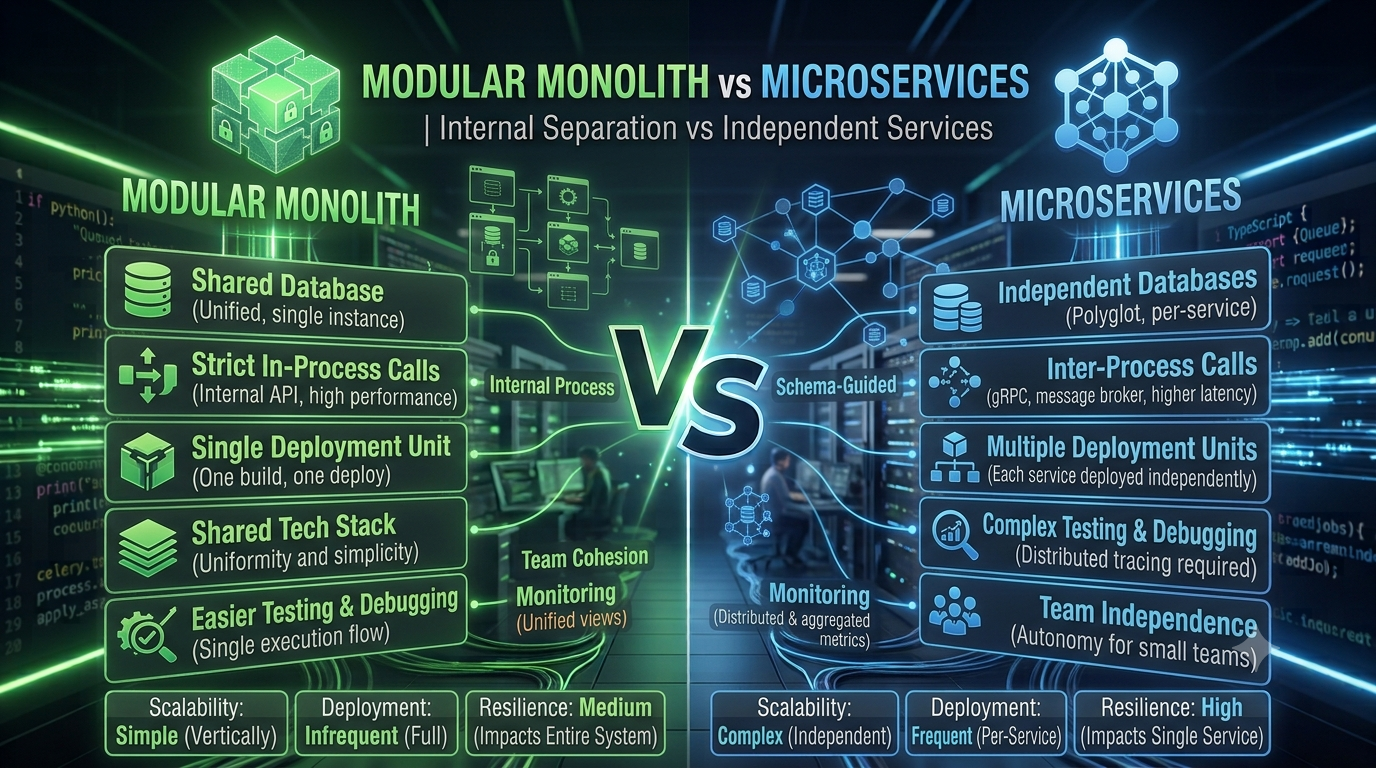
Choosing an application architecture is one of the most consequential decisions in software development. It affects how teams build features, deploy releases, scale infrastructure, troubleshoot failures, and maintain the system over time.
Two approaches frequently appear in architecture discussions: the modular monolith and microservices.
Microservices are often presented as the natural choice for scalable applications, while monoliths are sometimes treated as an outdated architecture. In reality, the decision is more nuanced. A well-structured modular monolith can provide strong boundaries, simpler operations, and faster development without introducing the distributed-system complexity of microservices.
The right question is therefore not "Which architecture is more modern?" but "Which architecture fits our application's complexity, team structure, scaling requirements, and business goals?"
Modular Monolith vs Microservices at a Glance
| Aspect | Modular Monolith | Microservices |
|---|---|---|
| Deployment | Typically deployed as one application | Services can be deployed independently |
| Codebase | One application with clearly separated modules | Multiple independently developed services |
| Communication | Usually in-process calls | Network calls, messaging, or APIs |
| Scaling | Typically scales the application as a unit | Individual services can be scaled independently |
| Operational complexity | Lower | Higher |
| Data management | Can use shared infrastructure with strong module boundaries | Often favors service-owned data and distributed data management |
| Best fit | Growing applications with manageable domain complexity | Large systems with strong service boundaries and independent scaling or deployment needs |
What Is a Modular Monolith?
A modular monolith is a single deployable application that is internally divided into well-defined modules.
The important word is modular. A modular monolith is not simply a large codebase where everything can access everything else.
A properly designed modular monolith establishes boundaries between business capabilities such as:
- Users and identity
- Sales
- Orders
- Payments
- Inventory
- Reporting
- Notifications
These modules can have defined responsibilities and interfaces while still running inside the same application process.
Example: An E-Commerce Platform
Imagine an e-commerce application with modules for customers, catalog, orders, payments, inventory, and shipping.
In a modular monolith, these areas can remain logically separated while sharing the same deployment and infrastructure.
An order module might interact with the inventory module through a defined application interface rather than allowing arbitrary database access throughout the codebase.
This provides architectural discipline without immediately introducing distributed services.
What Are Microservices?
A microservices architecture decomposes an application into multiple independently deployable services, with each service responsible for a particular business capability or bounded context.
A typical platform might contain separate services for:
- Authentication
- Product catalog
- Order management
- Payments
- Notifications
- Search
- Analytics
Services communicate through APIs, messaging systems, or other network protocols. Depending on the architecture, services may also own their data independently.
Example: A High-Scale Marketplace
Consider a marketplace where product search receives millions of requests while the payment system has very different scaling, security, and reliability requirements.
Separating these capabilities can allow the search service to scale independently from payment processing.
This independence is one of the major advantages of microservices, but it comes with additional infrastructure and operational responsibility.
The Core Difference: Deployment and Boundaries
The biggest practical distinction is not simply the number of modules or repositories. It is the degree of independence between components.
In a modular monolith, modules share the same application runtime and deployment lifecycle.
In microservices, services are designed to be independently deployable and communicate across process or network boundaries.
That boundary creates both freedom and complexity.
A local function call is replaced by a network interaction. A transaction across modules may become a distributed workflow. A local failure may become a timeout. Debugging may require tracing a request across multiple services.
Development Speed: Modular Monolith vs Microservices
For many small and medium-sized teams, a modular monolith can make development significantly simpler.
Developers can work within one application, use familiar debugging tools, run the system locally with fewer dependencies, and make changes across modules without coordinating multiple service deployments.
Microservices can provide stronger independence, but that independence requires additional engineering.
Teams may need service discovery, API contracts, centralized logging, distributed tracing, container orchestration, deployment pipelines, secrets management, monitoring, retries, timeouts, and failure-handling strategies.
If those capabilities are not actually required, introducing them can slow development instead of improving it.
Scaling: When Microservices Have an Advantage
One of the strongest arguments for microservices is independent scaling.
Suppose an application has five major components, but one component receives ten times more traffic than the others.
With microservices, that service can potentially be scaled independently rather than scaling the entire application.
This becomes particularly useful when different parts of a system have substantially different resource requirements.
However, independent scaling is valuable only when there is a real scaling boundary. If every module experiences similar traffic and resource consumption, the additional complexity may not provide enough benefit.
Deployment Independence
A modular monolith usually has a shared deployment lifecycle. A change to one module can require deploying the application as a whole.
Microservices allow teams to deploy individual services independently when the architecture and delivery pipelines are designed for it.
For large engineering organizations, this can be a major advantage.
Imagine a company where the notification team needs to release an improvement several times a week while the accounting service is subject to stricter release controls. Independent services can allow those teams to move at different speeds.
Data and Transactions
Database architecture is one of the areas where the difference becomes particularly important.
A modular monolith can often use a common database while enforcing logical ownership and access boundaries between modules.
Microservices frequently encourage each service to own its data. This can reduce coupling but makes cross-service consistency and transactions more complicated.
Consider an order that requires inventory reservation and payment authorization. In a monolithic architecture, these operations may be coordinated within a simpler transactional model.
In a distributed architecture, the workflow may require events, compensating actions, retries, idempotency, and careful failure handling.
Microservices do not automatically make data architecture better. They make service ownership more explicit, while also making distributed consistency a design concern.
Reliability and Failure Handling
A modular monolith has fewer network boundaries, which means fewer network-related failure modes.
In a microservices architecture, one user request may travel through several services. Any dependency can introduce latency, timeout, partial failure, or unavailable downstream services.
Production microservices therefore require deliberate resilience patterns such as:
- Timeouts
- Retries with appropriate backoff
- Circuit breakers where appropriate
- Idempotent operations
- Dead-letter handling for asynchronous workflows
- Distributed tracing
- Health checks and observability
These patterns are powerful, but they are additional architectural responsibilities.
Testing and Debugging
Modular monoliths generally provide a simpler environment for end-to-end testing because the application can often be executed as one system.
Microservices require testing not only individual services but also their contracts and interactions.
A bug may originate in one service but only appear when another service receives an unexpected response or when a message is delayed or processed more than once.
This makes contract testing, integration testing, observability, and realistic staging environments increasingly important as the number of services grows.
Team Structure Matters
Architecture should reflect how an organization actually works.
A small team of five developers may not benefit from operating twenty independently deployed services.
A large organization with multiple teams working independently on different business capabilities may gain significant value from service boundaries.
This is one reason microservices are often associated with organizational scalability as much as technical scalability.
When a Modular Monolith Is the Better Choice
A modular monolith is often a strong choice when:
- The product is still evolving rapidly.
- The engineering team is relatively small.
- The domain boundaries are not fully understood yet.
- Most components scale similarly.
- Operational simplicity is important.
- Fast feature delivery matters more than independent service deployment.
- The application does not yet require distributed infrastructure.
It can also be an excellent foundation for future decomposition. Strong module boundaries make it easier to identify which components might eventually become independent services.
When Microservices Make More Sense
Microservices become more attractive when there are clear reasons for independent services.
- Different business capabilities need independent scaling.
- Multiple teams need independent deployment ownership.
- Parts of the platform have different reliability or security requirements.
- Services need different technology stacks for legitimate reasons.
- Independent release cycles provide significant business value.
- The organization already has strong DevOps and observability capabilities.
The key is that these should be actual requirements, not assumptions about what a modern application should look like.
Microservices Are Not Automatically More Scalable
Microservices can enable independent scaling, but simply splitting an application into services does not guarantee better performance.
Poor service boundaries can increase network traffic, duplicate data, create excessive coordination, and introduce bottlenecks between services.
A well-designed monolith can scale very effectively. Architecture should therefore be evaluated against actual traffic patterns, workloads, and bottlenecks rather than architectural fashion.
A Practical Decision Framework
Before choosing an architecture, ask these questions:
- Do different parts of the application genuinely need independent deployment?
- Do different workloads require independent scaling?
- Are the business boundaries clear enough to define service ownership?
- Does the team have the operational capability to manage distributed systems?
- Will service boundaries reduce coupling or simply move complexity into APIs and infrastructure?
- Could a modular monolith solve the current requirements more simply?
If most answers point toward simplicity, a modular monolith may be the better starting point. If there are strong requirements for independent deployment, scaling, ownership, or isolation, microservices may provide meaningful advantages.
A Hybrid Path: Start Modular, Split When Necessary
Architecture does not have to be a permanent decision made on day one.
A practical strategy is to begin with a modular monolith, establish strong domain boundaries, monitor the system, and extract services when there is a measurable reason to do so.
For example, an application may begin with modules for orders, payments, notifications, and reporting. If notification processing later becomes resource-intensive and needs an independent deployment cycle, it can be considered for extraction into a dedicated service.
This approach avoids paying the operational cost of microservices before the business actually needs them.
How Code-Ox Approaches Application Architecture
At Code-Ox Technologies LLP, application architecture is selected according to the product's business requirements, expected growth, integrations, data flows, and operational needs.
Depending on the project, a solution may use a modular monolith, microservices, APIs, event-driven components, cloud infrastructure, databases, dashboards, or custom integrations.
The objective is not to make an application unnecessarily complex. It is to create an architecture that can support today's requirements while providing a practical path for future growth.
For businesses developing custom web applications, ERP extensions, AI-powered systems, dashboards, or integrated platforms, this architectural decision can have a significant impact on long-term development and operating costs.
Final Verdict: Modular Monolith or Microservices?
A modular monolith is not a compromise. For many applications, it is the most practical architecture for achieving strong code boundaries, rapid development, and operational simplicity.
Microservices are valuable when independent deployment, scaling, ownership, isolation, or organizational boundaries justify distributed architecture.
The best architecture is not the one with the most services. It is the one that gives your team the right balance between development speed, scalability, reliability, operational complexity, and long-term maintainability.