.svg)
REST API vs GraphQL: Which API Architecture Fits Your Application?
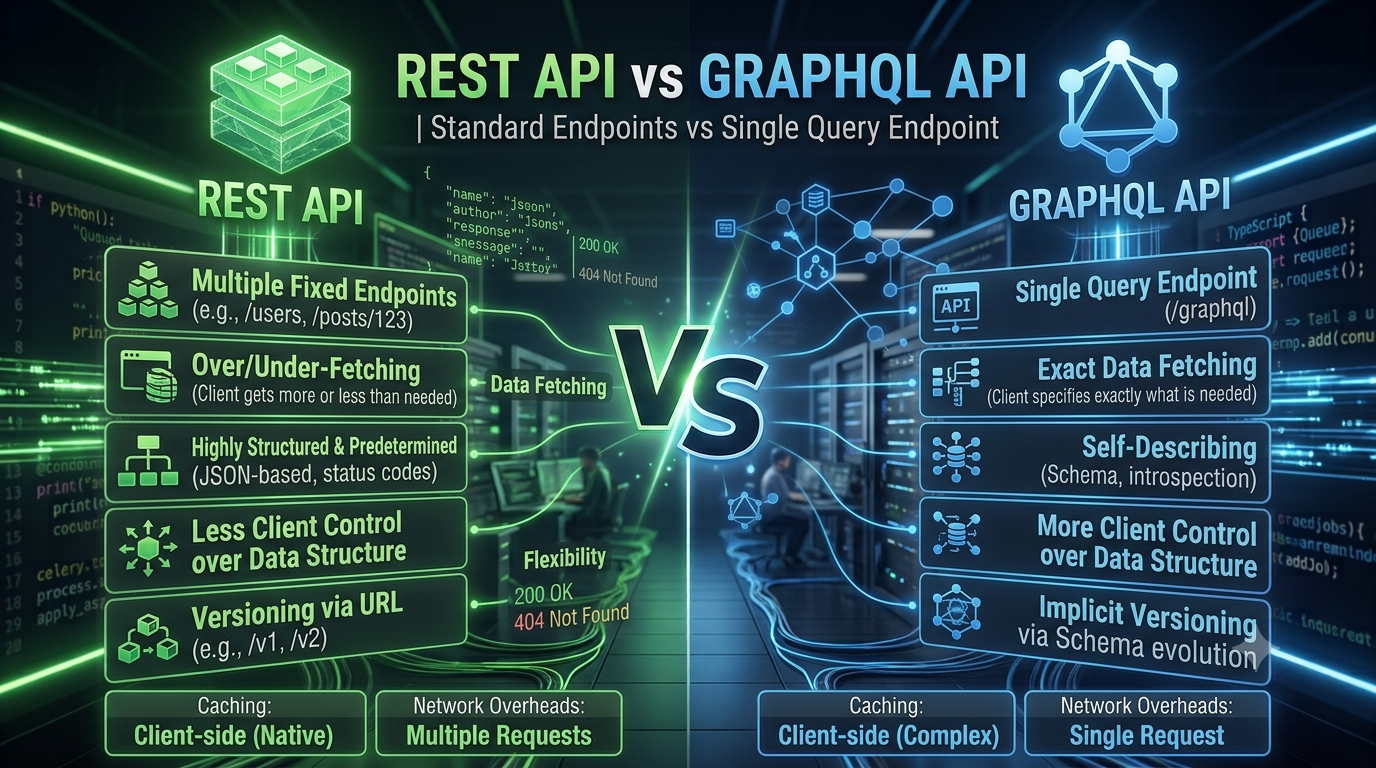
REST API vs GraphQL: Which API Architecture Fits Your Application?
Choosing an API architecture is not simply a matter of deciding which technology is more modern. The right choice depends on how your application exposes data, how clients consume that data, how frequently requirements change, and how much control your backend needs over requests.
REST has remained one of the most widely adopted approaches for building web APIs, while GraphQL introduced a different model where clients can describe the data they need through a single query language.
For a simple business application, REST may provide everything required. For applications with complex data relationships, multiple client types, or rapidly changing interfaces, GraphQL can offer a different level of flexibility.
The important question is therefore not simply “REST or GraphQL?” but rather:
“Which API architecture fits the way this application actually works?”
REST API vs GraphQL at a Glance
| Area | REST | GraphQL |
|---|---|---|
| API model | Resource-based endpoints | Query-based API |
| Data fetching | Defined by endpoints | Client specifies requested fields |
| Endpoints | Usually multiple endpoints | Often centered around a single endpoint |
| Over-fetching | Can occur depending on endpoint design | Usually reduced because clients request specific fields |
| Under-fetching | May require multiple requests | Related data can often be requested in one query |
| Caching | Works naturally with HTTP caching | Usually requires more deliberate caching strategies |
| Learning curve | Generally straightforward | Higher due to schema and query concepts |
| Best suited for | Resource-oriented business APIs | Complex and flexible data requirements |
What Is a REST API?
REST, or Representational State Transfer, is an architectural style commonly used to expose application resources through HTTP.
A typical REST API might expose resources such as:
/customers/orders/products/invoices
HTTP methods communicate the intended operation. For example:
- GET retrieves information.
- POST creates a resource.
- PUT/PATCH updates a resource.
- DELETE removes a resource.
This resource-oriented structure makes REST particularly comfortable for conventional business applications.
Imagine an e-commerce application where the frontend needs a customer's recent orders. A REST implementation might provide a customer endpoint and a separate orders endpoint, depending on how the API is designed.
The simplicity of this model is one of REST's biggest strengths.
What Is GraphQL?
GraphQL is a query language for APIs and a runtime for executing those queries against a defined schema.
Instead of creating separate endpoints for every representation of a resource, a GraphQL API exposes a schema describing the available data and relationships.
A client can then request exactly the fields it needs.
For example, a frontend could request a customer together with selected order information:
{
  customer(id: "123") {
    name
    email
    orders {
      id
      total
      status
    }
  }
}
The server resolves that query and returns data matching the requested structure.
This approach can be particularly useful when different clients require different views of the same underlying data.
The Fundamental Difference: Who Controls the Response?
The most important distinction between REST and GraphQL is how the response structure is determined.
With REST, the endpoint generally determines the representation returned to the client.
With GraphQL, the client describes the fields it wants, while the server controls which fields and relationships are available through the schema.
Consider a product page.
A desktop application might need:
- Product name
- Description
- Pricing
- Inventory
- Reviews
- Related products
A mobile application may only need the product name, thumbnail, price, and availability.
With REST, you might create specialized endpoints or accept that one endpoint returns more information than every client needs.
With GraphQL, both clients can query the same schema while requesting different fields.
Over-Fetching and Under-Fetching
One of GraphQL's strongest selling points is its ability to address common data-fetching problems.
Over-Fetching
Over-fetching occurs when an API returns more data than the client actually needs.
For example, a mobile application may need only a customer's name and profile image, while a REST endpoint returns dozens of additional fields.
GraphQL allows the client to request only the required fields.
Under-Fetching
Under-fetching happens when one API request does not provide enough information to render a screen, forcing the client to make additional requests.
Imagine a dashboard requiring:
- User information
- Recent orders
- Account balance
- Notifications
A REST implementation may require several API calls depending on the endpoint design.
GraphQL can potentially represent these related requirements within a single query.
However, this does not automatically mean that GraphQL is faster. The backend still has to resolve every requested field, and poorly designed resolvers can introduce significant performance problems.
REST Endpoints vs GraphQL Schema
REST organizes an API around resources and URLs.
GraphQL organizes the API around a typed schema and the relationships between data.
That difference becomes increasingly important as applications grow.
A REST API might evolve into endpoints such as:
/customers/customers/{id}/customers/{id}/orders/orders/{id}/orders/{id}/items
A GraphQL schema can instead model these relationships explicitly and allow clients to traverse them through queries.
This can make complex data requirements easier to represent, although schema design becomes an important engineering responsibility.
Versioning: REST vs GraphQL
REST APIs commonly use explicit versioning strategies.
For example:
/api/v1/products
/api/v2/products
Another approach is to evolve endpoints while maintaining backward compatibility.
GraphQL generally approaches API evolution differently. Instead of creating an entirely new version of the schema, fields can be deprecated while new fields are introduced.
This can reduce the need for large version transitions, but it does not eliminate the need for disciplined API governance.
Performance: Which One Is Faster?
There is no universal answer.
API performance depends on considerably more than whether the API uses REST or GraphQL.
Important factors include:
- Database query efficiency
- Indexing
- Network latency
- Payload size
- Caching
- Connection management
- Backend architecture
- Resolver implementation
- Concurrency
GraphQL can reduce unnecessary data transfer, but a complex query can also create expensive backend operations.
REST can be extremely efficient when endpoints are carefully designed and responses are cacheable.
The architecture should therefore be benchmarked using the application's actual workload instead of assuming one technology is inherently faster.
Caching Considerations
REST benefits naturally from the HTTP ecosystem. Standard HTTP caching mechanisms can be used with appropriately designed GET requests.
GraphQL introduces a different caching model because many requests may be sent to the same endpoint while requesting different data.
GraphQL applications can still implement effective caching, but teams often need more deliberate strategies involving client caching, persisted queries, response caching, or server-side data loaders.
If your application depends heavily on straightforward HTTP caching, REST may provide a simpler architecture.
Security: REST vs GraphQL
Both architectures can be secured effectively, but GraphQL introduces additional considerations.
A REST API can apply authorization rules at the endpoint and resource level.
GraphQL requires careful authorization around fields and relationships because a single query can traverse multiple parts of the schema.
GraphQL APIs should also consider:
- Query depth limits
- Query complexity limits
- Rate limiting
- Authentication
- Field-level authorization
- Input validation
- Introspection policies where appropriate
The flexibility of GraphQL is powerful, but unrestricted query flexibility can become a security and performance concern.
REST for Business Applications
REST is often an excellent choice for conventional business applications where resources and workflows are clearly defined.
Consider a business management system containing:
- Customers
- Products
- Sales orders
- Invoices
- Payments
- Employees
Each resource already maps naturally to API endpoints.
For an internal ERP integration, mobile application, or partner-facing API, a well-designed REST API can provide a predictable contract that is easy for different development teams to understand.
GraphQL for Complex Frontends
GraphQL becomes particularly attractive when the frontend has complex data requirements.
Imagine a SaaS platform with separate web, mobile, and tablet applications. Each interface may need a different combination of customer, subscription, billing, usage, and notification data.
Instead of building a growing collection of specialized REST endpoints, a GraphQL schema can provide a common data layer from which each client requests the fields it requires.
This can reduce frontend coupling to backend response structures.
When REST Is the Better Choice
REST is often the stronger option when:
- Your data maps naturally to resources.
- Your API is relatively straightforward.
- HTTP caching is important.
- You need a simple public API.
- Your team wants minimal infrastructure complexity.
- Different consumers can work with predictable endpoint responses.
- Your integrations are primarily CRUD and business-process oriented.
For many business applications, REST remains a highly practical architecture rather than an outdated one.
When GraphQL Is the Better Choice
GraphQL can be a strong fit when:
- Clients need significantly different data representations.
- The application has deeply related data.
- Frontend requirements change frequently.
- Multiple clients consume the same backend.
- Reducing unnecessary payloads is important.
- The frontend needs to compose data from multiple relationships.
- A typed schema is valuable for development workflows.
GraphQL is particularly compelling when the API acts as a flexible data layer for several sophisticated client applications.
Can REST and GraphQL Be Used Together?
Yes.
Choosing GraphQL does not necessarily mean replacing every REST service in an existing architecture.
A company might continue using REST for external integrations while introducing GraphQL as a frontend-facing aggregation layer.
For example:
Web / Mobile Clients
          |
       GraphQL
          |
   -----------------
   |       |       |
 REST    REST    Services
 API     API     / Database
In this architecture, GraphQL can act as a unified interface while existing backend services remain largely unchanged.
This approach can be useful when modernizing an existing platform without rewriting every backend service.
Common Mistakes When Choosing an API Architecture
Choosing GraphQL Just Because It Is Newer
GraphQL introduces flexibility, but that flexibility also adds schema management, resolver design, query complexity, caching considerations, and operational requirements.
Assuming REST Cannot Handle Complex Applications
A well-designed REST architecture can support large-scale applications. Complexity does not automatically require GraphQL.
Ignoring Backend Query Costs
GraphQL can make it easy for clients to request deeply nested data. Without proper controls and efficient data loading, those queries can become expensive.
Designing REST Endpoints Around Screens
Creating a separate endpoint for every frontend screen can produce an API that becomes difficult to maintain. REST APIs should still be designed around meaningful resources and business operations.
How to Choose Between REST and GraphQL
Instead of asking which technology is better, evaluate the application against a few practical questions:
- How complex are the relationships between your data?
- How many different clients will consume the API?
- Do clients frequently require different fields?
- How important is conventional HTTP caching?
- How much API infrastructure can your team comfortably maintain?
- Will external partners consume the API?
- How complex are your authorization requirements?
- Do you already have REST services that could be reused?
If your application is resource-oriented and predictable, REST is often the simpler and more maintainable answer.
If your application requires flexible data composition across multiple sophisticated clients, GraphQL may provide a better fit.
How Code-Ox Approaches API Architecture
At Code-Ox Technologies LLP, API architecture is treated as part of the application's overall system design rather than as an isolated development decision.
For a business application, the right approach may involve REST APIs for straightforward integrations, GraphQL for complex client-facing data requirements, or a hybrid architecture that connects existing services through a unified API layer.
Our custom web application development and integration work focuses on building APIs around real business workflows, data relationships, security requirements, scalability, and the needs of the applications consuming them.
The objective is not to use the most fashionable API technology. It is to create an API layer that remains reliable and maintainable as the application grows.
Final Verdict: REST or GraphQL?
REST is usually the better choice for simplicity, predictable resource-oriented APIs, conventional integrations, and straightforward HTTP caching.
GraphQL is often the better choice when multiple clients need flexible views of complex, interconnected data.
Neither architecture is universally superior.
A small business application with customers, products, orders, and invoices may have little reason to introduce GraphQL. A large SaaS platform with web, mobile, and third-party clients may benefit significantly from a flexible GraphQL data layer.
The best API architecture is ultimately the one that matches your application's data model, client requirements, team capabilities, and long-term growth strategy.