.svg)
Microservices Architecture: From Monolithic Applications to Scalable, Independently Deployable Systems
Reported By
Muhammed Mishal
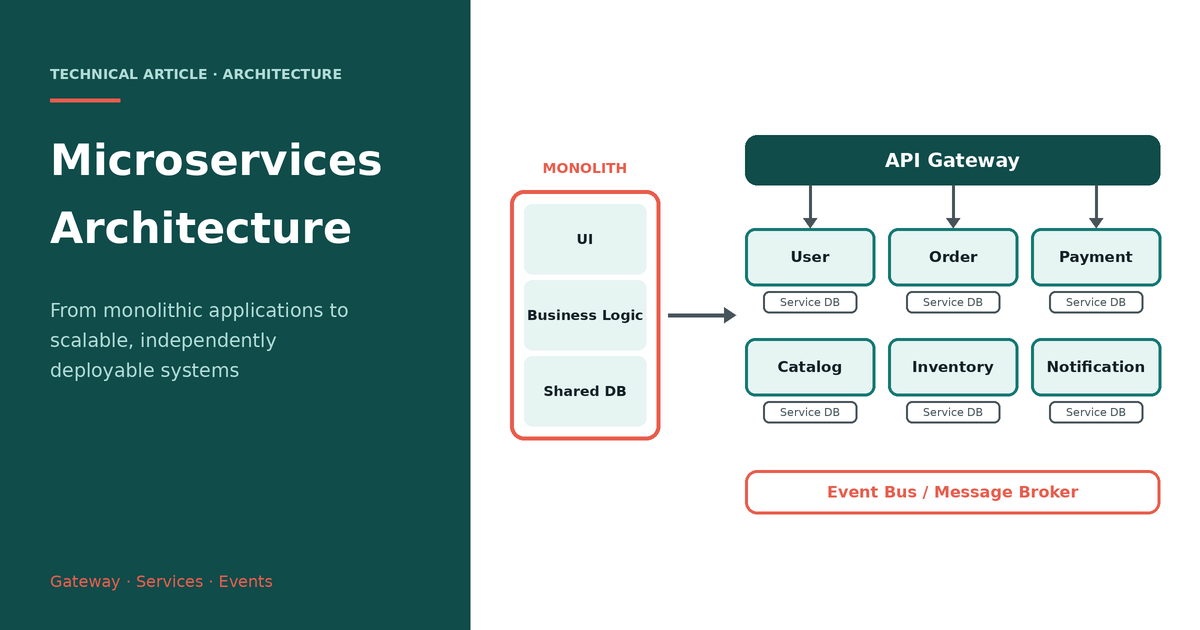
From Monolithic Applications to Scalable, Independently Deployable Systems
A practical technical article for developers, architects, and engineering teams
The Big Picture
Microservices architecture is a way of designing software as a collection of small, focused, independently deployable services. Instead of placing every business capability inside one large application, the system is divided around meaningful business responsibilities such as users, orders, payments, inventory, search, or notifications. Each service exposes a clear contract and hides its internal implementation from the other parts of the platform.
The important idea is not simply to create many backend applications. The real architectural change is the creation of clear ownership boundaries. A service should own a meaningful capability, its business rules, and normally the data required to support that capability. Services then collaborate through APIs or asynchronous events. Modern architecture guidance similarly emphasizes independent deployment, well-defined APIs, and service-owned state.

Why Microservices Became Important
A monolithic application is often an excellent starting point. It is relatively easy to run, debug, test, and deploy because the application exists as one major unit. Problems appear when the product grows. Different business areas start changing at different speeds, one module requires more computing capacity than another, deployment becomes risky, and a growing development team begins stepping on the same codebase.
Microservices address these pressures by allowing a business capability to evolve separately. A payment service can be deployed without rebuilding the inventory service. A high-traffic catalog service can be scaled without creating the same number of additional payment instances. Teams can also take clearer ownership of individual services. The trade-off is that the application becomes a distributed system, so networking, failures, consistency, monitoring, and deployment must now be designed explicitly.
Monolith and Microservices: The Architectural Shift
The difference becomes easiest to understand visually. In a traditional monolith, user interface code, business logic, and multiple business modules usually belong to one deployable application and commonly interact with a shared database. In a microservices system, those capabilities are separated into independently deployable services. Each service can own a database or another clearly controlled persistence boundary.

This does not mean that every function deserves its own service. Excessive fragmentation creates the opposite problem: too many deployments, too many network calls, and too much coordination. The objective is to find boundaries that represent stable business capabilities and allow meaningful independent change.
How a Microservices System Is Structured
A production system commonly starts at a web application, mobile application, or external client. Requests enter through an edge layer, often an API gateway or load balancer. The gateway provides a stable external entry point while backend services can change internally. It can also participate in authentication enforcement, routing, rate limiting, TLS termination, request transformation, and other cross-cutting concerns. Microsoft describes the API gateway as a centralized entry point for interactions between clients and application services.

Behind the gateway are the domain services. An e-commerce platform, for example, may contain customer, catalog, cart, order, payment, inventory, delivery, and notification capabilities. The exact boundaries depend on the business domain. The strongest designs avoid exposing internal database structures and instead communicate through stable interfaces.
Service Boundaries Are More Important Than Service Count
The hardest microservices decision is deciding where one service should end and another should begin. A useful boundary keeps related business rules together. If order validation, order state transitions, and order-specific business rules are constantly spread across five services, the system becomes difficult to understand. On the other hand, if orders, payments, inventory, and notifications are all placed in one giant service, the team has simply recreated a monolith under a different name.
Domain-driven design is often useful here because it encourages teams to identify business capabilities and bounded contexts before deciding the technical service structure. The question should be, "Which business capability needs independent ownership?" rather than, "How many APIs can we create?"
How Services Communicate
Microservices communicate mainly through synchronous requests or asynchronous messages. Synchronous HTTP or gRPC communication is appropriate when a caller needs an immediate result. For example, an Order service may synchronously ask an Inventory service whether a product can be reserved.
Asynchronous communication is different. Instead of waiting for another service to complete, a service publishes an event to a message broker. Other services consume that event when they are ready. This approach reduces direct coupling and is especially useful for notifications, analytics, integration workflows, and other operations that do not need to block the original request.

The asynchronous approach introduces eventual consistency. A user may place an order before every downstream service has finished processing it. That is not necessarily a problem, but the product and engineering teams must explicitly define the states an order can occupy and what happens when one of the downstream steps fails.
Data Ownership and the Database-per-Service Idea
One of the most important rules in microservices is data ownership. A service should normally control the data that belongs to its business capability. Other services should access that information through an API or event rather than directly updating another service's tables.
This does not require every service to use a completely different database product. A team may use the same database technology across multiple services while maintaining logical ownership and access boundaries. The key objective is to avoid a situation where every service can freely modify every table. That kind of shared ownership recreates tight coupling and makes independent deployment difficult.
Distributed transactions are also more difficult than transactions inside a single application. For workflows spanning multiple services, patterns such as Saga, transactional outbox, idempotent consumers, retries, and compensating actions can be used to maintain business consistency.
Security in a Microservices Environment
Security must exist at multiple layers. The gateway can validate authentication tokens and apply coarse-grained policies, but individual services must still enforce authorization for the resources they own. A service should never assume that a request is safe merely because it came through the gateway.
Production systems should protect credentials and secrets, validate incoming data, use encrypted communication where appropriate, apply rate limits to public interfaces, and maintain clear service identities. Security becomes more important as the number of network boundaries increases because every additional communication path becomes part of the system's attack surface.
Resilience: Designing for Failure
A function call inside a monolith normally fails in the same process. In microservices, the same operation may cross several networks and independent processes. A service can be healthy while its dependency is unavailable, slow, or returning errors. Therefore, failure is a normal architectural condition rather than an exceptional situation.
Timeouts prevent an unavailable dependency from holding resources indefinitely. Retries can recover from transient failures, but they should be bounded and use backoff so that an unhealthy service is not overwhelmed. Circuit breakers can temporarily stop calls to a failing dependency, while bulkheads isolate resources so that one workload cannot consume everything available to the service.
Idempotency is equally important. If a payment request is retried because the network failed, the system should be able to recognize the repeated operation and avoid charging the customer twice. These small design decisions are what make a distributed system reliable in practice.
Observability Is Not Optional
With many services, a single user action may travel through the gateway, authentication layer, order service, payment service, message broker, inventory service, and notification service. Looking at one service's log file is no longer enough to understand the complete request.
A mature platform therefore combines structured centralized logs, metrics, distributed tracing, health checks, and actionable alerts. Correlation IDs allow engineers to follow a request across services. Metrics reveal latency, traffic, error rates, and resource saturation. Distributed traces show where time is being spent and which dependency is causing a slowdown.

Testing a Distributed System
Testing microservices requires more than unit tests. Unit tests remain important for business rules, but services also need integration tests for databases and external dependencies, API tests for public contracts, and contract tests to ensure that producers and consumers agree on the shape and meaning of requests and events.
Critical customer journeys should also be tested end to end. Performance testing is necessary for high-volume services, while resilience testing should simulate timeouts, dependency failures, duplicate messages, and partial outages. The purpose is not to prove that failure never occurs; it is to verify that the system behaves predictably when failure does occur.
CI/CD and Independent Deployment
Independent deployment is one of the major reasons organizations adopt microservices. Each service should have a repeatable pipeline that builds the code, executes automated tests, performs security checks, packages the service, deploys it, verifies health, and supports rollback when necessary.
Containers are frequently used to package services consistently across environments. Orchestration platforms can then handle scheduling, scaling, service discovery, health checks, and rolling deployments. Deployment strategies such as canary and blue-green releases can reduce production risk by limiting the number of users exposed to a new version.
The Hidden Cost of Microservices
Microservices do not remove complexity; they move complexity from code organization into system coordination. Instead of one application process, the team now operates many processes. Instead of a local function call, it may have a network request. Instead of one transaction, it may have a distributed workflow. Instead of one log stream, it needs centralized observability.
This means microservices can be a poor choice for a small product, a small team, or a system whose domain has not yet stabilized. A modular monolith can provide strong separation of responsibilities while remaining operationally simple. Services can later be extracted when there is a clear scaling, deployment, organizational, or reliability reason.
A Practical Order Processing Example
Imagine an online marketplace where a customer places an order. The request first reaches the API gateway and is routed to the Order service. The Order service validates the request and creates an order in its own data store. It then publishes an OrderCreated event.
The Payment service consumes the event and performs the payment workflow. The Inventory service reserves the required items, while the Notification service prepares an email or push notification. These services do not need to execute as one large transaction. They maintain their own state and communicate through well-defined contracts.
If payment fails, the order can move to a payment-failed state. If inventory cannot be reserved after payment succeeds, the system may trigger a compensating payment action or send the order for manual review, depending on the business rules. The architecture therefore makes failure handling an explicit part of the workflow instead of hiding it inside a single large transaction.
When Should You Choose Microservices?
Microservices are a strong fit when a product contains clear business boundaries, multiple development teams, different scaling requirements, frequent independent releases, or workloads that need strong isolation. They are also useful when certain capabilities must evolve at a different pace from the rest of the platform.
They are not automatically the best architecture. If the application is small, the team is small, deployment is simple, and the domain is still changing rapidly, a well-structured modular monolith may be more economical. Architecture should follow the problem rather than the trend.
Final Takeaway
Microservices architecture is ultimately about controlled independence. The goal is to give teams and business capabilities enough separation to change, deploy, scale, and recover without requiring the entire platform to move as one unit. The strongest systems combine clear service boundaries with disciplined APIs, owned data, asynchronous events where appropriate, resilient communication, strong security, automated delivery, and deep observability.
The most successful microservices platform is therefore not the one with the largest number of services. It is the one where each service has a clear reason to exist, a clear owner, a clear contract, and a clear operational story.
Reference Notes
For the architecture discussion, current general architecture guidance was consulted, including Microsoft Azure's microservices and API gateway documentation.