.svg)
Event-Driven Architecture: From Request-Driven Systems to Loosely Coupled, Reactive Platforms
Reported By
Nakhul Krishna
From Request-Driven Systems to Loosely Coupled, Reactive Platforms
The Big Picture
Event-driven architecture (EDA) is a way of designing software around events—records that describe something that happened. Instead of forcing every downstream operation to finish inside one synchronous request, a service can publish an event and allow independent consumers to react. The key idea is loose coupling: the producer publishes a business fact without needing to know every consumer.
How It Works
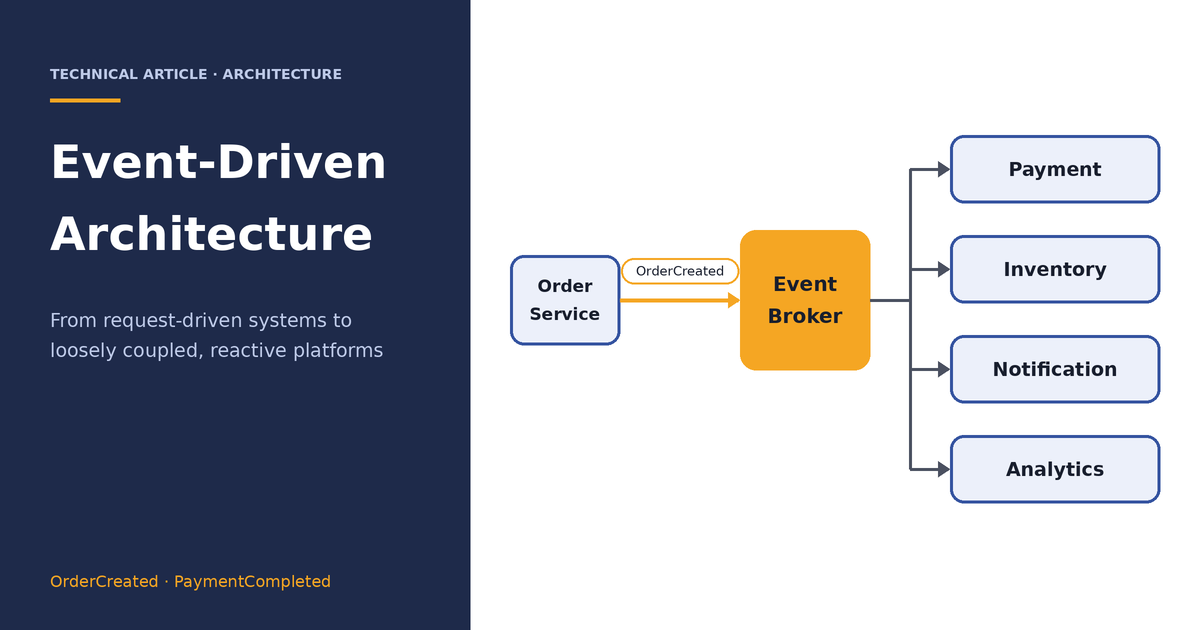
A typical flow is: Producer → Event Broker/Event Bus → Consumers. For example, when an Order service creates an order, it can publish an OrderCreated event. Payment, Inventory, Notification, Analytics, and other services can consume that event independently. The original request does not need to wait for every downstream operation to finish.
Core Components
Events represent facts such as OrderCreated, PaymentCompleted, or AppointmentCancelled. Producers create and publish those events. Consumers subscribe and perform their own responsibilities. The event broker transports and distributes messages, while event schemas define the contract that producers and consumers share. Clear ownership is important: each service should control its own business rules and data rather than directly modifying another service's database.
Why Use Event-Driven Architecture?
EDA is useful when work can happen asynchronously, when multiple services need to react to the same business event, or when workloads need to scale independently. It can reduce direct service-to-service coupling and allow new consumers to be added without changing the original producer. It is especially useful for notifications, analytics, audit processing, integrations, and background workflows.
The Engineering Challenges
Asynchronous systems introduce eventual consistency: different services may temporarily show different states while an event is being processed. Reliable systems therefore need explicit handling for duplicate messages, retries, timeouts, ordering, and failed consumers. Idempotent consumers prevent repeated events from producing repeated business effects. Dead-letter handling provides a controlled destination for messages that repeatedly fail.
Transactional Outbox
A common reliability problem occurs when a service updates its database successfully but crashes before publishing the corresponding event. The transactional outbox pattern solves this by storing the business change and an event record in the same database transaction. A separate publisher then sends the stored event to the broker, making recovery possible if publication fails.
EDA vs Microservices
Event-driven architecture and microservices are related but not identical. Microservices define independently owned business capabilities and deployment boundaries; EDA defines a communication style based on events. A microservices platform may use synchronous HTTP/gRPC for some operations and asynchronous events for others. Event-driven communication can also exist without microservices.
Final Takeaway
The goal of event-driven architecture is not simply to introduce Kafka, RabbitMQ, or another broker. The real goal is to create clear ownership and allow components to react independently to business facts. Strong EDA combines well-defined event contracts, reliable delivery, idempotency, explicit consistency rules, failure handling, security, testing, and observability. As with microservices, the architecture should follow the problem rather than the trend.