.svg)
Redis vs RabbitMQ: Which Message Broker Should You Choose?
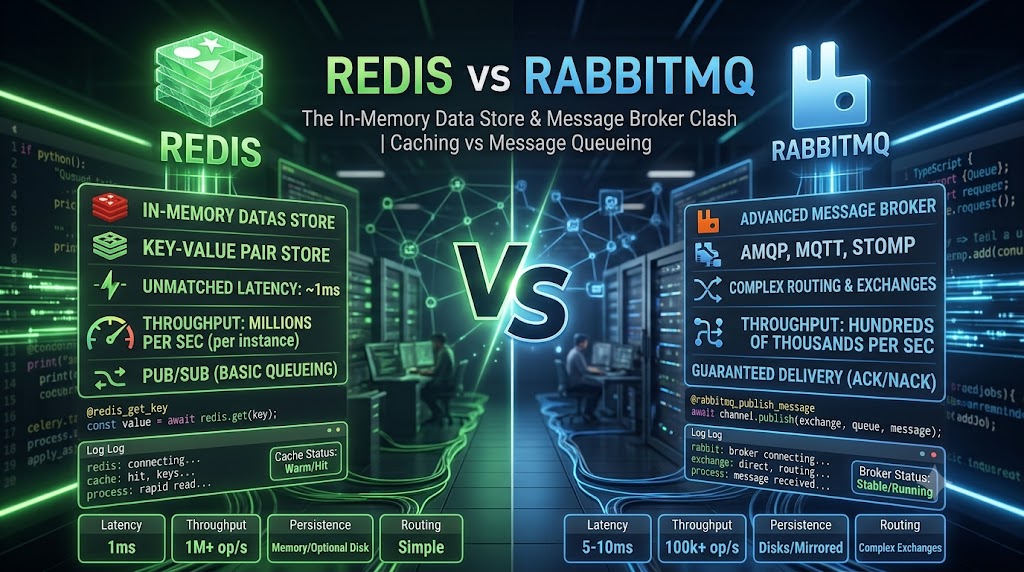
Redis vs RabbitMQ: Which Message Broker Should You Choose?
Modern applications rarely perform every operation inside a single request. Sending emails, processing payments, generating reports, resizing images, synchronizing systems and handling notifications are often moved into background processes so the main application remains responsive.
Message brokers and queue systems make this possible by allowing applications and services to communicate asynchronously. Two technologies frequently considered for these workloads are Redis and RabbitMQ.
Although both can be used to implement queues and asynchronous processing, they are not designed around exactly the same architecture. Redis is an in-memory data platform that can support queues, streams, caching and other workloads, while RabbitMQ is purpose-built as a message broker with concepts such as exchanges, queues, routing and acknowledgements.
So the real question is not simply which one is faster. It is which messaging model fits your application's reliability, routing, delivery and scaling requirements?
Redis vs RabbitMQ at a Glance
| Area | Redis | RabbitMQ |
|---|---|---|
| Primary purpose | In-memory data platform with messaging capabilities | Dedicated message broker |
| Messaging models | Lists, Streams and Pub/Sub | Queues, exchanges, bindings and routing |
| Routing | Simple to advanced patterns depending on the Redis feature used | Rich routing through exchanges and bindings |
| Message acknowledgements | Depends on the mechanism used | Built into the broker model |
| Persistence | Supports persistence depending on configuration | Supports durable queues and persistent messages |
| Replay / event history | Redis Streams can retain message history | Traditional queues are generally consumption-oriented |
| Typical use | High-speed queues, streams, caching and lightweight messaging | Reliable asynchronous messaging and service-to-service communication |
What Is Redis?
Redis is an in-memory data platform commonly used for caching, session storage, counters, real-time data and messaging.
Its messaging capabilities can be implemented through several mechanisms, including lists, Pub/Sub and Redis Streams. This makes Redis particularly interesting when an application already uses Redis for caching or fast-access data and also needs background processing.
For example, an e-commerce platform might use Redis to cache product information while also using a queue mechanism to process image transformations or notification jobs.
The advantage is architectural simplicity when Redis already exists as part of the application's infrastructure.
What Is RabbitMQ?
RabbitMQ is a dedicated message broker designed to receive, route and deliver messages between producers and consumers.
Instead of having application services communicate directly, a producer can publish a message to RabbitMQ. The broker determines where that message should go, and one or more consumers process it.
RabbitMQ's architecture includes exchanges, queues and bindings. This allows applications to create routing strategies that go beyond a simple producer-to-consumer queue.
For example, an order service could publish an OrderCreated event. Separate consumers could receive that event for inventory processing, email notifications, analytics or fulfillment.
The Fundamental Difference
The biggest distinction is architectural.
Redis is a broader data platform that can provide messaging as one of its capabilities.
RabbitMQ is designed specifically around message brokering.
This difference becomes important when messaging requirements become more sophisticated.
A small application that needs to move background jobs from a web server to a worker may be perfectly comfortable with Redis.
A distributed architecture containing multiple services, routing rules, retry strategies and different consumers may benefit more from RabbitMQ's dedicated messaging model.
Redis Queues
Redis can implement queues using lists or Redis Streams.
A simple background-job architecture might look like this:
Web Application
      |
      v
    Redis
      |
      v
   Worker
The application places a job into Redis and a worker retrieves it for processing.
This model works well for tasks such as:
- Email processing
- Image processing
- Report generation
- Webhook handling
- Background API calls
- Scheduled application jobs
RabbitMQ Queues
RabbitMQ introduces another layer between producers and queues through exchanges.
Producer
   |
   v
Exchange
   |
   +------> Queue A ------> Worker A
   |
   +------> Queue B ------> Worker B
   |
   +------> Queue C ------> Worker C
This architecture becomes useful when one event needs to reach different services or when messages need to be routed according to specific rules.
For example, an order event could simultaneously trigger inventory processing, customer notifications and accounting workflows without the order service needing to know how each consumer works.
Message Routing
Routing is one of RabbitMQ's strongest areas.
RabbitMQ exchanges can route messages to queues based on different routing strategies. This allows developers to design event-driven architectures where producers publish business events without tightly coupling themselves to individual consumers.
Redis can also support messaging patterns, especially with Redis Streams and consumer groups, but the architecture is different.
If your application requires complex message routing between many services, RabbitMQ deserves serious consideration.
Delivery and Acknowledgements
Reliable background processing requires more than simply putting data into a queue.
Imagine a worker receives a payment-processing job and crashes before completing it. The system needs a clear strategy for determining whether that message should be considered successfully processed or delivered again.
RabbitMQ provides explicit message acknowledgement mechanisms. Consumers can acknowledge messages after successful processing, allowing the broker to manage unacknowledged deliveries according to the configured behavior.
With Redis, delivery semantics depend on which messaging mechanism and client library the application uses. Redis Streams provide consumer groups and acknowledgement-related functionality, while simpler list-based queues require the application to implement more of the workflow itself.
Persistence and Reliability
Neither technology should be evaluated simply by asking whether it is persistent or non-persistent.
Redis supports different persistence mechanisms and can be configured according to durability requirements. RabbitMQ supports durable queues and persistent messages, although durability still depends on correct configuration and operational design.
The important question is what happens when infrastructure fails.
If losing a queued message is unacceptable, the architecture should explicitly define persistence, acknowledgement, retry, dead-letter and recovery behavior rather than relying on default settings.
Retries and Failed Messages
Background jobs can fail for many reasons: an external API may be unavailable, a database connection may fail, or an application dependency may temporarily return an error.
A production messaging architecture should therefore define what happens after a failed message.
RabbitMQ provides mechanisms such as dead-letter exchanges that can be used to route rejected or expired messages to another queue for inspection or later processing.
Redis-based systems can also implement retry queues and failed-job workflows, but the exact design depends heavily on the queue library and processing framework used by the application.
Ordering Messages
Message ordering can become important in workflows where events depend on one another.
Consider these events:
- CustomerCreated
- CustomerUpdated
- CustomerDeleted
If consumers receive those events in an unexpected order, the resulting state may be incorrect.
Both Redis and RabbitMQ can support ordered processing under appropriate configurations, but ordering should be treated as an architectural requirement rather than an automatic guarantee across every deployment pattern.
Redis Streams vs RabbitMQ
This is a more meaningful comparison than Redis Pub/Sub versus RabbitMQ when durable event processing is required.
Redis Streams provide an append-oriented data structure with consumer groups, allowing multiple consumers to coordinate processing while retaining stream entries.
RabbitMQ's traditional model is centered around message delivery through queues. It is particularly strong when applications need broker-managed routing and delivery workflows.
If your system resembles an event stream where consumers may need to track their position and process retained entries, Redis Streams can be attractive.
If your system resembles a messaging network where messages must be routed to specific queues and consumers, RabbitMQ may be the more natural fit.
Performance: Which Is Faster?
There is no universal winner.
Redis is known for very fast in-memory operations, which can make it highly effective for latency-sensitive workloads.
RabbitMQ is optimized for message-broker workloads and provides features designed around reliable message delivery and routing.
Actual performance depends on message size, persistence settings, network latency, acknowledgement behavior, consumer throughput, workload patterns and infrastructure.
A meaningful benchmark should reproduce your application's actual message patterns instead of comparing isolated operations.
Redis for Background Jobs
Redis is often a practical choice for straightforward background-job architectures.
Consider a business application where users upload documents. Instead of processing every document during the HTTP request, the application can place a processing job into Redis.
A worker can then extract data, generate previews and update the database while the user continues using the application.
This approach is simple, fast and easy to integrate when Redis is already part of the stack.
RabbitMQ for Microservices
RabbitMQ can become particularly valuable as the number of services increases.
Imagine an order platform containing separate services for orders, inventory, payments, shipping and notifications.
Instead of every service directly calling every other service, events can be published through RabbitMQ.
This creates a more decoupled architecture where services can evolve independently while communicating through defined message contracts.
Redis for Real-Time Systems
Redis can be particularly useful in systems that combine messaging with real-time data.
Examples include live dashboards, counters, presence indicators, notifications and rapidly changing application state.
When Redis is already being used for caching and real-time state, adding suitable messaging capabilities can reduce the number of infrastructure components required.
RabbitMQ for Event-Driven Workflows
RabbitMQ is well suited to event-driven workflows where multiple services react to business events.
Consider a B2B order-management platform. When an order is confirmed, different consumers may need to:
- Reserve inventory
- Generate an invoice
- Notify the customer
- Schedule fulfillment
- Update analytics
Using a message broker allows these workflows to operate asynchronously instead of forcing the order request to wait for every downstream process.
When Redis Is the Better Choice
Redis may be the better choice when:
- You already use Redis extensively in your application.
- You need very low-latency data operations.
- Your queueing requirements are relatively straightforward.
- You need caching, sessions and background jobs in the same infrastructure.
- You need Redis Streams for stream-oriented workloads.
- You want to minimize infrastructure components.
When RabbitMQ Is the Better Choice
RabbitMQ may be the better choice when:
- Messaging is a central part of your architecture.
- You need sophisticated message routing.
- Multiple services consume different categories of messages.
- Explicit acknowledgements are important.
- You need broker-oriented retry and dead-letter workflows.
- You are building a service-oriented or event-driven architecture.
Can Redis and RabbitMQ Be Used Together?
Yes.
A system may use Redis for caching, sessions and real-time state while RabbitMQ handles reliable service-to-service messaging.
For example:
Web Application
      |
      +---- Redis ----> Cache / Sessions / Real-Time State
      |
      +---- RabbitMQ -> Background Services
                         |
                         +-> Payments
                         +-> Notifications
                         +-> Inventory
                         +-> Reporting
However, using two systems also increases operational complexity. Monitoring, backups, security, deployment and failure recovery all become more involved.
Common Mistakes When Choosing a Message Broker
Choosing only because it is fast
Raw throughput does not tell you whether a messaging system fits your reliability and routing requirements.
Using Pub/Sub for durable job processing
Simple publish/subscribe patterns are not automatically equivalent to a durable work queue. The messaging semantics must match the job's reliability requirements.
Ignoring failed jobs
Production systems need clear retry, dead-letter and monitoring strategies.
Putting too much work into synchronous requests
If an operation does not need to complete before the user receives a response, it may be a candidate for asynchronous processing.
Adding a broker without defining message contracts
Event-driven architecture still requires clear message schemas, versioning strategies and ownership boundaries.
Redis vs RabbitMQ: Which Should You Choose?
Choose Redis when your application needs fast data operations combined with relatively straightforward background processing, queues or streams.
Choose RabbitMQ when messaging is a core architectural component and you need strong routing, explicit delivery workflows and communication between multiple services.
And remember that the decision is not necessarily permanent. Your architecture can evolve as application requirements change.
How Code-Ox Approaches Messaging Architecture
At Code-Ox, message-broker selection starts with the application's workflow rather than the technology itself.
For a custom web application, we examine background jobs, expected message volume, service boundaries, failure scenarios, retry requirements, integrations and scalability before selecting a messaging architecture.
A straightforward application may only need a lightweight Redis-based job queue. A larger distributed platform may benefit from RabbitMQ and a more explicit event-driven architecture.
The goal is to build messaging infrastructure that makes the application more reliable and scalable without introducing unnecessary complexity.
Final Verdict
Redis and RabbitMQ can both solve asynchronous communication problems, but they approach messaging from different directions.
Redis is particularly attractive when speed, simplicity and multiple in-memory data capabilities are important.
RabbitMQ is particularly attractive when message routing, acknowledgements, service decoupling and broker-centric delivery workflows are central to the architecture.
The best choice is therefore not the technology with the highest benchmark number. It is the one whose messaging model matches the way your application actually works.
If you're designing a custom application, SaaS platform or microservices architecture, Code-Ox can help you choose the right messaging, backend and infrastructure architecture for your workload.