.svg)
Odoo vs Microsoft Dynamics: Which ERP Is Right for Your Business in 2026?
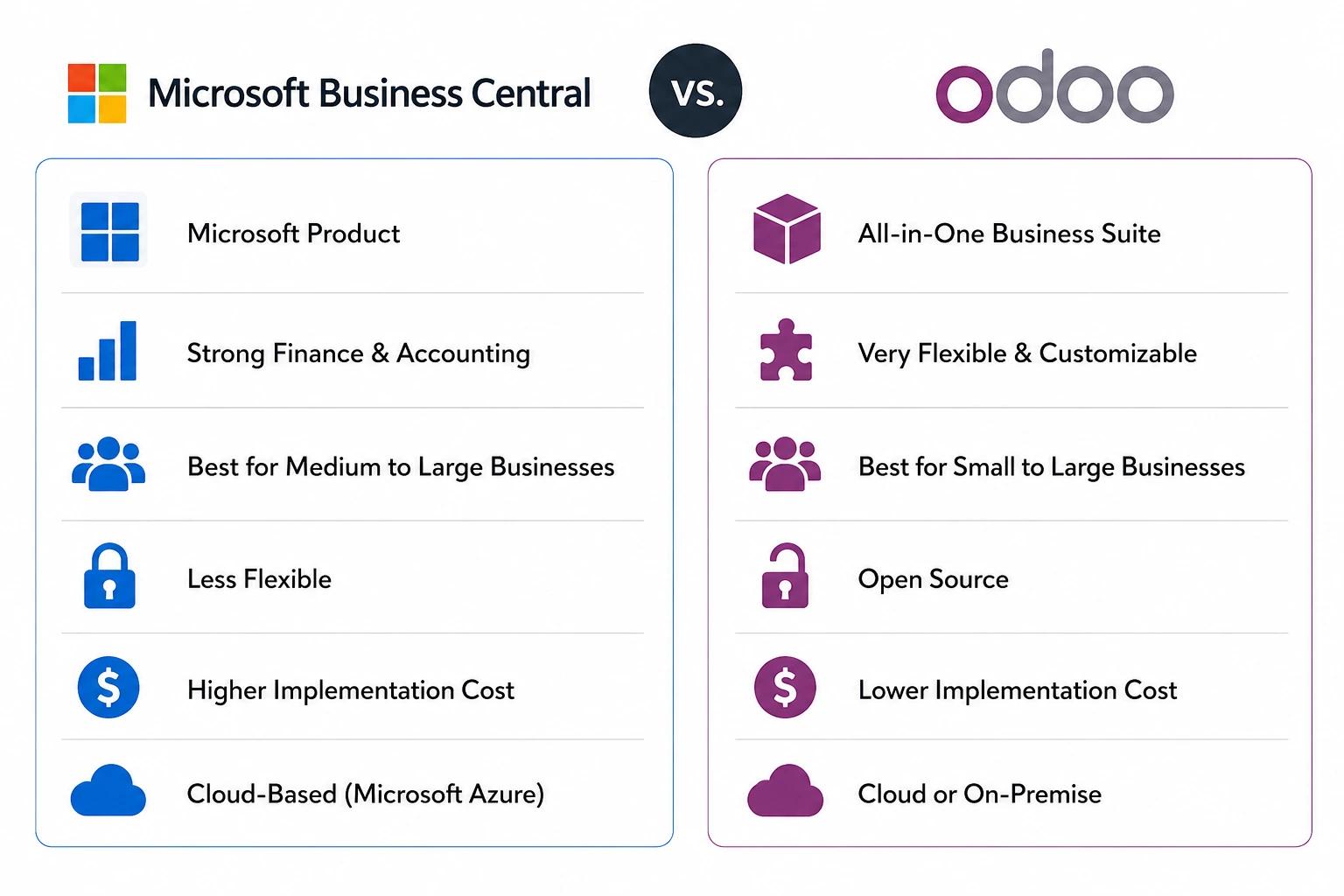
Choosing an Enterprise Resource Planning (ERP) system is an important decision for businesses that want to improve operations, automate workflows, and connect departments through a single platform.
Odoo and Microsoft Dynamics are two widely used business software ecosystems. Both provide capabilities for finance, sales, customer relationship management, supply chain, inventory, and other business processes, but they take different approaches to ERP, customization, integrations, and business growth.
In 2026, choosing between Odoo and Microsoft Dynamics should not simply come down to which platform has more features. The right choice depends on your company's size, business processes, budget, existing technology stack, implementation requirements, and long-term growth strategy.
What Is Odoo?
Odoo is an integrated business application platform built around a modular architecture. It provides applications for accounting, CRM, sales, inventory, manufacturing, purchasing, eCommerce, point of sale, project management, human resources, marketing, and other business functions.
Odoo is available in Community and Enterprise editions and has an open-source foundation. Businesses can start with a small number of applications and add additional modules as their requirements grow.
Its modular architecture and customization capabilities make Odoo attractive to organizations that want an ERP platform that can adapt to their specific workflows.
What Is Microsoft Dynamics?
Microsoft Dynamics is Microsoft's family of business applications. Its portfolio includes products such as Dynamics 365 Finance, Dynamics 365 Supply Chain Management, Dynamics 365 Sales, Dynamics 365 Business Central, and other specialized applications.
Microsoft Dynamics integrates closely with the wider Microsoft ecosystem, including Microsoft 365, Teams, Power Platform, Azure, and other Microsoft services.
This ecosystem can be particularly valuable for organizations that already depend heavily on Microsoft technologies.
Odoo vs Microsoft Dynamics: At a Glance
| Category | Odoo | Microsoft Dynamics |
|---|---|---|
| Platform approach | Integrated modular business application platform | Suite of enterprise and business applications |
| Target businesses | Small, midsize, and growing businesses, with scalability for larger organizations | Small and midsize businesses through large enterprises, depending on the Dynamics product |
| Open-source foundation | Yes | No |
| Customization | Highly flexible through modules and development | Strong configuration and extensibility through Microsoft's ecosystem |
| Microsoft ecosystem integration | Third-party and custom integrations | Native integration with many Microsoft services |
| CRM | Integrated CRM application | Advanced Dynamics 365 Sales and customer applications |
| Finance | Integrated accounting and financial management | Advanced financial management capabilities |
| Supply chain | Integrated inventory, purchasing, warehouse, and logistics features | Extensive enterprise supply-chain capabilities |
| Manufacturing | Integrated manufacturing and MRP | Advanced manufacturing capabilities in applicable Dynamics products |
| Best fit | Businesses seeking flexibility, integrated applications, and customization | Organizations seeking enterprise capabilities and deep Microsoft integration |
Odoo vs Microsoft Dynamics: Key Differences
1. Business Applications
Odoo approaches business management through a unified suite of applications. CRM, sales, accounting, inventory, purchasing, manufacturing, eCommerce, projects, and other applications can operate within the same platform.
Microsoft Dynamics takes a broader portfolio approach. Different Dynamics 365 applications target specific business areas, allowing organizations to combine products according to their requirements.
Odoo advantage: A unified modular application experience.
Dynamics advantage: A broad enterprise application portfolio with specialized products.
2. ERP and Financial Management
Odoo Accounting provides integrated financial management connected to other business processes such as sales, purchases, expenses, inventory, and invoicing.
Microsoft Dynamics provides advanced financial management capabilities across products such as Dynamics 365 Business Central and Dynamics 365 Finance.
Organizations with complex financial structures, multiple entities, sophisticated financial controls, and extensive reporting requirements may benefit from evaluating the more specialized Dynamics products.
Smaller and midsize businesses that want accounting tightly connected to sales, inventory, purchasing, and other applications may find Odoo's integrated approach attractive.
3. CRM and Sales
Odoo includes CRM and sales functionality within its integrated business application ecosystem.
Microsoft Dynamics 365 Sales provides dedicated CRM capabilities and integrates closely with other Microsoft services and Dynamics applications.
Dynamics can be particularly attractive for companies already using Microsoft 365, Teams, Power Platform, and other Microsoft services.
Odoo can be attractive for organizations that want CRM and ERP processes managed within a single modular platform.
4. Inventory and Supply Chain
Odoo provides inventory, purchasing, warehouse management, replenishment, barcode operations, logistics, and traceability features.
Microsoft Dynamics 365 Supply Chain Management is designed for more extensive supply-chain requirements, including procurement, inventory, warehouse management, planning, manufacturing, asset management, and logistics.
For simpler integrated operations: Odoo can provide a flexible approach.
For highly complex enterprise supply chains: Microsoft Dynamics can provide deeper specialized capabilities.
5. Manufacturing
Manufacturing is another important area where both platforms provide strong functionality.
Odoo Manufacturing supports bills of materials, manufacturing orders, work orders, routing, planning, quality management, maintenance, traceability, and shop-floor workflows.
Microsoft Dynamics 365 Supply Chain Management includes manufacturing capabilities designed for organizations with more complex production and supply-chain requirements.
The better option depends on manufacturing complexity, production models, planning requirements, integrations, and the level of customization required.
6. Customization and Flexibility
Odoo is well known for its modular and customizable architecture. Developers can create custom modules and modify workflows to match specific business requirements.
Microsoft Dynamics also provides extensive customization and extensibility through tools and services across the Microsoft ecosystem, including Power Platform, APIs, extensions, and development frameworks.
The difference is largely in the ecosystem and development approach.
Odoo can be attractive to businesses that want direct control over application modules and custom development. Dynamics can be especially attractive to organizations that want customization integrated with Microsoft's broader enterprise technology stack.
7. Microsoft Ecosystem Integration
This is one of the most significant differences between the two platforms.
Microsoft Dynamics can integrate closely with services such as Microsoft 365, Excel, Teams, Outlook, Power BI, Power Automate, Power Apps, and Azure.
For companies already invested heavily in Microsoft technologies, this can reduce friction between business applications and existing productivity, analytics, automation, and cloud tools.
Odoo can also integrate with external applications and services, but Microsoft Dynamics has a natural advantage when an organization wants to build around the Microsoft ecosystem.
8. Ease of Use
Odoo provides a unified interface across many applications, which can make it easier for businesses to introduce multiple functions through one platform.
Microsoft Dynamics provides a powerful ecosystem, but the user experience can vary depending on which Dynamics products and Microsoft services are deployed.
Ease of use ultimately depends on implementation quality, business-process design, training, customization, and user requirements.
9. Implementation
ERP implementation involves much more than installing software. It includes business-process analysis, configuration, data migration, integrations, testing, training, security, reporting, and change management.
Odoo's modular approach can allow businesses to begin with a smaller implementation and expand the platform over time.
Microsoft Dynamics implementations can range from relatively straightforward Business Central deployments to complex enterprise projects involving Finance, Supply Chain Management, CRM, Power Platform, Azure, and other services.
Therefore, implementation complexity depends on the specific Dynamics product, organizational size, integrations, data, customizations, and business processes.
10. Cost and Total Cost of Ownership
ERP pricing should never be evaluated only by looking at the software subscription.
Total cost can include:
- Software licenses or subscriptions
- Implementation services
- Customization
- Data migration
- Integrations
- Cloud infrastructure
- Training
- Support
- Maintenance
- Future upgrades
Odoo can be attractive for businesses looking for a modular platform with flexible customization options.
Microsoft Dynamics can provide strong value for organizations that already use Microsoft technologies and want to consolidate ERP, CRM, analytics, automation, productivity, and cloud services within a connected ecosystem.
The most meaningful comparison is therefore the total cost of ownership for your specific business, not simply the subscription price.
11. AI and Automation in 2026
AI and automation are becoming increasingly important in ERP systems.
Odoo is incorporating AI capabilities into its business applications, while its modular and customizable architecture can allow organizations to build specialized automated workflows.
Microsoft has invested heavily in Copilot and AI capabilities across the Dynamics 365 and Power Platform ecosystem. These capabilities can support areas such as sales, customer service, finance, supply chain, business analysis, and workflow automation.
For organizations already using Microsoft 365 and Power Platform, Microsoft's AI ecosystem can be a significant advantage.
However, businesses should evaluate AI based on practical business outcomes rather than simply choosing an ERP because it has AI features.
Who Should Choose Odoo?
Odoo may be a strong choice for businesses that:
- Want an integrated suite of business applications
- Prefer a modular ERP approach
- Need extensive customization
- Want CRM, accounting, inventory, sales, and eCommerce in one platform
- Value open-source technology
- Want to start small and expand over time
- Need flexible workflows
- Prefer a single platform for multiple business functions
Who Should Choose Microsoft Dynamics?
Microsoft Dynamics may be a strong choice for organizations that:
- Already rely heavily on Microsoft products
- Need advanced enterprise business applications
- Want deep integration with Microsoft 365
- Use Power BI, Power Automate, Power Apps, or Azure
- Need sophisticated financial management
- Have complex supply-chain requirements
- Require advanced CRM capabilities
- Need enterprise-level scalability and governance
Odoo vs Microsoft Dynamics: Which Is Better?
There is no universal winner between Odoo and Microsoft Dynamics.
Odoo may be the better choice for organizations that prioritize flexibility, modularity, customization, integrated applications, and an open-source foundation.
Microsoft Dynamics may be the better choice for organizations that need advanced enterprise capabilities and already have a strong Microsoft technology ecosystem.
| Business Requirement | Potentially Better Fit |
|---|---|
| Open-source flexibility | Odoo |
| Highly customized business workflows | Odoo |
| Integrated ERP applications | Odoo |
| Small or midsize business seeking a modular ERP | Odoo |
| Deep Microsoft 365 integration | Microsoft Dynamics |
| Power Platform ecosystem | Microsoft Dynamics |
| Advanced enterprise finance | Microsoft Dynamics |
| Complex enterprise supply chain | Microsoft Dynamics |
| Microsoft-centric technology environment | Microsoft Dynamics |
How to Choose Between Odoo and Microsoft Dynamics
- Understand your business processes. Document sales, finance, purchasing, inventory, manufacturing, HR, CRM, and other workflows.
- Identify the systems you already use. Consider Microsoft 365, Azure, Power Platform, accounting systems, websites, eCommerce platforms, and other applications.
- Define your customization requirements. Determine which workflows require standard functionality and which require customization.
- Evaluate integrations. Make sure the ERP can connect with the applications your business depends on.
- Calculate total cost of ownership. Include implementation, training, integrations, support, maintenance, and future expansion.
- Consider future growth. Evaluate additional users, locations, legal entities, countries, warehouses, products, and transaction volumes.
- Test real workflows. Use your actual business scenarios during demonstrations and proof-of-concept exercises.
- Choose the right implementation partner. A technically strong implementation partner can significantly affect the success of an ERP project.
Final Thoughts
Odoo and Microsoft Dynamics are both capable platforms, but they are suited to different business strategies.
Odoo stands out for its modular architecture, open-source foundation, integrated applications, and customization flexibility. Microsoft Dynamics stands out for its enterprise capabilities and deep connection with the Microsoft ecosystem.
For a growing business looking for a flexible and integrated ERP platform, Odoo can be a compelling option. For an organization already invested in Microsoft technologies or requiring advanced enterprise capabilities, Microsoft Dynamics can be an excellent fit.
The best ERP decision should be based on your actual business requirements, not simply the number of features a platform offers.
The right question is not "Which ERP is better?" but "Which ERP fits our business today and supports where we want to go tomorrow?"