.svg)
Infrastructure as Code, Two Different Mindsets: Terraform or Pulumi?
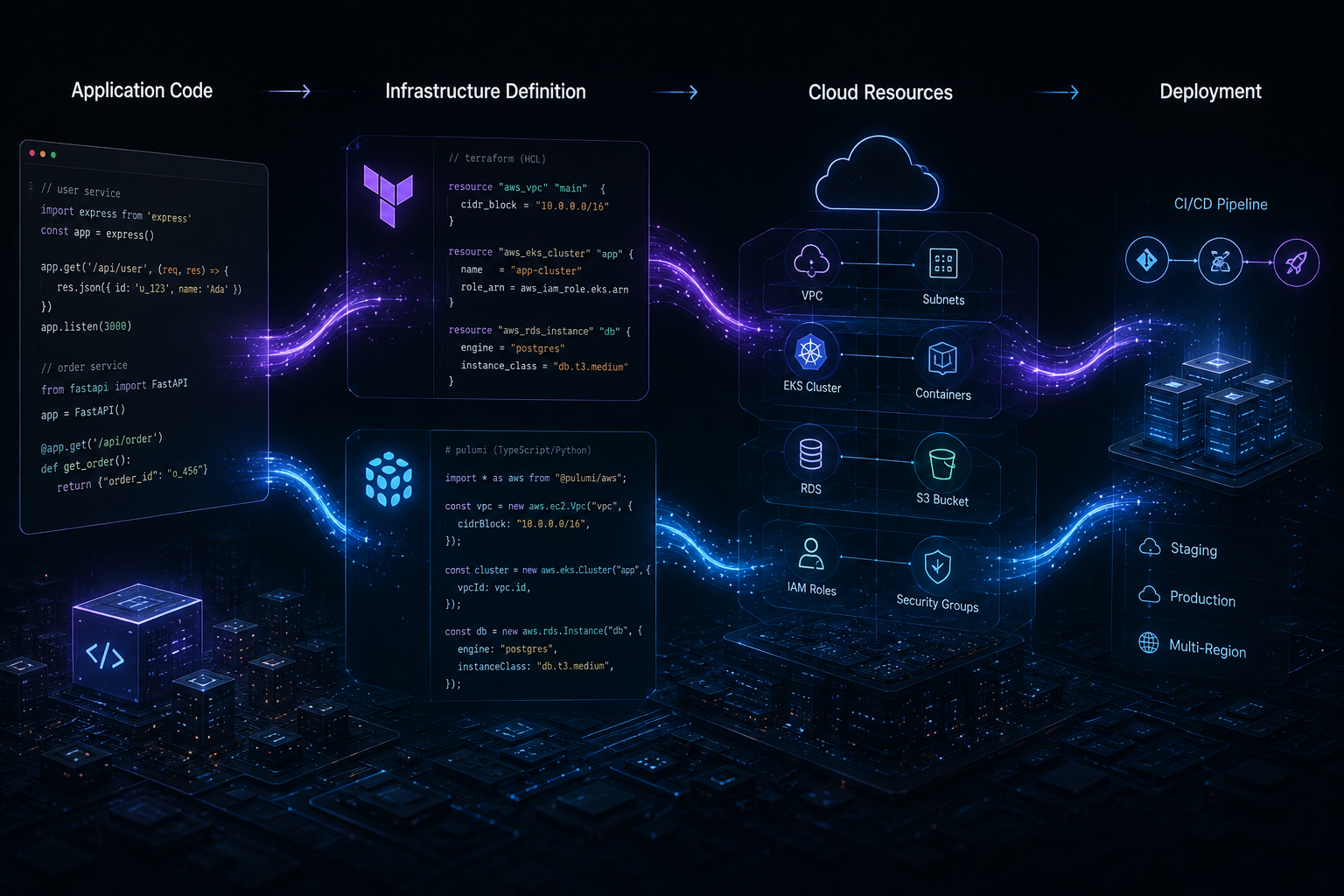
Infrastructure has become part of the software development process. Cloud environments are no longer configured once and left untouched. Applications depend on databases, networks, containers, queues, storage, identity systems, monitoring, secrets, and deployment infrastructure that must evolve alongside the code.
That is why Infrastructure as Code (IaC) has become such an important part of modern DevOps. Instead of manually configuring cloud resources, teams describe infrastructure in files that can be reviewed, versioned, tested, and deployed through automated workflows.
Two prominent choices in this space are Terraform and Pulumi.
They solve the same broad problem, but they encourage developers to think about infrastructure in very different ways. Terraform introduced a declarative infrastructure model built around its own configuration language, while Pulumi lets teams use familiar programming languages such as TypeScript, Python, Go, C#, Java, and YAML.
For a company building cloud applications, SaaS products, APIs, or automated deployment environments, the question is therefore not simply which tool is more powerful.
The more useful question is: which infrastructure model fits the way your engineering team already builds software?
Terraform and Pulumi at a Glance
| Area | Terraform | Pulumi |
|---|---|---|
| Infrastructure model | Declarative | Infrastructure expressed through general-purpose languages |
| Primary configuration | HCL | TypeScript, Python, Go, C#, Java, YAML and others |
| State | Central part of Terraform workflows | Managed through Pulumi's state model |
| Cloud support | Broad provider ecosystem | Broad provider and package ecosystem |
| Programming logic | Terraform-specific language constructs | Native language features such as functions, loops and classes |
| Developer experience | Purpose-built IaC workflow | Feels closer to conventional software development |
| Best fit | Teams wanting a standardized declarative IaC model | Teams wanting to use familiar programming languages for infrastructure |
1. Terraform Starts With a Declarative Mindset
Terraform asks you to describe the infrastructure you want rather than writing a sequence of commands explaining how to create it.
Imagine a production application that requires:
- a virtual network
- private and public subnets
- a managed database
- an application cluster
- load balancing
- object storage
- security rules
Instead of manually creating each resource, the desired infrastructure can be represented as Terraform configuration.
Terraform then compares the declared configuration with its understanding of the existing infrastructure and determines which changes are required.
This model is particularly attractive for organizations that want infrastructure changes to follow a predictable and standardized process.
2. Pulumi Brings Infrastructure Closer to Application Code
Pulumi takes a different route. Instead of requiring teams to learn a dedicated configuration language, Pulumi allows infrastructure to be defined using general-purpose programming languages.
A TypeScript development team, for example, can use TypeScript to define cloud infrastructure.
That creates an interesting advantage when infrastructure contains substantial logic.
Consider an environment where every customer receives slightly different infrastructure based on:
- subscription tier
- geographic region
- data requirements
- performance requirements
- compliance configuration
With Pulumi, developers can use normal programming constructs to represent these conditions and build reusable infrastructure components.
This can make Pulumi particularly appealing to teams whose infrastructure logic is becoming more application-like.
3. HCL vs TypeScript, Python, Go and Other Languages
This is probably the most visible difference between Terraform and Pulumi.
Terraform uses HCL, a language designed specifically for configuration. Pulumi supports several general-purpose programming languages.
Terraform's dedicated syntax can be an advantage because it keeps infrastructure configuration recognizable and focused.
Pulumi's programming-language approach can be an advantage because developers already understand concepts such as:
- functions
- loops
- conditions
- classes
- modules
- package management
- unit testing
For a team heavily invested in TypeScript or Python, this can significantly reduce the conceptual distance between application development and infrastructure development.
4. State Is More Important Than It Looks
Infrastructure as Code is not simply about storing cloud configuration in Git.
State is one of the most important concepts behind infrastructure management.
Terraform maintains a state representation that helps it understand the relationship between configuration and real infrastructure. Teams commonly store state remotely when infrastructure is managed collaboratively.
Pulumi also maintains state so it can track resources and determine how infrastructure should change between deployments. Pulumi supports managed state through Pulumi Cloud as well as other state backends.
This matters when multiple engineers work on the same environment.
A production infrastructure repository should not become a collection of competing local assumptions. State management, locking, access control, backups, and review processes need to be part of the architecture.
5. Reusability Looks Different in Each Tool
Large infrastructure projects rarely consist of one configuration file.
Teams typically create reusable patterns for networks, databases, Kubernetes clusters, monitoring, identity, and application environments.
Terraform provides modules for packaging reusable infrastructure configurations.
Pulumi provides packages and component resources that allow teams to create higher-level abstractions around infrastructure.
Consider a company that deploys ten SaaS environments with the same architecture. Rather than duplicating the entire infrastructure definition ten times, the team can create reusable infrastructure components and supply environment-specific configuration.
The architectural principle is the same in both ecosystems:
Reuse the architecture, not the copy-pasted configuration.
6. Terraform's Provider Ecosystem Is a Major Advantage
One of Terraform's strongest characteristics is its extensive provider ecosystem.
Infrastructure frequently crosses service boundaries. A single application may use a major cloud provider alongside Cloudflare, GitHub, Datadog, Kubernetes, a database platform, or another SaaS service.
Providers allow Terraform configurations to interact with resources exposed by these different platforms.
This broad ecosystem has helped Terraform become a familiar standard in many DevOps environments.
For organizations with an existing Terraform codebase, established modules, internal expertise, and CI/CD workflows, moving away from Terraform simply because another IaC tool looks attractive may create unnecessary migration cost.
7. Pulumi's Programming Model Can Simplify Complex Infrastructure
The opposite situation can also happen.
Suppose an organization has built an infrastructure platform where dozens of resources are created dynamically depending on application configuration.
Instead of repeatedly expressing complex configuration patterns, developers may prefer to write reusable functions and components.
Pulumi's use of general-purpose languages makes this approach natural.
For example, a TypeScript function could encapsulate the infrastructure required for a complete application environment and accept parameters for region, database size, domain, scaling requirements, and environment type.
That is a very different developer experience from treating infrastructure primarily as configuration.
8. Testing Infrastructure Changes
Infrastructure can break production just as easily as application code.
A small change to a security rule can block an API. A database configuration change can increase latency. An incorrect network dependency can make an application unreachable.
This is why infrastructure should be reviewed and tested with the same seriousness as application code.
Terraform teams can validate configuration, generate plans for review, and integrate those checks into CI/CD pipelines.
Pulumi's use of general-purpose languages also opens the door to familiar programming-language testing approaches, alongside Pulumi-specific validation and preview workflows.
The exact testing strategy should depend on infrastructure risk rather than simply on the chosen tool.
9. CI/CD Is Where IaC Becomes Operationally Valuable
Infrastructure as Code becomes much more powerful when infrastructure changes are connected to the software delivery lifecycle.
A mature workflow might look like:
Pull Request → Validation → Infrastructure Plan/Preview → Review → Apply → Verification
Imagine a team preparing a new production release. The application requires an additional queue and database index. Instead of manually changing production infrastructure, the required infrastructure changes can be committed alongside the application work.
Reviewers can inspect the infrastructure changes before they are applied.
This creates an important operational advantage: infrastructure becomes visible, reviewable, and repeatable.
10. Multi-Cloud and Hybrid Environments
Organizations rarely stay architecturally simple forever.
A company may start with one cloud provider and later introduce another provider, a managed SaaS platform, Kubernetes, or on-premises infrastructure.
Both Terraform and Pulumi support multi-provider infrastructure approaches.
The more important consideration is how much abstraction the organization actually needs.
If the team already has mature Terraform modules across multiple environments, Terraform may be the lower-risk choice.
If developers are building an internal platform and want infrastructure components to behave more like software libraries, Pulumi may offer a compelling model.
11. Team Skills Should Influence the Decision
Technology choices should consider the people maintaining the system.
A DevOps team experienced in Terraform, HCL, modules, providers, and existing Terraform workflows will probably be productive faster with Terraform.
A software engineering team already working extensively with TypeScript, Python, Go, or C# may find Pulumi more natural.
But there is an important warning:
Using a familiar programming language does not automatically make infrastructure easier.
Cloud architecture still requires knowledge of networking, IAM, security, availability, state, dependencies, cost, observability, and failure recovery.
Pulumi reduces the need to learn a specialized configuration language. It does not eliminate the need to understand infrastructure.
12. What About Security?
Neither Terraform nor Pulumi makes an infrastructure environment secure automatically.
The IaC tool is only one layer of the security model.
Teams should still consider:
- secret management
- least-privilege IAM
- state protection
- code review
- credential rotation
- network isolation
- policy enforcement
- auditability
Infrastructure repositories should also be treated as sensitive engineering assets because configuration can expose architectural details, permissions, endpoints, and operational assumptions.
13. When Terraform Is the Better Choice
- You want a mature, declarative IaC workflow.
- Your organization already has Terraform expertise.
- You depend heavily on existing Terraform modules and providers.
- Your infrastructure is primarily configuration-driven.
- You want infrastructure definitions that are intentionally separated from application programming languages.
- Your organization already has Terraform-based CI/CD and governance.
14. When Pulumi Is the Better Choice
- Your engineering team prefers TypeScript, Python, Go, C#, or another supported programming language.
- Infrastructure contains significant conditional or reusable programming logic.
- You want infrastructure components to behave more like software libraries.
- Your developers will actively maintain infrastructure alongside application code.
- You want to use familiar programming-language tooling and package ecosystems.
15. Terraform vs Pulumi for a Growing SaaS Product
Consider a SaaS company starting with one production environment.
Over time it needs:
- development, staging, and production environments
- regional deployments
- automated database provisioning
- container infrastructure
- monitoring
- custom domains
- automated DNS
- scaling policies
At the beginning, almost any reasonable IaC approach may work.
The architectural pressure appears later. Configuration becomes reusable modules, environments need isolation, state becomes collaborative, deployments need approval, and infrastructure changes become part of release management.
This is the point where the initial IaC decision starts having a long-term impact.
Terraform can provide a highly structured declarative model for these environments. Pulumi can provide a programming-oriented approach that may be particularly useful when infrastructure needs substantial abstraction and logic.
How Code-Ox Thinks About Infrastructure as Code
At Code-Ox, cloud infrastructure is most useful when it supports the application architecture instead of becoming a separate operational island.
When building custom web applications, APIs, SaaS platforms, and automated systems, infrastructure decisions need to account for scalability, deployment frequency, security, integrations, observability, and future maintenance.
That means choosing Terraform or Pulumi should happen alongside decisions about application architecture, CI/CD, cloud services, databases, environments, and operational ownership.
For example, a TypeScript-heavy product team may naturally consider Pulumi because the same engineering ecosystem can extend from application development into infrastructure. Another organization with established DevOps standards and a large Terraform estate may gain more value by improving its existing Terraform architecture rather than introducing another tool.
The objective is not to use the newest infrastructure tool. The objective is to create an infrastructure platform that remains predictable as the product grows.
Final Verdict
Terraform is a strong choice when a team wants a mature declarative infrastructure model, broad provider support, established modules, and a well-understood IaC workflow.
Pulumi is compelling when developers want to express infrastructure using familiar programming languages and when infrastructure requires reusable components and more sophisticated programming logic.
Neither tool automatically produces better infrastructure.
The quality of the result depends on architecture, state management, security, testing, CI/CD, governance, and the engineering practices surrounding the tool.
For a new project, choose the model your team can maintain confidently for years. For an existing project, consider the migration cost before replacing an infrastructure stack that already works.
If your team is designing a new cloud application or rethinking its infrastructure automation strategy, Code-Ox can help connect the application architecture, cloud infrastructure, automation, and deployment workflow into one scalable engineering approach.
Good infrastructure should disappear behind a reliable product experience.