.svg)
Pinecone Vector Database: How It Powers Modern AI Applications
Pinecone Vector Database: How It Powers Modern AI Applications
Modern AI applications are moving beyond simple question-and-answer interfaces. Businesses increasingly want AI systems that can search internal documents, understand customer questions, retrieve relevant information, recommend products, and support employees using proprietary knowledge.
That creates an important engineering problem: how do you efficiently search information by meaning rather than relying only on exact keywords?
This is where vector databases such as Pinecone become useful.
Pinecone is a managed vector database designed for storing and retrieving vector representations of data. It can support semantic search, retrieval-augmented generation (RAG), recommendations, hybrid search, and other AI applications that need similarity-based retrieval.
But a vector database is not simply a traditional database containing a different type of number. Its value comes from how application data, embeddings, metadata, retrieval, and AI models work together.
What Is a Vector Database?
A vector database stores numerical representations of information called vectors or embeddings.
An embedding model converts information such as text into a mathematical representation that captures aspects of its meaning. Instead of searching only for identical words, an application can compare the vector representation of a query with the vector representations of stored content.
For example, consider a company's knowledge base containing:
- “Employees can request annual leave through the HR portal.”
- “Leave applications must be submitted before the requested vacation date.”
- “Medical leave requires supporting documentation.”
A user might ask:
“How do I apply for vacation?”
A keyword search may prioritize documents containing the exact word “vacation.” Semantic search can recognize that “vacation,” “annual leave,” and “leave application” can be related concepts.
Pinecone's documentation describes dense vectors as representations of meaning and relationships, where vectors that are closer together represent semantically similar information.
Why AI Applications Need Vector Search
Traditional databases are excellent at structured queries.
If a business wants to find:
- customers from a specific country,
- orders above a certain value,
- products belonging to a category,
- employees in a particular department,
a relational or document database is usually the right tool.
But AI applications often need questions such as:
- “Find documents related to our employee benefits policy.”
- “Show products similar to this description.”
- “Find previous support cases that resemble this customer's issue.”
- “Retrieve information relevant to this question before generating an answer.”
These are similarity and meaning-based retrieval problems.
A vector database provides infrastructure specifically suited to this type of search.
How Pinecone Fits Into an AI Application
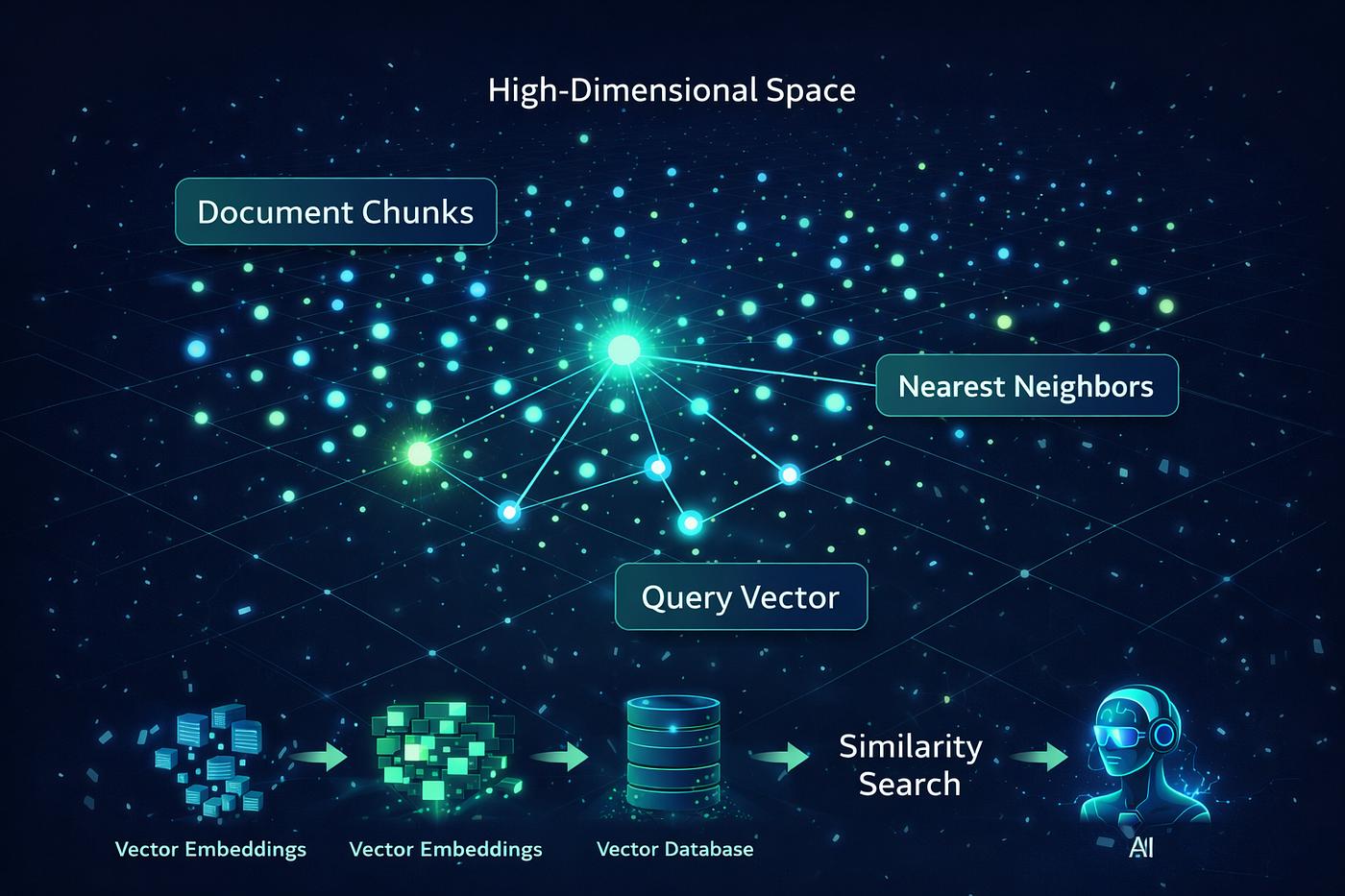
A typical AI retrieval workflow can be understood as a pipeline:
- Collect data from documents, websites, databases, applications, or other sources.
- Split the content into useful chunks when necessary.
- Generate embeddings for those chunks.
- Store vectors and metadata in Pinecone.
- Convert the user's query into a vector or use an integrated embedding workflow.
- Search Pinecone for the most relevant records.
- Return the retrieved context to the AI model.
- Generate a response using the retrieved information.
This architecture is especially important for RAG applications because the language model does not have to rely exclusively on information contained in its original training process.
Pinecone and RAG
Retrieval-Augmented Generation, commonly called RAG, is one of the most important applications of vector databases.
Imagine a company wants an AI assistant that can answer questions about its internal:
- HR policies
- product manuals
- technical documentation
- contracts
- support procedures
- company knowledge base
Instead of sending the entire document collection to an AI model every time a question is asked, the application can first retrieve the most relevant information.
For example:
User: “What is our policy for replacing a damaged product?”
Application: Converts the question into a searchable representation and retrieves relevant policy sections from Pinecone.
AI model: Receives the retrieved context and generates an answer based on it.
The result is a system that connects a generative AI model with a searchable business knowledge layer.
Pinecone's current quickstart documentation specifically demonstrates building applications for semantic search, recommendations, and RAG.
Dense Vectors: Searching by Meaning
Dense vectors are commonly used for semantic retrieval.
Suppose an e-commerce application contains this product description:
“Lightweight waterproof hiking jacket designed for cold-weather outdoor activities.”
A customer searches:
“Jacket for trekking in rainy weather.”
The wording is different, but the concepts are related.
A semantic search system can represent both the product and the query as vectors and compare their similarity.
This is fundamentally different from searching for an exact phrase.
Pinecone supports dense-vector semantic search, including querying with vectors or, for indexes with integrated embedding, searching using text that Pinecone converts into vectors.
Metadata Makes Retrieval More Useful
Semantic similarity alone is not always enough.
Consider a company with thousands of documents across multiple departments and regions. An AI assistant might need to find information that is both semantically relevant and within a particular business scope.
A vector record can therefore include metadata such as:
- department
- document type
- language
- country
- product category
- publication date
- customer ID
- access level
For example, an application could retrieve documents matching a question while restricting the search to:
department = finance
or:
country = UAE
Pinecone supports metadata filters alongside vector search, allowing applications to narrow results using values such as strings, numbers, booleans, and lists.
Namespaces and Multi-Tenant AI Applications
Multi-tenant applications introduce another challenge: keeping one customer's information separated from another customer's information.
For example, imagine a SaaS platform offering an AI knowledge assistant to hundreds of companies.
Company A should be able to search its own documents.
Company B should be able to search its own documents.
The retrieval layer should not accidentally mix their data.
Pinecone namespaces can partition records within an index. This can be useful for separating tenant data and controlling which records are searched for a particular request. Pinecone's documentation also describes namespaces as a mechanism for data isolation in multi-tenant architectures.
A practical architecture could therefore look like:
AI SaaS Application
        |
        +-- Customer A → Pinecone Namespace A
        |
        +-- Customer B → Pinecone Namespace B
        |
        +-- Customer C → Pinecone Namespace C
This is particularly useful when building enterprise AI products where data boundaries are part of the application architecture rather than an afterthought.
Semantic Search vs Keyword Search
Vector search should not automatically replace keyword search.
Consider a technical support system.
A customer may search for:
“Why does error E1047 appear after firmware update?”
The exact error code E1047 is important.
At the same time, a customer might describe the same problem as:
“The device stopped connecting after I installed the latest firmware.”
The first query benefits from exact lexical matching. The second may benefit from semantic similarity.
This is why hybrid retrieval can be valuable.
Hybrid Search with Pinecone
Hybrid search combines semantic and lexical signals.
Semantic search helps identify relationships, synonyms, and paraphrases.
Lexical search helps identify exact terms and domain-specific keywords.
Pinecone supports hybrid retrieval patterns that combine dense and sparse representations. Its documentation explains that semantic search can miss exact keyword matches, while lexical search can miss relationships such as synonyms and paraphrases.
For a technical documentation platform, this can be especially useful.
A user searching for:
“OAuth refresh token expiration”
may need both:
- documents containing the exact technical terminology, and
- documents explaining the underlying authentication behavior in different wording.
Hybrid retrieval can combine these signals instead of forcing the application to choose only one search strategy.
Pinecone in an AI Customer Support System
Consider a company operating a large customer support platform.
Every day, the system receives questions about:
- product issues
- installation procedures
- returns
- warranty policies
- configuration problems
- previous support cases
A traditional search interface may require customers or support agents to know exactly what terms to search for.
With a vector retrieval layer, the application can search based on the meaning of the question.
For example:
“My device keeps restarting whenever I connect it to Wi-Fi.”
The system could retrieve troubleshooting documentation and previous cases describing similar symptoms, even when those documents use different terminology.
An AI model can then summarize the relevant information into a response.
The architecture might look like:
Customer Question
       ↓
Embedding / Search Query
       ↓
Pinecone Retrieval
       ↓
Relevant Support Documents
       ↓
LLM
       ↓
Generated Response
This approach can turn a static knowledge base into a more conversational support experience.
Pinecone for Product Recommendations
Vector databases are not limited to RAG.
They can also support recommendation systems.
For example, an online store can represent products using attributes such as:
- description
- category
- features
- use case
- customer interaction signals
A customer viewing a particular product could receive recommendations based on similarity between product representations.
For example:
Customer views a lightweight travel backpack.
The application can retrieve products with similar characteristics rather than simply returning products from the same category.
The same concept can be extended to content recommendations, job matching, image search, and other similarity-based applications.
Data Ingestion: Getting Information Into Pinecone
A vector database is only as useful as the data that goes into it.
A production ingestion pipeline may involve:
- Extracting information from source systems.
- Cleaning and normalizing the content.
- Splitting large documents into meaningful chunks.
- Generating embeddings.
- Adding metadata.
- Upserting records into Pinecone.
- Updating or deleting records when the source changes.
Pinecone supports ongoing writes through upserts and also provides import workflows for large datasets. Its current documentation recommends import from object storage for certain very large ingestion workloads, while upserts are suited to ongoing writes.
This distinction matters when designing a production ingestion architecture.
Chunking Can Matter as Much as the Vector Database
One common mistake in RAG projects is assuming that retrieval quality depends only on the vector database.
It does not.
Imagine a 200-page product manual is treated as one enormous chunk.
A question about replacing a battery might retrieve the entire manual, but the relevant instructions may be buried inside it.
Instead, the application could divide the manual into logical sections such as:
- Safety instructions
- Installation
- Battery replacement
- Troubleshooting
- Maintenance
Better chunking can produce more useful retrieval results because the stored records represent more focused pieces of information.
This means a successful RAG system requires attention to the entire retrieval pipeline—not just the choice of vector database.
Metadata Design Is Also an Architecture Decision
Metadata should be designed around how the application will actually retrieve information.
For example, a document chunk might contain metadata such as:
{
  "document_id": "policy-2026-014",
  "department": "hr",
  "country": "UAE",
  "language": "en",
  "document_type": "policy",
  "chunk_number": 7
}
When an employee asks a question, the application can combine semantic similarity with metadata constraints.
For example:
Query:
"How many days of annual leave can I carry forward?"

Filter:
department = "hr"
country = "UAE"
language = "en"
This is much more precise than simply searching the entire knowledge base.
Pinecone vs a Traditional Database
The choice is not necessarily “Pinecone or PostgreSQL.”
In many real applications, they serve different purposes.
| Requirement | Typical Technology |
|---|---|
| Customers, orders and transactions | Relational or document database |
| Business records and relationships | Traditional database |
| Semantic similarity search | Vector database |
| RAG document retrieval | Vector search layer |
| Exact keyword search | Lexical/full-text search |
| Combined semantic + lexical retrieval | Hybrid retrieval |
A business application can therefore use a traditional database as the system of record while using Pinecone as a specialized retrieval layer.
What Pinecone Does Not Solve Automatically
Adding Pinecone to an AI application does not automatically create a high-quality AI assistant.
Several other engineering decisions still matter.
Embedding Model Selection
The embedding model affects how information is represented. Different models can produce different retrieval behavior, so applications should evaluate models using their actual business queries.
Chunking Strategy
Poorly structured chunks can cause relevant information to be split apart or irrelevant information to be grouped together.
Retrieval Parameters
Returning too few results may omit important context. Returning too many can introduce noise and increase the amount of context sent to the language model.
Access Control
Retrieval systems handling private business information must enforce authorization. A document being semantically relevant does not mean every user is allowed to see it.
Evaluation
RAG systems should be tested using real questions and expected sources rather than judged only by whether a few demo conversations look impressive.
Building Production AI Systems with Pinecone
A production architecture might combine several technologies:
Business Applications
        ↓
Data Ingestion Pipeline
        ↓
Document Processing
        ↓
Embedding Model
        ↓
Pinecone
        ↓
Retriever / RAG Layer
        ↓
LLM
        ↓
AI Application
        ↓
User
The traditional application database can remain responsible for transactional information while Pinecone handles semantic retrieval.
This separation can make the architecture easier to reason about because each system is used for the type of workload it is designed to handle.
When Should a Business Consider Pinecone?
Pinecone can be a strong option when an application needs:
- semantic search across large knowledge collections
- RAG-based AI assistants
- AI-powered customer support
- document retrieval
- recommendation systems
- similarity search
- hybrid semantic and lexical retrieval
- multi-tenant AI search
- retrieval for AI agents
It may be unnecessary for a small application that only needs conventional CRUD queries or straightforward keyword filtering.
The important question is therefore not simply “Should we use a vector database?”
It is:
“Does our application have a genuine similarity-based retrieval problem?”
How Code-Ox Can Use Pinecone in Custom AI Solutions
For businesses building AI-powered software, the vector database is only one component of the solution.
Code-Ox can integrate vector retrieval into custom AI applications where business data needs to become searchable by meaning.
A typical project could involve:
- connecting existing business systems and databases
- processing PDFs, documents, websites, or structured data
- designing document chunking and metadata strategies
- generating and managing embeddings
- integrating Pinecone for vector retrieval
- building RAG pipelines
- connecting retrieval with language models
- implementing authentication and access control
- building AI assistants and internal knowledge systems
- monitoring and evaluating retrieval quality
For example, a company could have an internal AI assistant connected to its policies, product documentation, support history, and operational knowledge. Instead of asking employees to search through multiple systems manually, the application can retrieve relevant information and present it through a conversational interface.
The Future of Vector Databases in AI
As AI applications become more action-oriented, retrieval will become increasingly important.
AI agents need access to relevant information before they can make useful decisions.
Enterprise assistants need access to private knowledge.
Recommendation systems need similarity signals.
Search applications need to understand intent rather than only matching words.
These requirements make vector retrieval an increasingly important part of modern AI architecture.
At the same time, the best systems will not rely on semantic search alone. Dense retrieval, sparse retrieval, metadata filtering, structured databases, full-text search, and business rules can all play different roles in the same architecture.
Conclusion
Pinecone is more than a place to store embeddings. It provides a specialized retrieval layer for applications that need to search information based on semantic similarity and, where appropriate, combine that capability with lexical search and metadata filtering.
Its strongest applications include RAG, semantic search, AI assistants, recommendations, support automation, and enterprise knowledge retrieval.
However, a successful AI retrieval system depends on more than the database. Data quality, chunking, embedding models, metadata, access control, retrieval strategy, evaluation, and the surrounding application architecture all influence the final result.
For businesses building custom AI solutions, Pinecone can therefore become an important part of a broader architecture that connects business data with modern AI models.