.svg)
Vercel vs AWS: Which Platform Is Better for Modern Web Applications?
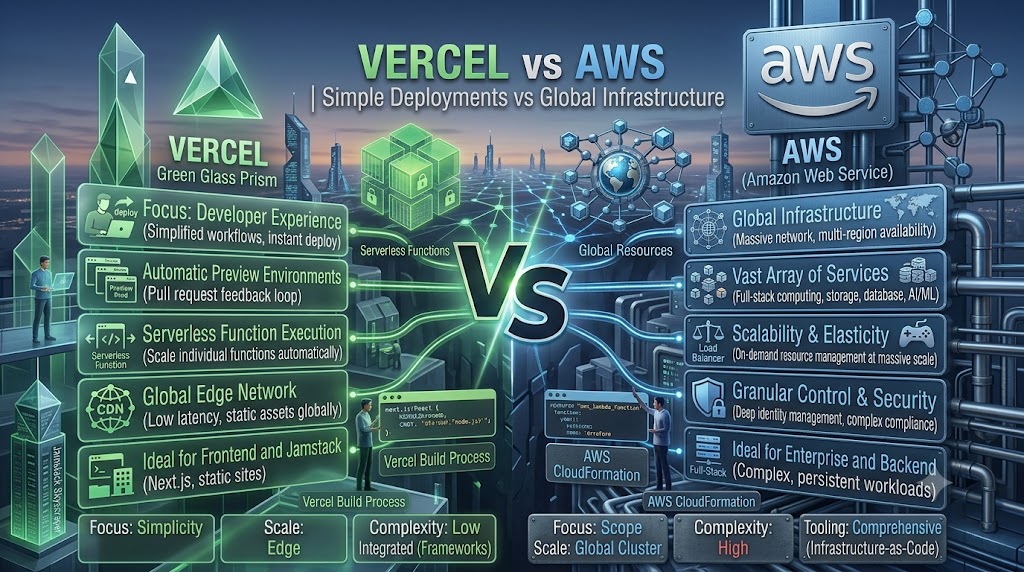
Vercel vs AWS: Which Platform Is Better for Modern Web Applications?
Choosing where to deploy a web application is no longer simply a question of picking a server. Modern applications may involve serverless functions, edge delivery, managed databases, object storage, background jobs, containers, caching, observability and automated deployments.
Two names frequently appear in these discussions: Vercel and Amazon Web Services (AWS).
They are sometimes compared as if they were direct competitors, but that comparison needs context. Vercel is primarily a developer-focused platform for deploying and operating modern web applications, with particularly strong integration with Next.js. AWS is a broad cloud ecosystem containing infrastructure and managed services for almost every layer of an application.
That difference matters.
A startup launching a Next.js SaaS product may value Vercel's deployment workflow and frontend experience. A large enterprise operating a complex platform with custom networking, databases, containers, queues and infrastructure requirements may need the breadth of AWS.
This guide explains the practical differences between Vercel and AWS and how to decide which approach fits your application.
Vercel vs AWS at a Glance
| Area | Vercel | AWS |
|---|---|---|
| Primary focus | Web application deployment and developer experience | Broad cloud infrastructure and managed services |
| Next.js integration | Excellent | Possible, but requires more architectural decisions |
| Deployment workflow | Highly streamlined | Depends on the services and tooling selected |
| Infrastructure control | More abstracted | Very extensive |
| Service breadth | Focused platform | Extremely broad cloud ecosystem |
| Operational complexity | Generally lower for supported web workloads | Can range from simple to highly complex |
| Custom infrastructure | More limited | Extensive options |
| Enterprise architecture | Strong for many web workloads | Very broad enterprise capabilities |
What Is Vercel?
Vercel is a cloud platform designed around deploying and operating web applications with a strong focus on frontend development and developer experience.
It is closely associated with Next.js and provides workflows designed around Git-based deployments, preview environments, automated builds and globally distributed application delivery.
For example, a development team building a Next.js SaaS application can connect its repository to Vercel and have deployments triggered automatically when changes are pushed.
This removes much of the infrastructure setup that would otherwise be required for a conventional deployment pipeline.
What Is AWS?
AWS is a broad cloud computing platform offering infrastructure and managed services across computing, storage, databases, networking, security, analytics, machine learning and application integration.
Instead of providing one deployment model, AWS gives teams a large collection of building blocks.
A web application might use services such as compute instances or containers, object storage, managed databases, content delivery, DNS, queues, serverless functions and monitoring.
This flexibility is one of AWS's biggest strengths, but it also means the development team has more architectural decisions to make.
Vercel vs AWS: The Fundamental Difference
The simplest way to understand the distinction is this:
Vercel focuses on making web application deployment easier, while AWS focuses on providing a broad set of cloud infrastructure capabilities.
Vercel abstracts away many infrastructure decisions.
AWS exposes more of those decisions to the engineering team.
Neither approach is inherently better. The right level of abstraction depends on the application.
Deployment and Developer Experience
Deployment is one of the areas where Vercel is particularly attractive to web development teams.
A typical workflow can look like:
Developer
   ↓
Git Repository
   ↓
Vercel Build
   ↓
Preview / Production Deployment
   ↓
Users
Teams can use preview deployments to review changes before merging them into production.
A marketing website, SaaS dashboard or content platform can therefore move from code commit to publicly accessible deployment with relatively little infrastructure management.
AWS can support equally sophisticated deployment pipelines, but the implementation depends on the architecture. A team may need to combine CI/CD tooling with services for compute, networking, storage and monitoring.
Next.js: Vercel vs AWS
For Next.js applications, Vercel has a particularly strong proposition because the platform and framework are closely aligned.
Features such as server-side rendering, static generation, image optimization and application routing can be deployed through an environment designed specifically around modern web applications.
Next.js applications can also run on AWS, but the team needs to choose and configure an appropriate deployment architecture.
For a small product team whose primary goal is to ship a Next.js application quickly, Vercel can reduce infrastructure overhead.
For an organization with established AWS infrastructure, security controls and operational expertise, deploying Next.js within AWS may make more architectural sense.
Scaling: Vercel vs AWS
Both platforms can support applications that need to handle changing traffic, but scaling works differently because their abstractions are different.
Vercel manages much of the underlying infrastructure for supported application workloads, allowing developers to focus on application behavior rather than individual servers.
AWS provides multiple scaling models. Teams can scale virtual machines, containers, serverless functions, databases, queues and other components independently depending on the architecture.
Consider an e-commerce application that experiences a large traffic increase during a seasonal campaign.
On Vercel, the web delivery layer can scale through the platform's managed infrastructure.
On AWS, the engineering team can design separate scaling policies for the frontend, APIs, workers, database and caching layers.
The second approach offers more control, but it also requires more architecture and operations work.
Infrastructure Control
This is one of the clearest differences between the platforms.
Vercel intentionally abstracts infrastructure away from many application developers.
AWS gives engineers considerably more control over infrastructure.
If a business requires a highly customized network architecture, private subnets, specialized compute workloads, custom container environments or complex infrastructure policies, AWS provides extensive building blocks for designing that environment.
Vercel is more opinionated about how supported workloads are deployed and operated.
This creates an important trade-off:
More abstraction usually means less infrastructure work, while more infrastructure control usually means more operational responsibility.
Serverless Applications
Both Vercel and AWS support serverless-style application architectures, although the developer experience differs.
Vercel provides functions and platform primitives designed around web applications.
AWS provides services such as AWS Lambda alongside API, storage, database and event-driven services that can be combined into larger architectures.
For example, an application that receives an uploaded document could trigger backend processing, store the file, update a database and send a notification.
Vercel can be a convenient choice for the web-facing portion of such a workflow, while AWS may provide a broader set of services for building the entire event-driven backend.
Databases and Storage
Neither Vercel nor AWS should automatically be treated as the database itself.
A modern application typically separates the frontend and application deployment layer from persistent storage.
A project deployed on Vercel may use an external or integrated database provider depending on its requirements.
An AWS-based architecture can use managed services such as relational databases, NoSQL databases and object storage within the same cloud ecosystem.
For a SaaS application handling large amounts of customer data, the database architecture can become more important than the choice between Vercel and AWS for frontend deployment.
Networking and Security
AWS provides extensive networking capabilities for organizations that need detailed control over their cloud environment.
Teams can design virtual networks, subnets, routing, security policies, private connectivity and other infrastructure components around specific requirements.
Vercel provides a more managed approach where much of the underlying infrastructure is abstracted.
This can be advantageous for teams that do not want to manage complex network infrastructure, but organizations with strict infrastructure requirements may value AWS's deeper control.
Security is therefore not simply a matter of asking which platform is more secure. The important question is whether the platform's security model and available controls match the application's requirements.
Edge Delivery and Global Applications
Modern web applications increasingly need to serve users across multiple geographic regions.
Vercel is designed around globally distributed application delivery and edge-oriented web workloads.
AWS also provides global delivery infrastructure through services such as Amazon CloudFront and a large global network of cloud regions and availability zones.
The difference is largely architectural: Vercel packages much of the experience into a web-focused platform, while AWS lets teams assemble the required global architecture from individual services.
Containers: Vercel vs AWS
If your application depends heavily on long-running containers, custom runtime environments or specialized background services, AWS becomes particularly attractive.
AWS supports container workloads through services such as Amazon ECS and Amazon EKS.
For example, a platform might run:
- Frontend application
- REST or GraphQL API
- Background workers
- Scheduled jobs
- Message consumers
- Machine learning services
These components may have different runtime and scaling requirements.
Vercel is generally a better fit when the workload aligns with its web application deployment model rather than requiring a broad container orchestration environment.
CI/CD and Preview Environments
One of Vercel's major advantages for frontend teams is the tight relationship between source control, builds and deployment previews.
A developer can create a branch, push changes and generate an environment for testing before production deployment.
AWS can provide sophisticated CI/CD workflows as well, but teams typically assemble the pipeline using the appropriate AWS and third-party tools.
For teams where rapid UI iteration is central to the workflow, Vercel's approach can reduce friction.
Observability and Operations
Production applications need more than deployment.
Teams need visibility into errors, latency, logs, resource usage, traffic patterns and application health.
Vercel provides platform-level monitoring and observability capabilities for its workloads.
AWS offers a much broader collection of monitoring and operational tools that can cover infrastructure, applications, networks, databases and distributed systems.
Again, the difference is between a more integrated platform experience and a broader infrastructure ecosystem.
Cost: Vercel vs AWS
There is no universal answer to which platform is cheaper.
Cloud cost depends on traffic, compute requirements, data transfer, storage, function execution, database usage, caching, observability and architectural design.
A simple application may be inexpensive on either platform.
As an application grows, however, the cost model can become more complicated.
Vercel's value proposition includes reducing infrastructure management and engineering time. AWS can offer detailed control over resource selection and architecture, but that flexibility also requires careful cost management.
The correct comparison should therefore include both infrastructure cost and engineering/operations cost.
Vercel vs AWS for Startups
For a startup building a modern web product, Vercel can be attractive when the team wants to move quickly with minimal infrastructure management.
Consider a small team launching a Next.js SaaS platform. The developers may prefer to spend their time building authentication, billing, dashboards and product features rather than maintaining deployment infrastructure.
Vercel can fit that development model well.
AWS becomes more attractive when the startup has unusual infrastructure requirements, substantial backend workloads, existing AWS expertise or a product architecture that already depends heavily on AWS services.
Vercel vs AWS for Enterprise Applications
Enterprise applications often have requirements beyond frontend deployment.
They may involve private networking, centralized identity, compliance controls, multiple databases, internal services, queues, containers, data pipelines and complex integration requirements.
AWS's broad infrastructure ecosystem can make it a strong foundation for these environments.
However, that does not mean enterprises cannot use Vercel.
An enterprise could use Vercel for specific web experiences while keeping core backend systems and data infrastructure on AWS or other platforms.
Can Vercel and AWS Be Used Together?
Yes.
In many real-world architectures, the choice does not have to be Vercel or AWS.
A company might deploy its Next.js frontend on Vercel while using AWS for databases, storage, background processing, private services or other backend infrastructure.
Users
  ↓
Vercel
  ↓
Next.js Application
  ↓
API / Integration Layer
  ↓
AWS Services
  ├── Database
  ├── Storage
  ├── Queues
  ├── Workers
  └── Other Backend Services
This hybrid approach can provide a strong developer experience without giving up the capabilities of a larger cloud ecosystem.
Vercel vs AWS: Which One Should You Choose?
Instead of choosing based on popularity, evaluate the application itself.
Choose Vercel when:
- Your application is heavily focused on modern web development.
- You are using Next.js extensively.
- Fast deployment and preview environments are important.
- Your team wants to minimize infrastructure management.
- Your workload fits a managed web application platform.
- You want a streamlined frontend deployment workflow.
Choose AWS when:
- You need extensive infrastructure control.
- Your architecture depends on multiple cloud services.
- You require specialized compute or container workloads.
- You need sophisticated networking or private infrastructure.
- Your organization already has significant AWS expertise.
- Your application includes complex distributed backend systems.
Consider a Hybrid Architecture when:
- The frontend benefits from Vercel's deployment workflow.
- The backend already depends on AWS.
- Different application components have different infrastructure requirements.
- You want to separate frontend delivery from backend infrastructure.
Vercel vs AWS: A Practical Decision Example
Imagine a company building an online B2B platform.
The frontend contains a Next.js dashboard, customer portals and marketing pages. Behind it are APIs, a relational database, document storage, background processing and integration services.
A small development team could deploy the web application through Vercel and connect it to managed backend services.
As the platform grows, some backend workloads may require dedicated infrastructure or specialized AWS services.
There is no requirement to migrate everything simply because the application has grown. The architecture can evolve component by component based on measurable requirements.
How Code-Ox Approaches Vercel and AWS Architecture
At Code-Ox, deployment architecture is selected based on the application's workload rather than treating one cloud platform as the universal answer.
For a modern web application, the team may evaluate frontend framework requirements, backend architecture, APIs, databases, integrations, traffic patterns, deployment workflows, security requirements and expected growth before selecting the deployment model.
A Next.js application with a relatively straightforward backend may benefit from a highly managed deployment workflow. A complex enterprise system may require AWS infrastructure, containers, managed databases or a combination of cloud services.
In some cases, a hybrid architecture can provide the best balance: a streamlined web deployment layer combined with dedicated cloud infrastructure for backend workloads.
The goal is not to choose the platform with the longest feature list. It is to build an architecture that is reliable, maintainable, scalable and appropriate for the business.
Final Verdict
Vercel and AWS solve different levels of the deployment problem.
Vercel is particularly compelling for teams building modern web applications that value streamlined deployment, frontend-focused workflows and reduced infrastructure management.
AWS is better suited to organizations that need broad cloud capabilities, deep infrastructure control and complex application architectures.
For many modern businesses, the most practical answer may not be choosing one over the other. A Vercel frontend combined with AWS backend services can provide both developer convenience and infrastructure flexibility.
The right decision should ultimately be based on workload, team expertise, operational requirements, security, scalability, cost and the level of infrastructure control the application actually needs.
If you are planning a new web application or evaluating an existing deployment architecture, Code-Ox can help design the frontend, backend and cloud infrastructure around your actual business and technical requirements.