.svg)
Shopify and Odoo Integration: How to Connect Your E-Commerce Business with ERP
Reported By
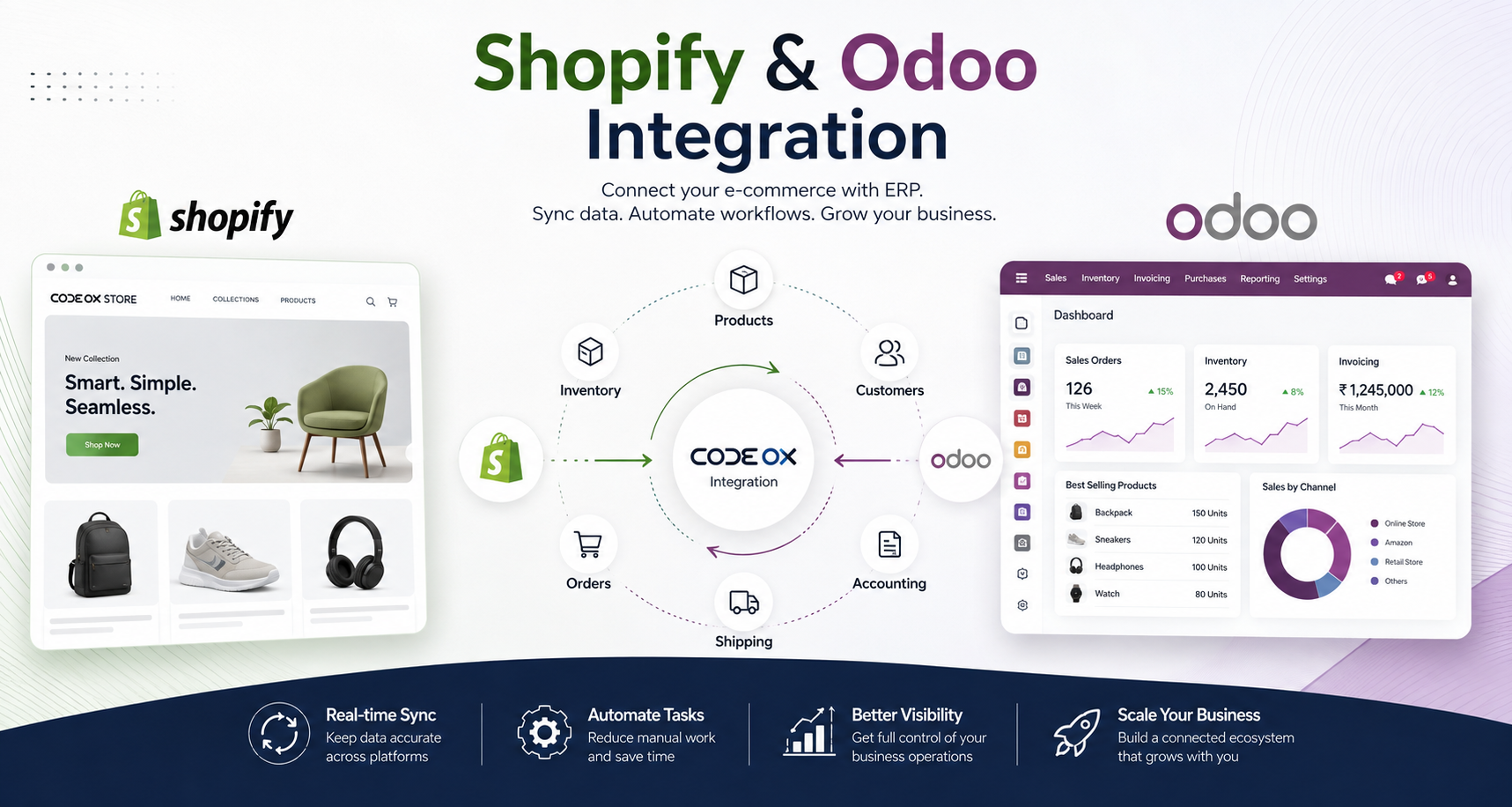
Running an online store involves much more than selling products. Businesses need to manage products, inventory, customers, orders, accounting, shipping, and multiple sales channels efficiently. When these operations are handled through separate systems, businesses can face duplicate data, manual work, inventory inconsistencies, and delays.
Shopify and Odoo integration provides a practical way to connect your e-commerce store with a centralized ERP system. By synchronizing important business data between Shopify and Odoo, companies can automate workflows, improve operational visibility, and reduce repetitive tasks.
What Is Shopify and Odoo Integration?
Shopify is a popular e-commerce platform designed to help businesses build and manage online stores, while Odoo is an integrated ERP platform that supports areas such as sales, inventory, accounting, purchasing, CRM, and logistics.
With a properly configured Shopify Odoo integration, information can move between both platforms automatically. Depending on your business requirements, products, prices, customers, orders, inventory levels, shipping information, and other data can be synchronized between Shopify and Odoo.
Why Integrate Shopify with Odoo?
Managing an online store and back-office operations separately can create unnecessary complexity. Employees may need to enter the same information into multiple systems, increasing the possibility of errors.
Integrating Shopify with Odoo creates a connected workflow where your e-commerce and ERP operations can work together more efficiently.
1. Real-Time Product and Catalog Synchronization
Product information is one of the most important data sets for an e-commerce business. Shopify Odoo integration can help synchronize product names, descriptions, prices, images, SKUs, and other catalog information.
This reduces the need to update product information manually across multiple platforms and helps maintain consistency between your online store and ERP system.
2. Better Inventory Management
Inventory discrepancies can lead to overselling, delayed orders, and poor customer experiences. Connecting Shopify with Odoo allows businesses to maintain a more consistent view of inventory across their operations.
When stock levels change through sales, purchases, or warehouse operations, synchronized inventory data can help keep your Shopify store and Odoo backend aligned.
3. Automated Order Management
Every online order creates several operational activities, including payment processing, inventory updates, fulfillment, invoicing, and shipping.
With Shopify and Odoo connected, orders from the Shopify store can be transferred to Odoo automatically. This gives your operations team a centralized place to manage order processing and fulfillment.
4. Centralized Customer Data
Customer information is valuable for sales, customer service, marketing, and business analysis. Integration can synchronize customer information between Shopify and Odoo, reducing duplicate data entry and helping teams work with more consistent customer records.
5. Improved Accounting and Reporting
For growing e-commerce businesses, financial visibility becomes increasingly important. Connecting Shopify orders with Odoo can help businesses streamline invoicing, payment tracking, and financial workflows.
Instead of manually transferring transaction information, businesses can create a more connected flow between e-commerce activity and ERP operations.
What Data Can Be Synchronized?
The exact synchronization process depends on your business requirements and integration architecture. Common data that can be synchronized includes:
- Products and product variants
- Product prices and SKUs
- Product images and descriptions
- Inventory and stock levels
- Customers and customer details
- Shopify orders
- Order status
- Shipping information
- Invoices and financial information
Benefits of Shopify Odoo Integration
A well-designed integration can provide several operational benefits for e-commerce businesses.
- Reduced manual data entry: Automate repetitive data transfer between Shopify and Odoo.
- Improved inventory accuracy: Keep online stock information better aligned with your ERP.
- Faster order processing: Move Shopify orders into your operational workflow more efficiently.
- Centralized business information: Manage important business processes through Odoo.
- Better scalability: Build a connected technology environment that can support business growth.
- Fewer data errors: Reduce duplicate manual entry and inconsistencies.
How Does Shopify Odoo Integration Work?
A typical integration involves connecting Shopify with Odoo through a secure connector, API, or integration middleware. The integration architecture depends on the complexity of the business and the data that needs to be synchronized.
- Analyze business requirements: Identify the Shopify and Odoo processes that need to communicate.
- Define synchronization rules: Determine which data should move between the platforms and when it should be updated.
- Configure the integration: Set up the required API connections, authentication, mapping, and workflows.
- Test the integration: Validate products, inventory, orders, customers, and other important scenarios.
- Go live and monitor: Launch the integration and continuously monitor synchronization and system performance.
Common Shopify Integration Challenges
Although integration can significantly improve efficiency, every business has different processes and requirements. Poorly planned integrations can create synchronization conflicts or incorrect data mapping.
Common challenges include differences in product structures, inventory locations, variant mapping, order statuses, pricing rules, and shipping workflows. A detailed integration plan and testing process can help prevent these issues.
Why Choose CodeOx for Shopify and Odoo Integration?
At CodeOx, we help businesses connect their e-commerce operations with powerful ERP workflows. Our approach focuses on understanding your existing processes before designing the integration.
From product and inventory synchronization to order management and post-launch support, we can help create an integration strategy that fits your business requirements.
Our process includes requirements analysis, integration design, API and connector configuration, testing, deployment, user support, and ongoing optimization.
Conclusion
Shopify and Odoo integration can help e-commerce businesses connect their storefront with their core business operations. By reducing manual work and synchronizing important data, businesses can improve efficiency, inventory visibility, order processing, and operational control.
If your business is using Shopify for e-commerce and Odoo for ERP management, connecting both platforms can create a more streamlined and scalable digital workflow.
Ready to connect Shopify with Odoo? Talk to CodeOx about building an integration designed around your business processes.