.svg)
Auth.js vs Clerk: Which Authentication Solution Should You Choose for Your Next Web App?
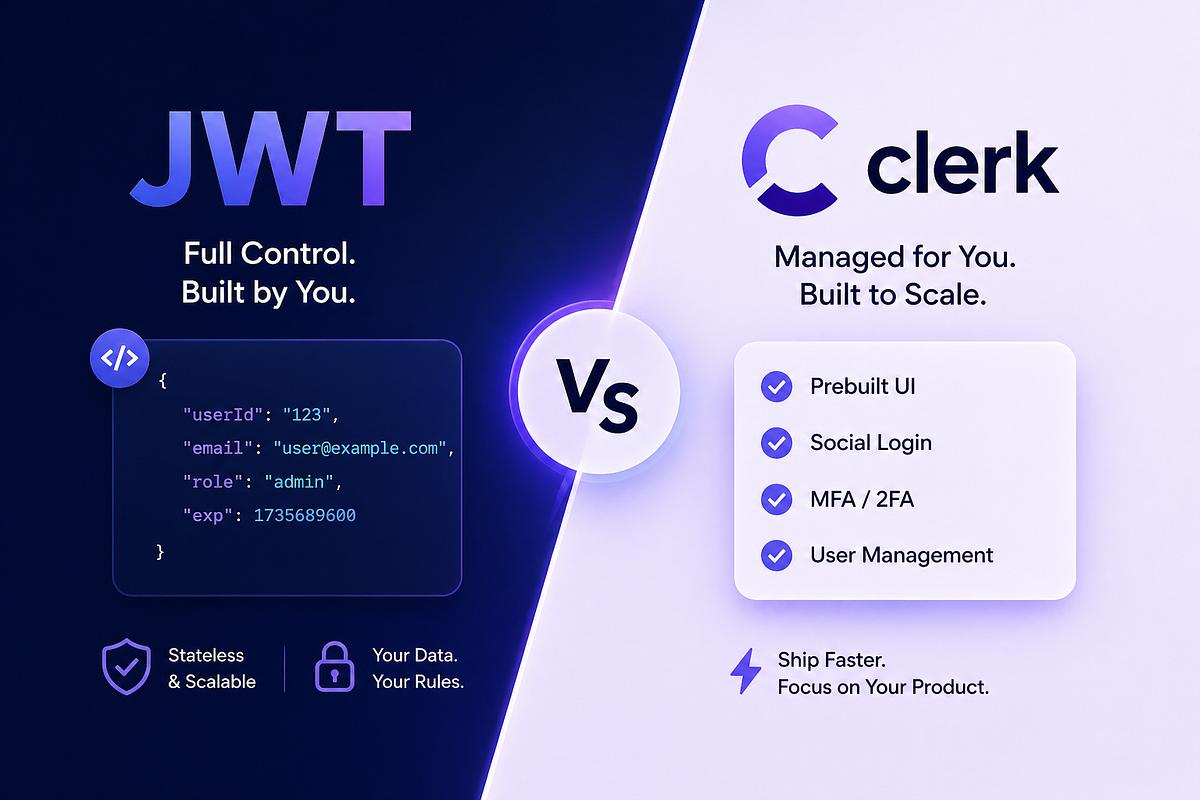
Auth.js vs Clerk: Which Authentication Solution Should You Choose for Your Next Web App?
Authentication is one of the first architectural decisions developers face when building a modern web application. It affects how users sign in, how sessions are managed, how protected routes work, how organizations and roles are handled, and how much authentication infrastructure the development team must maintain over time.
For developers working with modern JavaScript and Next.js applications, Auth.js and Clerk are two popular approaches. They solve the same broad problem—authentication and access control— but they do so with very different philosophies.
Auth.js gives developers a flexible, open-source authentication foundation that can be integrated with their own application architecture, database, providers, and session strategy. Clerk takes a more managed approach, providing authentication infrastructure together with prebuilt UI, user management, sessions, organizations, and authorization capabilities.
The right choice therefore isn't simply about asking which library is "better." The more useful question is: how much authentication infrastructure do you want your development team to own?
This guide compares Auth.js and Clerk from a practical software-development perspective and explains where each approach makes sense for startups, SaaS products, enterprise applications, and custom web platforms.
Auth.js vs Clerk at a Glance
| Area | Auth.js | Clerk |
|---|---|---|
| Core approach | Open-source authentication framework/library | Managed authentication and user-management platform |
| Developer control | High | High at the application level, with more infrastructure managed for you |
| Prebuilt authentication UI | Limited / application-controlled | Strong |
| Session management | Configurable | Managed by Clerk |
| Database integration | Highly flexible through adapters | Managed user infrastructure with application integration |
| Organizations | Typically application-designed | Built-in organization capabilities |
| Roles and permissions | Application-defined | Integrated authorization capabilities |
| Authentication UI customization | Maximum application ownership | Highly customizable managed components |
| Infrastructure responsibility | More responsibility for the development team | More responsibility handled by the provider |
| Best fit | Teams wanting control and architectural flexibility | Teams wanting a complete authentication platform |
What Is Auth.js?
Auth.js is an open-source authentication solution designed to provide authentication capabilities without forcing developers into a completely managed identity platform.
It evolved from the NextAuth.js ecosystem and now supports integrations across several web frameworks. In a Next.js application, developers can configure authentication providers, create authentication handlers, access sessions, protect application routes, and connect authentication to their own data layer.
This approach is particularly attractive when authentication is part of a larger custom application architecture. Instead of handing the entire identity layer to an external platform, a development team can decide how users, accounts, sessions, databases, and application-specific authorization should fit together.
Auth.js supports configurable providers and allows developers to use adapters to connect authentication to a database, ORM, backend API, or other data layer.
Why Developers Choose Auth.js
- Open-source approach
- Strong architectural flexibility
- Control over application and authentication data
- Configurable authentication providers
- JWT and database session strategies
- Database and ORM integration through adapters
- Ability to build custom authentication experiences
- Good fit for teams comfortable owning authentication architecture
A Practical Auth.js Example
Imagine a Code-Ox development team is building a B2B SaaS platform for a company that already has a PostgreSQL database, a custom customer table, an internal permissions model, and several backend services.
The business does not simply need a login page. It needs authentication to fit an existing architecture. Customers may belong to accounts, employees may have internal roles, and permissions may be connected to existing business entities.
In this scenario, Auth.js can be attractive because the authentication layer can be designed around the application's existing architecture rather than forcing the application to reorganize around a managed identity platform.
What Is Clerk?
Clerk takes a different approach. Instead of providing primarily an authentication foundation that developers assemble into their application, Clerk provides a managed authentication and user-management platform.
For Next.js applications, Clerk provides SDKs, prebuilt components, React hooks, server-side helpers, route protection, session management, and organization-related capabilities.
This can significantly reduce the amount of authentication infrastructure a development team needs to design and maintain itself.
Why Developers Choose Clerk
- Fast implementation
- Prebuilt sign-in and sign-up experiences
- Managed session infrastructure
- Built-in user management
- Organization and multi-tenant capabilities
- Roles and permission support
- Strong Next.js integration
- Useful server-side and client-side helpers
- Less authentication infrastructure to build from scratch
The Fundamental Difference: Control vs Convenience
The most important distinction between Auth.js and Clerk is not the login form. It is where the responsibility for authentication infrastructure lives.
With Auth.js, more of the architecture remains inside your application. You decide how the authentication system connects to your database, how users are represented, how sessions are persisted, and how application-specific authorization is implemented.
With Clerk, much of that infrastructure is provided as a managed service. Your application consumes authentication capabilities instead of building the complete identity infrastructure itself.
This creates an important engineering trade-off:
Auth.js gives you more ownership of the authentication architecture. Clerk gives you more authentication infrastructure out of the box.
Auth.js vs Clerk for Next.js
Next.js is an important part of this comparison because both approaches can fit modern Next.js architectures, but the developer experience is different.
Auth.js with Next.js
Auth.js can be configured directly within a Next.js application. Developers can define providers, authentication configuration, session behavior, custom pages, and data-layer integration.
This works particularly well for teams that want authentication to remain closely connected to their own backend architecture.
Clerk with Next.js
Clerk provides a dedicated Next.js SDK with components, hooks, middleware/proxy integration, and server-side authentication helpers.
A development team can therefore spend less time implementing common authentication flows and more time building the product itself.
For a startup trying to launch a SaaS MVP quickly, this difference can be meaningful. The team might need authentication, protected routes, account management, and organization switching without wanting to spend several development cycles creating those systems from scratch.
Session Management
Sessions are one of the most important technical differences to evaluate.
Auth.js allows developers to configure how sessions are handled. Its documentation supports JWT-based sessions and database-backed sessions. This gives teams control over how authentication state fits into their application's architecture.
Clerk takes a managed approach. The application consumes Clerk's authentication state through its SDK and helpers, reducing the amount of session infrastructure the application team needs to maintain.
For a team with strong backend expertise and specific infrastructure requirements, Auth.js can provide valuable control. For a product team that wants authentication to behave as an infrastructure service, Clerk can reduce engineering overhead.
Database Integration
Database architecture is another major decision point.
Auth.js supports adapters that allow it to integrate with different data layers. This is useful when authentication needs to coexist with an application's existing user, account, session, or authorization data.
For example, a custom enterprise platform might already have:
- A PostgreSQL database
- An existing users table
- Customer accounts
- Employee records
- Application roles
- Audit records
- Internal permission rules
In such an environment, architectural ownership may be more important than minimizing implementation effort. Auth.js can be considered when the authentication model needs to fit deeply into an existing system.
Clerk is more attractive when the business prefers to use a dedicated authentication platform rather than make identity infrastructure another subsystem the engineering team has to operate.
Organizations and Multi-Tenant SaaS
Multi-tenancy changes the authentication problem considerably.
Consider a SaaS application where one user can belong to multiple companies. The application may need to understand:
- Which organization the user is currently accessing
- Which organizations the user belongs to
- What role the user has in each organization
- Which resources belong to that organization
- Which actions the user is authorized to perform
Clerk provides organization functionality designed specifically for this type of B2B SaaS architecture, including organization switching and role-based access checks.
With Auth.js, the application team has greater responsibility for designing this model. That is not necessarily a disadvantage. In a highly customized SaaS platform, owning the tenant model can actually be an advantage because the business may have authorization rules that go far beyond standard organization membership.
Authentication UI and User Experience
Authentication is also a user-experience problem.
A production application may require sign-in, sign-up, password recovery, email verification, account management, social authentication, loading states, errors, session handling, and responsive interfaces.
Building all of these experiences internally takes time.
Clerk's prebuilt components can shorten this implementation path. Developers can use managed authentication components while still integrating the authentication state into the application's own UI.
Auth.js provides more freedom for teams that want to own the complete experience. This can be especially valuable when authentication is part of a highly branded product experience where the login journey needs to behave differently from conventional authentication flows.
Roles and Authorization
Authentication answers one question: Who are you?
Authorization answers a different question: What are you allowed to do?
This distinction becomes important when comparing Auth.js and Clerk.
Auth.js can establish authenticated identity, but application-specific roles and permissions are generally part of the application's own authorization architecture.
Clerk provides authorization-oriented capabilities, including organization roles and permission checks, which can make common B2B access-control scenarios faster to implement.
However, neither approach removes the need for careful authorization design. A serious application still needs to enforce permissions on the server and ensure that sensitive business operations cannot be accessed simply because a user interface hides a button.
Security: Which Is More Secure?
There is no responsible way to say that one platform is automatically "more secure."
Security depends on architecture, configuration, implementation quality, dependency management, session handling, authorization logic, secrets management, account recovery, monitoring, and operational practices.
Auth.js gives development teams more responsibility over parts of the authentication architecture. That can provide control, but it also means the team must understand what it is implementing and maintaining.
Clerk reduces some of that infrastructure burden by providing managed authentication services, but the application still remains responsible for secure authorization, business logic, API protection, data access, secrets, and application-level security.
For Code-Ox projects, authentication is therefore treated as part of the wider application security architecture rather than as an isolated login feature.
Customization: Auth.js vs Clerk
| Customization Area | Auth.js | Clerk |
|---|---|---|
| Authentication flow | Very flexible | Flexible within managed architecture |
| Database model | Strong control | More provider-managed |
| Login UI | Application-owned | Prebuilt and customizable |
| Session architecture | Highly configurable | Managed |
| Tenant model | Application-defined | Organizations available out of the box |
| Custom business authorization | Excellent flexibility | Can integrate with application authorization |
Developer Experience
Developer experience often determines the practical winner.
Auth.js can be an excellent choice for experienced engineering teams because it provides the building blocks needed to create an authentication system that fits the application.
The trade-off is that developers need to understand more of the architecture.
Clerk is designed to reduce that implementation burden. A team can integrate the SDK, configure the application, use authentication components, protect routes, and consume authentication state without building every common identity-management capability themselves.
If your engineering team has limited authentication expertise, a managed platform can reduce the risk of spending valuable development time rebuilding common infrastructure.
Performance and Application Architecture
Authentication should not be evaluated only by how quickly a login page appears.
Production performance depends on the complete request path, including middleware or proxy behavior, session validation, database access, API calls, caching, rendering, and network conditions.
Auth.js can be integrated closely into an application's architecture, which can be useful when developers need detailed control over data access and request processing.
Clerk can simplify common authentication operations by providing managed infrastructure and SDK abstractions.
In either case, authentication should be designed so that unnecessary user-data queries and authorization checks do not become a bottleneck on high-traffic routes.
Auth.js vs Clerk for Different Types of Projects
Startup MVP
If the primary objective is to validate a product quickly, Clerk can be a strong option because it reduces the amount of authentication infrastructure that needs to be built before the product can reach users.
A startup can focus its engineering resources on the actual product rather than spending weeks building account management and authentication infrastructure.
Custom SaaS Platform
Both options can work well.
Clerk becomes particularly attractive when the SaaS product needs standard multi-tenant organization functionality, while Auth.js can be attractive when the tenant and authorization architecture is highly specialized.
Enterprise Application
Enterprise applications should evaluate more than implementation speed.
Teams should examine identity requirements, compliance expectations, data ownership, integration requirements, authorization complexity, auditability, operational responsibility, and long-term architecture.
An enterprise application with a highly customized identity architecture may benefit from greater control. An organization that wants authentication managed as a specialized service may prefer Clerk.
Customer Portal
For a customer portal where users mainly need registration, login, account management, and access to protected resources, Clerk can reduce implementation effort significantly.
Internal Business Application
For an internal business system that already has a sophisticated employee database and permissions model, Auth.js may be worth considering if authentication needs to integrate closely with that existing architecture.
When Auth.js Is the Better Choice
Auth.js may be the better fit when:
- You want an open-source authentication foundation.
- Your team wants maximum architectural control.
- You already have a database and user model.
- Your authentication requirements are highly customized.
- You want to control the authentication UI completely.
- Your engineering team is comfortable owning authentication infrastructure.
- You need authentication to fit tightly into a custom backend architecture.
When Clerk Is the Better Choice
Clerk may be the better fit when:
- You want to launch authentication quickly.
- You prefer managed authentication infrastructure.
- You want prebuilt sign-in and sign-up experiences.
- Your product needs user management without building it from scratch.
- You are building a multi-tenant SaaS application.
- You need organization switching and role-based access control.
- Your team wants to reduce authentication maintenance.
- You are using Next.js and want a tightly integrated authentication SDK.
A Practical Decision Framework
Instead of choosing based on popularity, ask the following questions before selecting your authentication architecture.
-
How much authentication infrastructure do we want to maintain?
If the answer is "as little as possible," a managed service becomes attractive. -
Do we already have a user and identity model?
If yes, architectural flexibility may be more important. -
Does the application require multi-tenancy?
If yes, evaluate organization and tenant-management capabilities carefully. -
How complex are our authorization rules?
Simple role-based access may be straightforward. Complex resource-level permissions may require a custom authorization architecture regardless of the authentication provider. -
How quickly does the product need to launch?
Faster delivery often favors managed infrastructure. -
How much control do we need over authentication data and architecture?
The greater the requirement for application-owned infrastructure, the more carefully a managed platform should be evaluated.
Auth.js vs Clerk: A Real-World Example
Imagine a company wants to build a B2B platform where customers can create organizations, invite employees, manage subscriptions, access reports, and connect the platform to an existing ERP.
The frontend is built with Next.js. The backend exposes APIs, while PostgreSQL stores business data.
If the company wants to launch quickly and does not have a dedicated identity-management team, Clerk can provide a significant head start.
If the same company has strict requirements around where identity data is stored, already operates a mature identity model, and needs authentication to integrate deeply with internal systems, Auth.js may be worth evaluating.
The important point is that the technology decision should follow the business architecture—not the other way around.
How Code-Ox Approaches Authentication Architecture
At Code-Ox, authentication is considered part of the application's overall architecture rather than a feature that is selected independently.
When building a custom web application or SaaS platform, the technology choice depends on factors such as the existing database, frontend framework, API architecture, user model, tenant structure, authorization requirements, integrations, security expectations, scalability, and long-term maintenance.
For a straightforward SaaS product that needs to reach the market quickly, a managed authentication platform may remove unnecessary engineering work.
For a highly customized enterprise application, a more application-owned authentication architecture may provide the control needed to integrate authentication with existing systems and business rules.
Code-Ox's custom web application development approach focuses on selecting technology based on the actual business problem. The objective is not to add the largest possible technology stack, but to build an architecture that is secure, scalable, maintainable, and appropriate for the product.
The same principle applies when authentication needs to connect with APIs, ERP systems, CRM platforms, payment services, analytics systems, or other business applications.
Auth.js vs Clerk: Which One Should You Choose?
There is no universal winner.
Choose Auth.js when architectural ownership, flexibility, open-source foundations, and custom integration are more important than having a complete managed identity platform.
Choose Clerk when development speed, managed authentication, prebuilt user experiences, organizations, and reduced infrastructure responsibility are higher priorities.
For a small team building a product quickly, Clerk can reduce the amount of authentication engineering required. For an experienced engineering team building a deeply customized application, Auth.js can provide greater control over how identity fits into the broader architecture.
Final Thoughts
Auth.js and Clerk represent two different philosophies for building authentication.
Auth.js gives developers a flexible foundation and greater responsibility for the surrounding architecture. Clerk provides a managed authentication platform that removes much of that infrastructure burden.
The right choice depends on your application—not simply on which technology is more popular.
Before making the decision, evaluate your user model, authorization requirements, database architecture, multi-tenancy needs, security expectations, development capacity, and long-term maintenance strategy.
If you are planning a new SaaS product, customer portal, enterprise web application, or custom business platform, Code-Ox can help you evaluate the architecture and select an authentication approach that fits the wider system rather than treating authentication as an isolated feature.
Build the right architecture first. Then choose the authentication technology that supports it.